Sober living startup costs in Florida run from about $38,000 to open a leased home at the statewide model rent to roughly $171,000 to buy one in the Broward and Palm Beach corridor, and the spread has almost nothing to do with the house itself. It is driven by three Florida-specific lines: the down payment at Florida acquisition prices, a property insurance market where a Broward homeowners policy averaged $6,136 as of March 31, 2026 in the Florida Office of Insurance Regulation’s Property Insurance Stability Report, and an operating reserve most first-time operators leave out entirely.
The credentialing side is the cheap part. Florida caps what the Florida Association of Recovery Residences (FARR) may charge to certify a home under Fla. Stat. §397.487(2)(e), and the state charges $100 to file Articles of Organization. What follows itemizes every line in a Florida budget, prices it at real metro rents and median listing prices, and shows what changes when you lease instead of buy. The national figures for all 50 states show what it costs to open a sober living home in every state, including Florida.
Before you read onHow to Open a Sober Living Home in FloridaThis post covers one piece of the process. The complete Florida guide walks through every step, from planning to your first resident.→How Much Does It Cost to Start a Sober Living Home in Florida?
Florida startup cost snapshotA Florida sober living startup budget is the total one-time cash an operator needs before the first resident pays rent, including the property commitment, furnishing, credentialing, insurance for year one, and a reserve to carry the house while beds fill. Every figure on this page is an estimate. Almost the entire range is a housing decision. Lease a house and your property commitment is three months of rent at signing. Buy one and it becomes a down payment measured in six figures, because Florida acquisition prices are high and the recovery-housing premium sits on top of an already elevated median.
Location does the rest of the work. The same 12-bed plan is a materially different budget in Broward than in Hillsborough, and the gap widens on two lines at once: rent or purchase price, and property insurance. Florida scores 8 for fire and building feasibility in VSL’s Operating Climate Index (Foote, 2026), which also publishes a Startup Burden Score of 7 as a context measure alongside the composite rather than an input to it. Read as a pair, they describe a state where the physical build-out is cheap and the entry ticket is not. A sober living home for 16 or fewer residents with no custodial care stays in an ordinary residential class, so renovation stays modest, while Florida home prices and windstorm-exposed property premiums push the purchase-path capital requirement well above the national middle.
The unmet need and the bed shortfall, who pays the rent, what certification costs and what it unlocks, and the full operating model for buying versus leasing.
Get the Your State Starter Kit No cost, no obligation. Unsubscribe in one click.What Goes Into a Florida Startup Budget
The table below is a lease-path budget for a Florida sober living home, sized to a mid-size house in a residential neighborhood. Every dollar of it is one-time or year-one cash, and the total includes both insurance and the reserve.
| Cost item | Low | Typical | High | What it means |
|---|---|---|---|---|
| Entity formation & state filing fee | $125 | $175 | $300 | $100 Articles of Organization plus the $25 registered agent designation; add $50 for a fictitious name |
| Level 2 background screening | $60 | $150 | $300 | Every owner, director, and CFO is screened; cost scales with how many principals you have |
| CRRA administrator credential | $200 | $350 | $700 | Florida Certification Board application and exam fees, plus approved training hours |
| Certification fee, FARR year one | $100 | $250 | $400 | Application capped at $100 by statute; the onsite inspection fee is billed at actual cost |
| Fire, safety, and health inspections | $150 | $300 | $600 | Local fire official and health inspections required as certification documentation |
| Lease deposit or property down payment | $11,875 | $11,875 | $11,875 | Three months at signing at $3,958, the statewide average HUD FY2025 three-bedroom Fair Market Rent of $2,474 plus a 60% recovery-housing premium |
| Renovation and safety/code upgrades | $1,500 | $4,000 | $9,000 | Interconnected smoke and CO alarms, egress, extinguishers, handrails, exterior lighting, under the Florida Fire Prevention Code |
| Furniture and setup | $7,000 | $11,000 | $16,000 | Beds, dressers, common-area furniture, kitchen, laundry |
| Supplies and linens | $1,000 | $1,700 | $2,500 | Opening stock of linens, cleaning, kitchen, and testing supplies |
| Utility deposits | $500 | $800 | $1,200 | Power, water and sewer, internet |
| Marketing and launch | $400 | $700 | $1,500 | Signage, listing setup, referral outreach materials |
| Insurance (first year) | $3,300 | $4,500 | $6,500 | General liability plus a contents and tenant policy; the landlord carries the property policy |
| Operating reserve, three months | $12,000 | $15,600 | $18,400 | Rent plus fixed operating costs while beds fill |
| Estimated all-in to open | $38,210 | $51,400 | $69,275 | The realistic total to open a certified home in Florida, reserve included. |
Methodology & sources. Entity fees are the published Florida Division of Corporations filing fee schedule: $100 to file Articles of Organization, $25 for the registered agent designation, $50 for a fictitious name. Level 2 screening is priced from the Agency for Health Care Administration’s Care Provider Background Screening Clearinghouse, which lists $60 plus the LiveScan vendor fee for a new applicant. Administrator fees are the Florida Certification Board fee schedule: $100 application and $100 exam for the Certified Recovery Residence Administrator (CRRA). FARR’s application and renewal fees are capped at $100 each and its inspection fee must reflect actual cost under Fla. Stat. §397.487(2)(e), which is why the certification line carries a range rather than a single number. The statewide lease line starts from the HUD FY2025 three-bedroom Fair Market Rent, a $2,474 statewide average weighted by population, with the model’s 60% recovery-housing premium applied: $3,958 a month, or $11,875 for three months. The Tampa Bay and South Florida lease scenarios in the comparison table below are metro illustrations priced from the HUD FY2026 Fair Market Rent schedule four-bedroom FMR with a 25% premium: Tampa Bay $3,077 becomes $3,846 and Broward $3,810 becomes $4,763. Three months at signing reflects first month, last month, and a security deposit; Fla. Stat. §83.49 sets no cap on deposit size, so the amount is negotiated. The insurance line on the lease path covers general liability plus a contents and tenant policy; the landlord carries the property policy, and that market is documented in the Florida Office of Insurance Regulation’s Property Insurance Stability Report. Furniture, supplies, utility deposits, marketing, and the reserve are sized to the lease and fee lines above and carry no state-level adjustment. Safety and code upgrades are sized for a home in an ordinary residential class; a home that crosses into a care classification is a different number entirely.
Two lines in that table deserve a second look before you move on. Entity formation is trivially cheap in Florida, which tempts operators to skip the structural thinking behind it. The choice of how to form a legal entity for a sober living business in Florida shapes financing, liability, and whether you can hold the real estate separately from the operating business. Certification is the other one. At a statutory ceiling of $100 for the application, FARR certification is the cheapest meaningful thing an operator can buy in this state, and it is what lists the home in FARR’s Find Certified Housing directory, the surface treatment providers and discharge planners search when they place a resident.
Lease vs. Buy: How the Startup Number Changes
Leasing cuts the cash requirement by roughly two thirds in the same metro. The table prices both paths in South Florida and in Tampa Bay, the secondary market where the best-fit Florida operating model usually pencils better than the saturated Palm Beach and Broward corridor.
The filter we use before we ever call an agent: what makes a property work as a Level II home, the zoning and occupancy questions to ask before you tour, and the red flags that should end a showing in five minutes.
Get the guide free →| Cash requirement | Lease, South Florida | Lease, Tampa Bay | Buy, South Florida | Buy, Tampa Bay |
|---|---|---|---|---|
| Property commitment | $14,300 | $11,550 | $106,900 | $85,800 |
| Closing costs | $13,400 | $10,700 | ||
| Insurance, year one | $4,500 | $4,500 | $14,900 | $10,200 |
| Furnishing, supplies, deposits, launch | $14,200 | $14,200 | $14,200 | $14,200 |
| Safety and code upgrades | $4,000 | $4,000 | $4,000 | $4,000 |
| Entity, screening, credential, certification | $1,225 | $1,225 | $1,225 | $1,225 |
| Operating reserve, three months | $18,400 | $15,600 | $16,000 | $13,100 |
| Total cash to open | $56,625 | $51,075 | $170,625 | $139,225 |
The purchase figures use median listing prices for July 2026, Realtor.com data published by the Federal Reserve Bank of St. Louis: $397,450 for Tampa-St. Petersburg-Clearwater and $495,000 for Miami-Fort Lauderdale-West Palm Beach. These are listing prices, not sale prices. An 8% recovery-housing premium is added to each, reflecting that a workable home runs larger than the metro median, and the down payment is 20% of the adjusted price, the low end of the 20% to 30% conventional lenders typically require for investment property. Closing costs are estimated at 2.5% of the adjusted price. The resulting mortgage assumes a 30-year term at 6.66%, the Freddie Mac Primary Mortgage Market Survey average as of August 27, 2026, which produces a payment of about $2,748 a month in South Florida and $2,207 in Tampa Bay.
Year-one insurance is where the two metros separate hardest on the purchase path. Applying an 80% group-residential uplift to the county averages reported as of March 31, 2026 in the Florida Office of Insurance Regulation’s Property Insurance Stability Report puts a Broward property policy near $11,000 and a Hillsborough policy near $6,300, before general liability. That single line is a $4,700 annual difference between the two markets for an otherwise identical home.
If you lease
- Cash to open in Tampa Bay is about $51,075, roughly a third of the purchase path.
- You preserve cash and can test a neighborhood before committing to it.
- Your permission to operate sits in a landlord’s hands, and the house builds no equity for you.
If you buy
- Cash to open in Tampa Bay is about $139,225, and about $170,625 in South Florida.
- You control the property outright and the payments build equity.
- You lock in the housing expense that decides the ten-year outcome, including a year-one insurance line that runs from about $10,200 in Tampa Bay to about $14,900 in South Florida.
The trade-offs are not only financial. Leasing preserves cash and lets you test a neighborhood before committing, but it puts your permission to operate in a landlord’s hands and builds no equity. Buying costs three times as much on day one and locks in the housing expense that decides whether a Florida recovery home is profitable over a ten-year hold.
Florida guideIs It Profitable to Operate a Recovery Home in Florida?Once the doors open: realistic revenue, operating costs, and margins for Florida operators.→Florida Fire Code, Sprinklers, and the Bed-Count Cliff
Florida applies statewide uniform codes, which is unusually helpful for budgeting. The Florida Building Code, 8th Edition, is adopted statewide under Fla. Stat. §553.73 and supersedes local building codes, and the Florida Fire Prevention Code, 8th Edition adopts NFPA 1 and NFPA 101. Neither carries a recovery-housing occupancy class. Classification turns on two questions, and both are inside your control at the planning stage.
- Sixteen residents is the line. At 16 or fewer residents with no custodial care, a sober living home is treated as an ordinary dwelling under Group R-3 of the Florida Building Code, 8th Edition, adopted under Fla. Stat. §553.73, or as a lodging or rooming house under NFPA 101 as adopted by the Florida Fire Prevention Code, 8th Edition. Residential smoke alarms apply; there is no commercial sprinkler mandate at that tier.
- Custodial care is the other line. Six to 16 residents receiving custodial care escalates the home to Group R-4, which brings enhanced alarm requirements and typically NFPA 13 or 13R sprinklers. Because a sober living home provides peer support and not clinical care, staying out of R-4 is a program design decision, not a construction one.
- Personal care services escalate independently. Providing personal care services to four or more unrelated residents moves the home toward a residential board and care classification regardless of headcount.
- Above 16 residents, the budget changes category. More than 16 residents moves the home into institutional, large board and care, or hotel and dormitory classification under the Florida Fire Prevention Code, with full fire alarm and sprinkler systems. Retrofitting sprinklers into an existing single-family house is the single largest renovation line a Florida operator can trigger.
One physical-environment requirement applies no matter which classification the home lands in, and it is the one that puts a hard number in the budget above.
- Certification requires documented inspections regardless. Even a home that qualifies as an ordinary dwelling must submit proof of satisfactory fire, safety, and health inspections with its certification application under Fla. Stat. §397.487(3)(m). That is the practical fire-code gate, and it is why the inspection line sits in the budget above.
A change of use or occupancy determination by the local building department is the moment upgrade costs are triggered, so the sequencing that protects a budget is simple: confirm the classification with the building official and the fire marshal before signing anything. Operators sizing a house should work through determining maximum occupancy alongside the code thresholds rather than after.
Know your rights before you spendThe Federal Fair Housing Act and Sober Living: Everything You Need to KnowPeople in recovery are a protected class; understand these protections before you accept a costly local requirement.→The Costs First-Time Operators Underbudget
Four lines account for most of the gap between a first budget and the real one, and three of them are Florida-specific.
- Property insurance. Florida is the most expensive property insurance market in the country, and a group-residential use makes it more expensive still. Broward averaged $6,136 and Palm Beach $6,323 for a homeowners policy as of March 31, 2026 in the Florida Office of Insurance Regulation’s Property Insurance Stability Report, before any uplift for occupancy. Budget for it as a fixed cost, not a variable one, and read the underwriting rules on sober house insurance before you quote.
- The operating reserve. Beds do not fill on day one. Three months of rent or mortgage plus fixed operating costs is the minimum that keeps a home from making desperate admission decisions in month two, and it is the line most often missing from a first budget.
- The credential stack, not just the certification fee. FARR’s $100 application ceiling is the visible number. Behind it sit Level 2 background screening for every owner, director, and CFO under Fla. Stat. §397.487(6), and a CRRA credential from the Florida Certification Board carrying $100 application, $100 exam, and $100 annual renewal, plus 100 hours of approved training.
- Safety and code upgrades on an older house. Interconnected alarms, egress corrections, and handrails on an older house are ordinary work under the Florida Fire Prevention Code, but they are not free, and they are usually discovered after the lease is signed. Reviewing sober living fire safety during due diligence moves that cost forward, where it belongs.
How to Lower Your Startup Costs
The levers that actually reduce a Florida budget are structural, and the false economies are easy to spot once you know what they cost later.
- Lease first, buy second. The tables above show a $114,000 difference in South Florida. Leasing lets an operator prove occupancy and referral flow before committing to a down payment.
- Site in a secondary metro. Tampa Bay, Orlando, and Jacksonville carry lower rents, lower purchase prices, and materially lower property insurance than the Palm Beach and Broward corridor, which is also the most saturated and most scrutinized recovery-housing market in the country.
- Stay at or under 16 residents with no custodial care. This is the difference between residential smoke alarms and a sprinkler system.
- Phase the furnishing. Furnish the bedrooms that will be occupied in month one and add the rest as beds fill. It moves several thousand dollars from startup into operating cash flow.
- Negotiate the deposit. Florida sets no statutory cap on a security deposit, which cuts both ways: a landlord can ask for more, and an operator can negotiate down, especially with a longer term or a stronger guarantor.
- Buy the certification, not the shortcut. Skipping FARR certification saves the $100 to $400 of year-one certification cost and closes off the referral channel that Florida law routes through certified homes. Underinsuring saves a few thousand dollars and puts the whole business at risk in a state with real windstorm exposure.
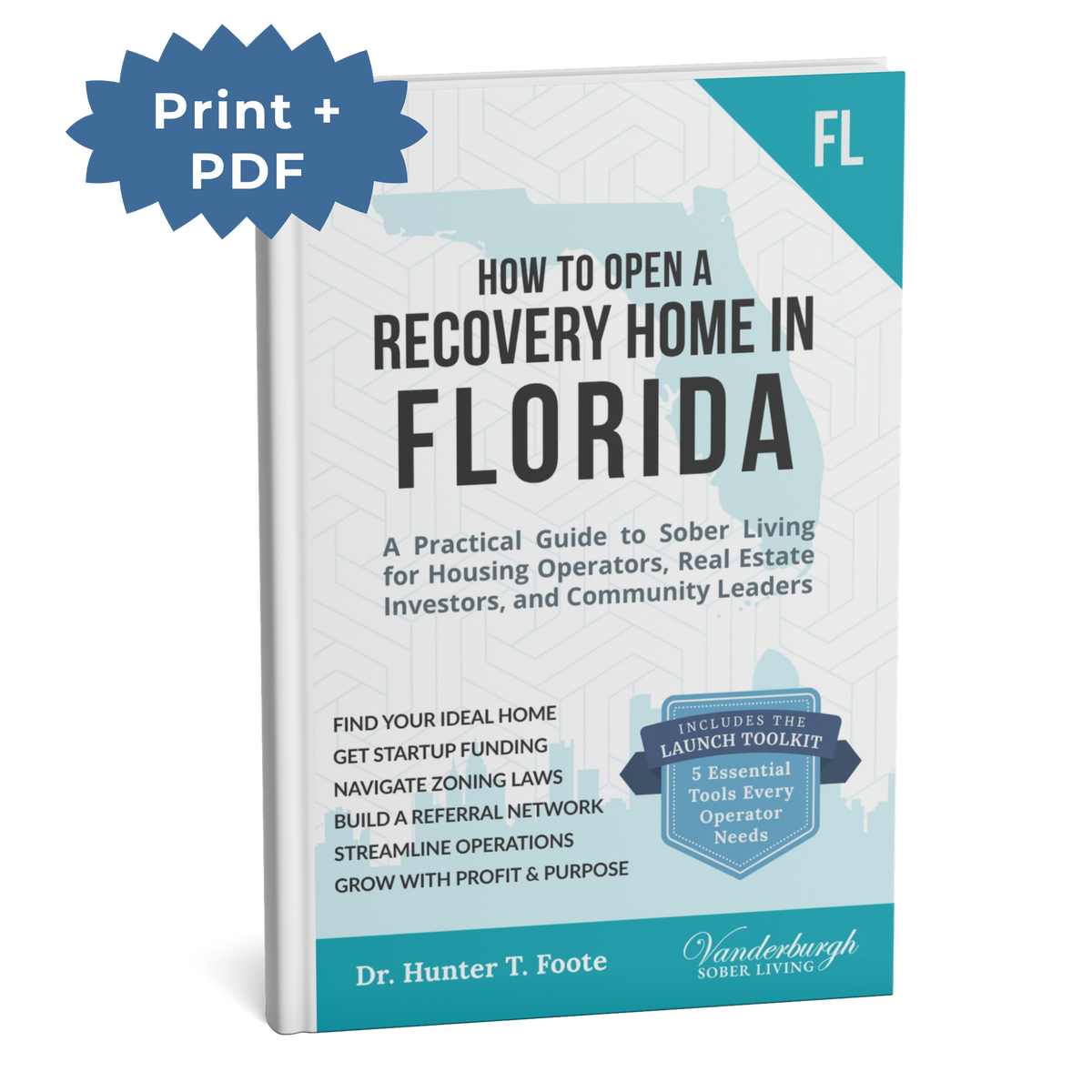
Sequencing matters as much as any single saving. Each item on the list below is cheaper to resolve before a lease or a purchase contract is signed than after, which is the whole reason it sits in front of the money.
Keep readingHow to Certify a Sober House: An Overview of NARR Affiliate CertificationWhat certification involves, what it costs, and how the process works in every state.→Your Florida Startup Checklist
Florida Funding That Offsets the Upfront Outlay
Florida has no direct startup grant a small operator can apply for and receive, but several channels reduce the cash a launch requires. Most run through partnerships rather than direct awards, which is the detail that catches new operators by surprise. On the real estate side, financing structure does more for a startup budget than any grant.
- SBA 504 financing. An SBA 504 loan can bring owner-occupied real estate in at roughly 10% borrower equity rather than 20%, which on a Tampa Bay purchase is the difference between $85,800 and about $43,000 of down payment.
- Mission lenders and predevelopment loans. These cover early soft costs for nonprofit and mission-driven borrowers, before a property is under contract.
- Resident fees fund the ramp. At Florida sober living rents, a house that fills steadily replaces its reserve within the first several months of operation, which is why the reserve is a bridge rather than a permanent capital requirement.
Most of what Florida spends on recovery housing moves through nonprofit subrecipients, local governments, and regional managing entities rather than to individual operators. The full program map, eligibility rules, and application routes are covered in Florida recovery housing funding.
Florida guideHow Recovery Housing Funding Works in FloridaGrants, settlement dollars, and the programs that help offset what it costs to open.→Sober Living Guides Every Operator Needs
These evergreen guides apply in every state and go deeper on the pieces behind your startup budget: the standards your home certifies to, the property you choose, the insurance you carry, and the referral partners who keep the beds full.
Frequently Asked Questions About Sober Living Startup Costs
What is the minimum realistic amount to open a sober living home in Florida?
About $38,000 opens a leased Florida home at the statewide model rent, covering three months of rent at signing, furnishing, credentialing, year-one liability insurance, and a three-month operating reserve. Anything meaningfully below that is skipping the reserve, the insurance, or both.
Can you start a sober living home in Florida by leasing instead of buying?
How much does FARR certification cost in Florida?
Florida law caps the FARR application fee and the annual renewal fee at $100 each, and requires any onsite inspection fee to reflect actual cost. Budget $100 to $400 for year one. The certified recovery residence administrator credential is billed separately by the Florida Certification Board.
Do grants cover sober living startup costs in Florida?
Rarely, and not directly. Florida’s recovery housing dollars flow through nonprofit subrecipients, local governments, and regional managing entities rather than to individual operators. Financing structure, particularly SBA 504 equity requirements and mission-lender predevelopment loans, does more for a startup budget than grant applications.
Why is Florida insurance such a large startup line?
Florida carries the highest property insurance costs in the country, and a group-residential use raises them further. County averages ranged from $2,786 in Duval to $6,323 in Palm Beach as of March 31, 2026 in the Florida Office of Insurance Regulation’s Property Insurance Stability Report, so where you site the home changes year-one insurance by thousands of dollars.
Plan Your Florida Startup Budget With VSL
Every figure on this page is a starting point you should replace with quotes from your own county: your rent or purchase price, your insurance quote, your bed count. The Sober Living Calculator runs those inputs and returns a startup number and a monthly model you can defend to a lender or a partner.
If you would rather build it with people who have opened homes in Florida, reach out through the VSL contact form.
Start your sober house
Pick the path that fits where you are in the process.
Download the free guidePath to Purposeful Recovery Housing, by Dr. Hunter T. Foote.Explore the Mastery ProgramHands-on startup, certification, and operating support.See how starting with VSL worksThe opportunity, the community, and what a Charter includes.Prefer to talk now? Call (844) 762-3747, weekdays 8a to 5p.
Research & Sources
- Foote, H. T. (2026). Vanderburgh Sober Living Operating Climate Index, 2026 Edition. Vanderburgh Sober Living. https://www.vanderburghhouse.com/research/operating-climate-index-2026/
- Florida Senate. (2026). 2026 Florida Statutes §397.487, Voluntary certification of recovery residences. https://www.flsenate.gov/Laws/Statutes/2026/397.487
- Florida Department of State, Division of Corporations. (2026). Fees for corporations, limited liability companies, and fictitious names. https://dos.fl.gov/sunbiz/forms/fees/
- Florida Certification Board. (2026). Fees. https://flcertificationboard.org/fees/
- Florida Certification Board. (2026). CRRA requirements and application pathway. https://flcertificationboard.org/certifications/crra-requirements-application-pathway-2/
- Florida Association of Recovery Residences. (2026). Find certified housing. https://www.farronline.info/providers
- Florida Office of Insurance Regulation. (2026). Property Insurance Stability Report, July 1, 2026. https://floir.gov/docs-sf/default-source/property-and-casualty/stability-unit-reports/july-2026-isu-report.pdf
- U.S. Department of Housing and Urban Development. (2025). FY 2026 schedule of metropolitan and non-metropolitan fair market rents. https://www.huduser.gov/portal/datasets/fmr/fmr2026/FY2026_FMR_Schedule.pdf
- U.S. Department of Housing and Urban Development, Office of Policy Development and Research. (2024). FY2025 Fair Market Rents. https://www.huduser.gov/portal/datasets/fmr.html
- Federal Reserve Bank of St. Louis. (2026). Housing inventory: Median listing price in Tampa-St. Petersburg-Clearwater, FL (CBSA) [Realtor.com data]. https://fred.stlouisfed.org/series/MEDLISPRI45300
- Federal Reserve Bank of St. Louis. (2026). Housing inventory: Median listing price in Miami-Fort Lauderdale-West Palm Beach, FL (CBSA) [Realtor.com data]. https://fred.stlouisfed.org/series/MEDLISPRI33100
- Freddie Mac. (2026). Primary Mortgage Market Survey. https://www.freddiemac.com/pmms
- Florida Agency for Health Care Administration. (2026). Care Provider Background Screening Clearinghouse: Frequently asked questions. https://info.flclearinghouse.com/faq.html
- Florida Senate. (2026). 2026 Florida Statutes §553.73, Florida Building Code. https://www.flsenate.gov/Laws/Statutes/2026/553.73
- Florida Building Commission. (2026). Florida Building Code, 8th Edition. https://www.floridabuilding.org/c/default.aspx
- Florida State Fire Marshal. (2026). Florida Fire Prevention Code, 8th Edition. https://www.myfloridacfo.com/division/sfm/bfp/florida-fire-prevention-code
- Florida Senate. (2026). 2026 Florida Statutes §83.49, Deposit money or advance rent. https://www.flsenate.gov/Laws/Statutes/2026/83.49
- Florida Department of Children and Families. (2026). Managing entities. https://www.myflfamilies.com/services/samh/providers/managing-entities
- Florida Department of Children and Families. (2026). Managing entities contact list. https://www.myflfamilies.com/documents/1706.pdf