Most operators come to sober living zoning in Vermont braced for a fight, and Vermont is one of the few states where that bracing is mostly unnecessary. The legislature has already decided the question at the state level. A certified recovery residence serving eight or fewer people is a permitted single-family use by right in any Vermont district that allows single-family homes, and no Vermont town may cap the number of unrelated adults living in a dwelling unit.
That makes Vermont unusual. Foote (2026) rates Vermont 8 out of 10 for legal climate and classifies the state as lightly regulated. The pressure sits somewhere most operators do not expect: not in the zoning office, but in the fire marshal’s office, where converting a house into a rental recovery residence reclassifies the building and triggers state plan review. Vermont rates 5 out of 10 for fire and building feasibility in the same index (Foote, 2026), its weakest sub-index. This page covers both: what Vermont’s preemption statute actually says, how fair housing law backs it up, what to do when a neighbor or a select board pushes back, and where the real capital risk hides.
Before you read onHow to Open a Sober Living Home in VermontThis post covers one piece of the process. The complete Vermont guide walks through every step, from planning to your first resident.→Can You Open a Sober Living Home in a Residential Neighborhood in Vermont?
Yes. Under 24 V.S.A. § 4412(1)(G), a recovery residence serving not more than eight people is treated by right as a permitted single-family residential use anywhere a Vermont municipality allows single-family homes. No conditional use permit, no public hearing, and no special approval may be required for that home.
Vermont wrote the answer into its municipal land use chapter rather than leaving it to be fought out house by house. The same section bars a town from enforcing any occupancy limit on unrelated adults, which removes the tool most municipalities elsewhere use to block a sober house without ever mentioning recovery. The practical effect is that the zoning conversation in Vermont is short: confirm the district allows single-family dwellings, confirm the home meets the statutory definition, and proceed.
The shield is conditional in two ways, and both matter. It attaches to a certified recovery residence, and it stops at eight residents. Vermont’s protection lives in three subsections of one statute, and reading them together is what gives an operator a defensible position.
The by-right rule. Section 4412(1)(G) provides that a residential care home or group home operated under state licensing or registration serving not more than eight persons with a disability, “or a recovery residence serving not more than eight persons, shall be considered by right to constitute a permitted single-family residential use of property.” A municipality is not obligated to allow more such homes on a single lot than the number of single-family dwellings that lot already permits.
The certification condition and the 45-day clock. By-right status runs to a residence certified by an organization the Department of Health has approved, or one whose certification is pending. The statute adds a hard edge: if certification is pending beyond 45 days, “the municipality shall retain its right to consider the residence pursuant to zoning bylaws adopted in compliance with 24 V.S.A. § 4411.” In Vermont the approved certifier is the Vermont Alliance for Recovery Residences (VTARR), the state affiliate of the National Alliance for Recovery Residences (NARR). This is the single most important scheduling fact on this page. An operator who opens before applying, or who lets an application sit, hands discretionary zoning power back to the town on day 46. Certification timing is covered in depth in the walkthrough of how to certify a sober house in Vermont.
The unrelated-occupant ban. Section 4412(14) states that no zoning or subdivision bylaw “shall have the effect of prohibiting unrelated occupants from residing in the same dwelling unit.” Unlike the by-right rule, this one carries no resident ceiling and no certification condition. It applies statewide, to every home, at every size.
These provisions are current law, not legacy text. The recovery-residence language and the unrelated-occupants clause were added and amended by 2023 Acts No. 47 and No. 181, the latter effective June 17, 2024, as part of Vermont’s housing reform push. Vermont’s protection is statutory rather than case-driven, which is why the statute text above is the document to bring to a hearing. For the federal layer that applies in every state, the general framework of sober living zoning covers the ground this page does not repeat.
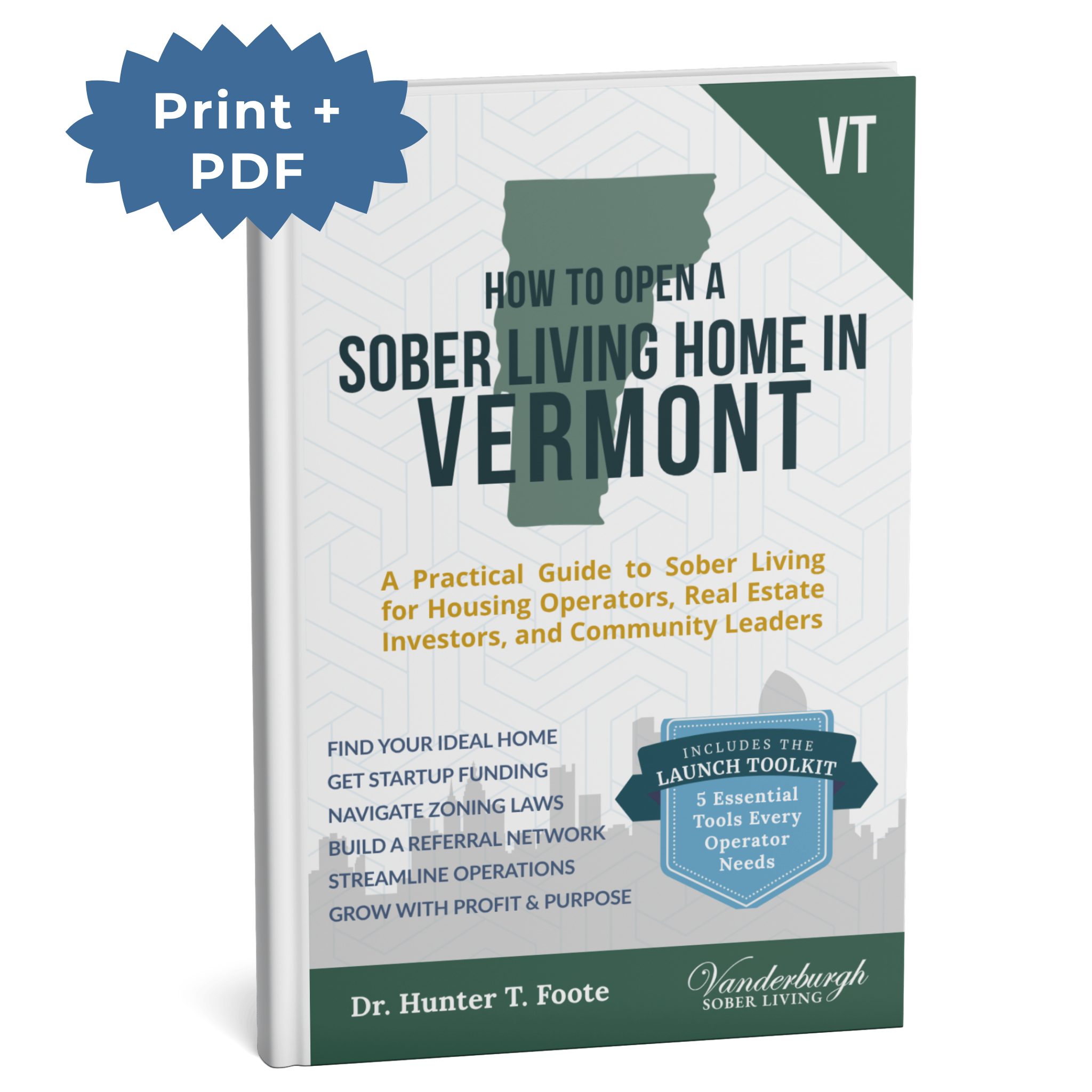
The book gives you the map to open a home in Vermont. When you are ready to launch, certify, and sustain, the Blueprint is the full playbook covering zoning, licensing, certification, funding, legal, insurance, and operations.
How Fair Housing Law Protects Vermont Sober Living
People in recovery from substance use disorder are a protected class under both federal and Vermont law, and Vermont’s zoning statute is wired directly into its fair housing act. 9 V.S.A. § 4501(3)(C) includes substance use disorders within the definition of a physical or mental impairment, while excluding a person who, by reason of current alcohol or drug use, poses a direct threat to property or the safety of others. 9 V.S.A. § 4503 then makes it an unfair housing practice to refuse to rent, or to impose different terms, on the basis of that disability. The bridge to land use is § 4412(1)(A), which bars any municipal bylaw from having “the effect of discriminating in the permitting of housing as specified in 9 V.S.A. § 4503.” A Vermont town that zones against a sober house is exposed under the zoning chapter and the fair housing act at once.
Vermont also protects residents receiving medication for opioid use disorder. 9 V.S.A. § 4452(b)(1)(A)(iv), as amended and made permanent by Act 103 of 2026, requires a certified home’s substance-use policy to exempt a resident’s valid prescription medication used as prescribed. A certified Vermont home cannot treat prescribed buprenorphine or methadone as a policy violation. Build that into the sober house rules before the first resident signs anything.
Keep readingThe Federal Fair Housing Act and Sober Living: Everything You Need to KnowThe federal protections every operator, neighbor, and local official should understand.→Where Vermont Sober Living Homes Can Operate
In most states the question of where a sober living home may operate is a fight over the local definition of “family,” because a bylaw that caps a household at three or four unrelated adults quietly makes shared recovery housing impossible. Vermont takes that fight off the table. Section 4412(14) bars any bylaw from prohibiting unrelated occupants from sharing a dwelling unit, so a group of adults living together in a certified home is a household for zoning purposes no matter how the town’s own definition reads.
Because the preemption is statewide, the municipal picture in Vermont is more uniform than in almost any other state. What varies is the local instrument you will actually be handed at the counter, and whether the town has zoning at all. Every row below is stated as of August 2026.
A stale bylaw is common and not a barrier. Plenty of Vermont towns still carry a definition of “family” written decades ago that counts unrelated adults. Section 4412(14) overrides it. When a zoning administrator points to that definition, the response is the statute, not an argument about the ordinance.
| Municipality | Zoning posture | Unrelated-occupancy cap | Governing instrument | As of |
|---|---|---|---|---|
| Burlington | Permitted by right as a single-family use in districts allowing single-family dwellings | None enforceable | Burlington Comprehensive Development Ordinance, read with 24 V.S.A. § 4412 | Aug. 2026 |
| Rutland City | Permitted by right as a single-family use in districts allowing single-family dwellings | None enforceable | Rutland City land use and development regulations, read with 24 V.S.A. § 4412 | Aug. 2026 |
| Brattleboro | Permitted by right as a single-family use in districts allowing single-family dwellings | None enforceable | Brattleboro land use regulations, read with 24 V.S.A. § 4412 | Aug. 2026 |
| Town with zoning but no recovery-residence language | Permitted by right; the statute supplies the rule the bylaw omits | None enforceable | 24 V.S.A. § 4412(1)(G), (14) | Aug. 2026 |
| Rural / unincorporated | No zoning permit exists to apply for; state fire, building, and rental housing review still applies | Not applicable | 24 V.S.A. § 4401 makes adopting bylaws optional for a municipality | Aug. 2026 |
Zoning and fair housing, answered
Know where sober homes can operate, and the federal protections that back you up.
Read the Vermont licensing guideWhether a peer-run recovery home needs a license in Vermont, and what lodging rules apply.Understand your Fair Housing rightsHow the federal Fair Housing Act protects sober living homes.Get zoning support in the LaunchpadIncludes an FHA zoning exemption request template and one-on-one strategy.Permitted by Right vs. Special Use Permits
Vermont’s default is by right. Conditional use review enters the picture only when a home falls outside the § 4412(1)(G) shield, which happens in two situations: the home serves nine or more residents, or certification has been pending past 45 days. In either case the home remains lawful; it is simply reviewed on the town’s timeline instead of at the permit counter.
Reading a Vermont bylaw for a specific address takes five ordered checks.
- Find the parcel’s zoning district. Pull the town’s zoning map and confirm which district the parcel sits in before you look at anything else.
- Read how the code defines “family” or household. Search the bylaw for “family,” “household,” “group home,” “community residence,” and “recovery residence.” Note anything restrictive so you can cite § 4412(14) against it before it becomes an issue.
- Check whether group residential use is allowed by right. Confirm the district permits single-family dwellings. That is the only question the by-right rule turns on. Then email the zoning administrator a short written request confirming that a certified recovery residence of eight or fewer residents is a permitted single-family use at that address under 24 V.S.A. § 4412(1)(G). A written answer is worth far more later than a phone call.
- Look for special or conditional use permit triggers. In Vermont there are only two: nine or more residents, or a certification application that has been pending more than 45 days.
- Confirm any spacing, density, or occupancy limits. Occupancy caps on unrelated adults are unenforceable statewide. While you are there, ask whether the town has an inspection agreement with the Division of Fire Safety, because that determines who reviews the building.
If the district allows single-family homes and you will run eight beds or fewerYou are by right. A ministerial zoning permit is the whole local process, and no hearing may be required.
If you plan nine or more residentsYou are in ordinary local review, still protected by § 4412(14) and by fair housing law, but reviewed on the town’s timeline.
If the town has no zoning bylaw at allThere is no local permit to apply for. Go straight to the fire and building review, which is the approval that actually applies.
One threat operators occasionally hear is that a sober house will need an Act 250 land use permit. For a single house it will not. Act 250’s housing jurisdiction attaches at unit thresholds well above a single dwelling, and the Natural Resources Board administers exemptions reaching up to 24 units in designated areas. Converting one existing home is not a covered development.
| Factor | Permitted by right | Special / conditional use permit |
|---|---|---|
| When it applies | Certified recovery residence, eight residents or fewer, in a district allowing single-family dwellings | Nine or more residents, or certification pending beyond 45 days |
| Advance approval needed | Zoning permit only, ministerial | Development review board approval required |
| Public hearing | No | Yes, with warned notice and abutter participation |
| Typical timeline | Days to a few weeks | Two to four months, longer on appeal |
| Fair-housing risk | Low | Higher for the town, because conditions imposed on a recovery home invite a § 4503 challenge |
How to Request a Reasonable Accommodation
A reasonable accommodation is a written request that a housing-related rule be changed so that people with disabilities have an equal opportunity to use and enjoy a dwelling. It is the operator’s strongest tool, and it works best used early rather than saved for a last resort. In Vermont you will need one less often than elsewhere, because the statute already does the work. Where it earns its place is above eight residents, or where a town applies a parking, density, or occupancy standard that would not stop an ordinary family.
Five steps make the request hard to ignore.
- Put the request in writing. Name the rule you want changed and state the legal basis in the same document: the federal Fair Housing Act, 9 V.S.A. § 4503, and 24 V.S.A. § 4412(1)(A), cited together.
- Send it to the right official. In most Vermont towns that is the zoning administrator, copied to the development review board chair and the town manager or select board.
- Tie the request to the disability. Connect the change to the disability-related need: shared housing at a workable scale is what makes recovery housing affordable and effective for people in recovery.
- Ask for something specific and necessary. “Waive the four-unrelated-adult limit for this property” is a request. “Please be reasonable” is not. Then show the request is reasonable by describing the home the way a neighbor experiences it, including parking, occupancy, quiet hours, and house standards.
- Request a written decision and keep records. Ask for a decision by a stated date and keep every piece of correspondence; a denial in writing is something you can act on, while silence is not.
If the request is denied, move to the escalation routes in the pushback section below. The mechanics of drafting one, including what a housing provider should attach, are covered in the guide to requesting reasonable accommodation, and the federal expectations for how a municipality should respond are set out in the HUD and DOJ joint statement on reasonable accommodations.
Vermont Lodging-House and Sprinkler Triggers to Watch
This is the section to read twice. Vermont hands operators the friendliest zoning statute in the region and then applies one of the heavier building regimes to the same house. Under 20 V.S.A. § 2730, a “public building” is defined broadly and excludes an owner-occupied single-family residence only so long as it is not used for one of the listed purposes. A house rented to unrelated residents as a recovery residence is generally not an owner-occupied single-family dwelling. It becomes a public building, and it falls under the Vermont Division of Fire Safety for construction permits, plan review, and periodic inspection. The building looks identical the day before and the day after. Its legal status does not.
- Change of use triggers review before you open. Converting a dwelling to a recovery residence is filed with the Division of Fire Safety through its change of use and ownership process, and construction may not begin before review. Skipping it is the most common enforcement exposure in the state.
- Occupancy classification scales with head count. Under the 2025 Vermont Fire and Building Safety Code, which adopts NFPA 1 and NFPA 101 (2021 editions), a building of two dwelling units or fewer sits in the one- and two-family dwelling chapter with modest requirements. Sleeping accommodations for more than a single household and up to 16 occupants land in the lodging or rooming house chapters. Seventeen or more occupants move to hotel or dormitory classification. Each step adds alarm, egress, and sprinkler obligations.
- Sprinklers are driven by construction, not head count alone. NFPA 13R residential sprinkler systems are generally required on new construction and major renovation, and where a required secondary means of escape is not otherwise met. An older Vermont farmhouse gutted to add bedrooms can pull sprinklers in through the renovation door.
- A second code layer applies regardless. The Residential Rental Housing Health and Safety Code sets baseline habitability standards for all Vermont rental housing, on top of the fire and building code.
The practical read: an eight-bed home is inside the zoning shield and inside the lodging house band at the same time. Those two thresholds do not line up, and pretending they do is how operators get surprised at inspection. Deciding the number honestly is the point of determining maximum occupancy before you buy, alongside the classification question covered in IRC vs. IBC and the system requirements in sober living fire safety. Bring the Division of Fire Safety into the conversation during due diligence, not after closing.
Vermont guideSober Living Startup Costs in VermontOne-time costs to open, including any sprinkler or fire-code retrofit a larger home may need.→Which Local Bodies Review a Vermont Sober Home
Vermont splits review between the town and the state, and the state half is the larger one. Each body checks a different thing, and knowing which one owns which question keeps a project from stalling at the wrong counter.
- Zoning administrator (town). Issues the zoning permit and confirms the use. For a certified home of eight or fewer this is ministerial.
- Development review board or zoning board of adjustment (town). Involved only for conditional use, variances, or appeals, meaning homes above eight residents or homes outside the certification window.
- Division of Fire Safety (state). Construction permits, plan review, change of use, occupancy classification, sprinklers and egress, and periodic inspection of public buildings. The heaviest reviewer in Vermont.
- Town health officer. Local habitability and public health complaints, working alongside the state rental housing code.
- Agency of Natural Resources. Water supply and wastewater permitting where bedroom count or septic capacity changes.
- VTARR. Not a government reviewer, but the certifier whose approval unlocks the zoning shield, the discharge protections, and state funding. VTARR also states plainly that certification does not substitute for local fire and building compliance.
The town half of that list usually moves in days. The state half sets the schedule, so open the file with the Division of Fire Safety first and let the zoning permit follow it.
Vermont guideDo You Need a License to Open a Sober Living Home in Vermont?What Vermont actually requires, and where voluntary certification fits instead.→How to Handle Neighborhood or Municipal Pushback
Vermont’s statute is strong, and the state’s general housing politics are not always welcoming. Expect questions. Most opposition is manageable, and it stays manageable when it is handled in order and escalated slowly.
- Stay calm and document everything. Answer neighbors before they organize. Most opposition is about parking, noise, and property values, not recovery. A short letter describing the household, the house standards, and who to call resolves a surprising share of it, and a dated file of what you sent matters later.
- Get the specific rule or objection in writing. Send the town a one-page memo quoting § 4412(1)(G) and § 4412(14) with the statute attached, and ask the zoning administrator for a written position. If the answer is adverse, you now have a decision you can appeal, which is better than an indefinite delay.
- Submit a reasonable accommodation request. Use the steps above whenever the town applies a rule that would not stop an ordinary family.
- Escalate to the state fair-housing or human-rights agency. The Vermont Human Rights Commission investigates housing discrimination complaints, and the Attorney General’s Civil Rights Unit also handles fair housing matters.
- File a complaint with HUD FHEO. A complaint can be filed with the Office of Fair Housing and Equal Opportunity through HUD’s housing discrimination reporting process, generally within one year of the act.
- Bring in a fair-housing attorney. Do this once a denial is formal, conditions are imposed, or a hearing turns hostile. Do not wait for the appeal deadline.
For municipal readers arriving here from the other side of the table, the case for treating these homes as ordinary housing is laid out in the discussion of recovery housing policy. The federal guidance every town planner should have on file is the HUD and DOJ joint statement on state and local land use laws.
Choosing a Defensible Location in Vermont
A defensible Vermont location is one where the zoning question is already answered and the building question is already survivable. Residential district, occupancy fit, parking, and proximity to services and transit are the factors that decide it, and they are the same factors the property-selection step of the state guide walks through.
- A district that allows single-family dwellings. That single fact carries the by-right rule.
- A property already in rental use. It is likely already treated as a public building, which removes the change-of-use surprise.
- Egress and life safety that already work. A second means of escape, interconnected alarms, and a code-legal stair are cheaper to inherit than to install.
- A town with a recovery center but no beds. The Department of Health’s assessment named Rutland, St. Albans, Barre and Montpelier, St. Johnsbury, and Morrisville as places with services and unmet residential need.
- A county with no certified residence at all. Addison, Essex, Grand Isle, Orange, Orleans, and Windham counties each have none, per the state’s own recovery housing program action plan.
- Deed and covenant review at diligence. Vermont has no statute voiding private restrictive covenants against recovery residences as of August 2026, so read the title work. The federal analysis is covered in HOAs and sober living.
Scale matters too. Vermont supply is thin: the state’s 2025 housing needs assessment counted roughly 80 certified beds statewide, down from 211 before the pandemic, against an estimated need for about 300 more.
Classification, Fair Housing protection, reasonable accommodation, and handling a city that says no.
Claim your free copyVermont Zoning and Fair Housing at a Glance
Four layers of law decide where a Vermont sober living home can operate, and they stack in this order.
| Layer | Rule | What It Means |
|---|---|---|
| Federal | The federal Fair Housing Act and the ADA protect people in recovery as persons with disabilities | A town has to treat your house like housing, and change a rule that unfairly blocks it |
| State | 9 V.S.A. §§ 4501, 4503 include substance use disorder as a disability and make discriminatory housing terms an unfair practice | The same protection under state law, enforced by the Vermont Human Rights Commission |
| State zoning preemption | 24 V.S.A. § 4412(1)(G): a certified recovery residence of eight or fewer residents is a permitted single-family use by right; § 4412(14) bars unrelated-occupant caps statewide; certification pending beyond 45 days returns discretion to the town. Preemption statute confirmed as of August 2026. | Your town cannot require a special permit or a hearing for a small certified home, and cannot cap unrelated adults at any size |
| State fire and building | 20 V.S.A. § 2730 plus the 2025 Vermont Fire and Building Safety Code | Renting to unrelated residents makes the house a public building, with state plan review, a change-of-use filing, and inspection |
| Local | The town bylaw applies only above eight residents or outside the certification window, and some towns have no bylaw at all | For most homes the local layer is a permit counter, not a decision point |
Sober Living Guides Every Operator Needs
These evergreen guides apply in every state and cover what pairs with getting your zoning right: choosing a defensible property, the standards you operate to, the coverage you carry, and the referrals that keep the home full.
Frequently Asked Questions About Sober Living Zoning in Vermont
Is a sober house allowed in residential zones in Vermont?
Yes. 24 V.S.A. § 4412(1)(G) makes a certified recovery residence serving eight or fewer people a permitted single-family use by right in any district that allows single-family dwellings. Homes above eight residents remain lawful but are reviewed under the town’s ordinary bylaw.
Do I need a special or conditional use permit in Vermont?
Usually not. Conditional use review applies only if the home serves nine or more residents or if certification has been pending more than 45 days, at which point § 4412(1)(G) returns discretionary authority to the municipality. Otherwise a ministerial zoning permit is the whole local process.
Can a Vermont town require me to register or license the home?
Vermont has no state operating license for recovery residences, and a town cannot condition a by-right single-family use on a special registration. The state review that does apply is fire and building review by the Division of Fire Safety, plus the rental housing health and safety code.
Do HOA rules or deed restrictions apply to a Vermont sober living home?
They can. There is no Vermont statute voiding private restrictive covenants against recovery residences as of August 2026, so private covenants are a diligence item rather than a preempted one. Federal fair housing law still reaches associations, which is the analysis in HOAs and sober living.
Can a historic district block a sober living home?
A historic district regulates exterior appearance and alteration, not who lives inside. Because § 4412(1)(A) bars any bylaw from discriminating in the permitting of housing under 9 V.S.A. § 4503, historic review that functions as a use restriction on a recovery residence is vulnerable.
Does Vermont allow spacing or distance requirements between homes?
Vermont’s statute permits a municipality to limit these homes on one lot to the number of single-family dwellings that lot allows, but it authorizes no dispersal or distance-between-homes ordinance. A spacing rule aimed at recovery residences would also face the § 4412(1)(A) fair housing hook.
How many residents can share a Vermont sober living home?
Zoning sets no ceiling, because § 4412(14) bars unrelated-occupancy caps. The real limits are the eight-resident line for by-right status and the fire code: more than a single household and up to 16 occupants is a lodging or rooming house under the 2025 Vermont Fire and Building Safety Code, and 17 or more shifts higher again.
A neighbor complained and the town scheduled a hearing. What now?
Attend, bring the statute, and stay factual. Send the town a written memo quoting § 4412 beforehand. If the town imposes conditions it would not impose on a family, file a reasonable accommodation request, then a complaint with the Vermont Human Rights Commission or HUD.
Open a Vermont Sober Living Home With Confidence
Vermont gives operators something rare: a legislature that already answered the zoning question in their favor. Confirm the district allows single-family dwellings, get the VTARR application in early enough to stay inside the 45-day window, and spend your diligence budget on the fire marshal rather than the zoning board. That sequence is what separates a Vermont home that opens on schedule from one that stalls. If you want a second set of eyes on a specific Vermont property, reach out to the team.
Disclaimer: The information provided in this article and all articles in the Laws & Regulations category is presented for informational purposes only and is not intended as legal advice. Laws and regulations regarding recovery housing vary by state and locality, and their interpretation can change over time. This content is meant to discuss general legal and regulatory topics related to sober living and recovery housing. For specific legal guidance, please consult a qualified attorney or legal professional.
Research & Sources
- Foote, H. T. (2026). Vanderburgh Sober Living Operating Climate Index, 2026 edition. Vanderburgh Sober Living. https://www.vanderburghhouse.com/research/operating-climate-index-2026/
- Vermont General Assembly. (n.d.). 24 V.S.A. § 4412: Required provisions and prohibited effects. https://legislature.vermont.gov/statutes/section/24/117/04412
- Vermont General Assembly. (n.d.). 24 V.S.A. § 4401: Purpose and authority to adopt bylaws. https://legislature.vermont.gov/statutes/section/24/117/04401
- Vermont General Assembly. (n.d.). 9 V.S.A. § 4501: Definitions, Fair Housing and Public Accommodations Act. https://legislature.vermont.gov/statutes/section/09/139/04501
- Vermont General Assembly. (n.d.). 9 V.S.A. ch. 139: Public accommodations, including § 4503 unfair housing practices. https://legislature.vermont.gov/statutes/fullchapter/09/139
- Vermont General Assembly. (2026). Act 103 of 2026 (S.157), as passed by both chambers, amending 9 V.S.A. § 4452(b). https://legislature.vermont.gov/Documents/2026/Docs/BILLS/S-0157/S-0157 As Passed by Both House and Senate Official.pdf
- Vermont General Assembly. (n.d.). 20 V.S.A. § 2730: Definition of public building. https://legislature.vermont.gov/statutes/section/20/173/02730
- Vermont Division of Fire Safety. (2025). Codes and standards: 2025 Vermont Fire and Building Safety Code. https://firesafety.vermont.gov/buildingcode/codes
- Vermont Division of Fire Safety. (n.d.). Permits, plan review, and change of use or ownership. https://firesafety.vermont.gov/buildingcode/permits
- Vermont Division of Fire Safety. (2022). Residential Rental Housing Health and Safety Code. https://firesafety.vermont.gov/sites/firesafety/files/documents/RRHHS Code 2022 .pdf
- Vermont Human Rights Commission. (n.d.). Housing discrimination complaints. https://hrc.vermont.gov/
- Vermont Natural Resources Board. (n.d.). Act 250 and the HOME Act housing exemptions. https://nrb.vermont.gov/HOME-act-info
- Vermont Agency of Commerce and Community Development. (2025). FY25 recovery housing program action plan update. https://outside.vermont.gov/agency/ACCD/ACCD_Web_Docs/CD/VCDP/RHP/FY25 Recovery Housing Program Action Plan Update DRAFT.pdf
- Vermont Alliance for Recovery Residences. (n.d.). Certification standards and process. https://vtarr.org/certification.php
- City of Burlington. (n.d.). Comprehensive development ordinance. https://www.burlingtonvt.gov/DPI/CDO
- City of Rutland. (n.d.). Land use and development regulations. https://ecode360.com/41273674
- Town of Brattleboro. (n.d.). Land use regulations. https://brattleboro.gov/lur
- U.S. Department of Housing and Urban Development & U.S. Department of Justice. (2004). Joint statement: Reasonable accommodations under the Fair Housing Act. https://www.hud.gov/sites/documents/huddojstatement.pdf
- U.S. Department of Housing and Urban Development. (n.d.). Report housing discrimination to the Office of Fair Housing and Equal Opportunity. https://www.hud.gov/reporthousingdiscrimination
- U.S. Department of Housing and Urban Development & U.S. Department of Justice. (2016). Joint statement: State and local land use laws and practices and the application of the Fair Housing Act. https://www.hudexchange.info/
- Justia. (n.d.). Fair housing laws: 50-state survey. https://www.justia.com/