

To start a sober living home in British Columbia you first decide what services the home will provide, because that decides whether you register. A home that provides housing, hospitality services and support services to three or more unrelated adults must register with the Assisted Living Registry; a home that provides care or treatment needs a community care facility license instead (Community Care and Assisted Living Act). Your city then decides whether a recovery house or business license applies. Demand is the highest in Canada: the BC Coroners Service reported 1,826 unregulated drug deaths in 2025, the lowest count since 2020.
This page covers what is specific to British Columbia: the registration line, the $60 per diem that comes with it, city licensing in Surrey, Abbotsford and Kelowna, local costs and prices, and the agencies that keep beds full. National context and the comparison with Ontario, Alberta and Quebec live in the Canada guide below, and the shared figures there are restated here, not recalculated.
Before you read onHow to Open a Sober Living Home in CanadaThis post covers one piece of the process. The complete Canada guide walks through every step, from planning to your first resident.→Is British Columbia a Good Place to Open a Sober Living Home?
Yes, for an operator ready to register. British Columbia is the only one of the four provinces with a registry built for supportive recovery homes, and registration unlocks a $60 daily per diem for residents on income assistance. The caveats are cost and compliance: BC rents are the highest of the four provinces at $2,597 for an average three-bedroom-plus apartment in October 2025, and registered homes carry staffing, training and inspection rules.
Recovery Housing Demand in British Columbia
British Columbia demand comes from four places, and the per diem makes the first two especially important.
- Treatment discharges: The province reports 3,785 publicly funded treatment and recovery beds (Government of British Columbia), and their graduates need a next step.
- Income assistance: Residents on income assistance bring the per diem to registered homes (BC Employment and Assistance).
- The justice system: The Drug Treatment Court of Vancouver and probation officers across the province (BC Corrections) look for sober addresses.
- Health authority contracts: Health authorities contract supportive recovery beds, as Vancouver Coastal Health does with registered or licensed providers.
These are the figures a lender, landlord or referral partner asks about first.
| Indicator | British Columbia figure | Why it matters to an operator |
|---|---|---|
| Unregulated drug deaths, 2025 | 1,826, down 21% from 2024 (BC Coroners Service) | Still about five deaths a day; demand for recovery housing remains high. |
| Deaths by health authority, 2025 | Fraser 533 and Vancouver Coastal 484, 56% of the total (BC Coroners Service) | The Lower Mainland is where need and referral volume concentrate. |
| Publicly funded treatment and recovery beds | 3,785 (Government of British Columbia) | A large pipeline of graduates looking for supportive housing. |
| Per diem for registered homes | $60 a day per resident on income assistance (Government of British Columbia, 2024) | About $1,824 a month per resident, set by the province for registered homes. |
| Average 3+ bedroom apartment rent | $2,597 in October 2025 (CMHC) | The highest of the four provinces, so occupancy matters more. |
Read together, the numbers say British Columbia has the deepest need and a provincial per diem for registered homes, but the home has to register to collect it and rent leaves little room for empty beds.
In British Columbia the services decide the paperwork. Decide before you sign a lease whether the home will provide support services, because that choice brings registration, staffing rules and the per diem with it.
How to Open a Sober House in British Columbia: Step-by-Step
The order below puts the service decision and the Registry check first, because in British Columbia the registration file shapes the entity, the property and the staffing. Most registered homes need four to six months from first search to first resident; the timeline after the last step breaks that down.
These ten steps take a British Columbia operator from an idea to an open home.
Step 1. Decide the Service Model and Confirm It With the Registry
Write down what the home will provide. Housing, hospitality services and support services such as psychosocial supports for three or more unrelated adults means registration; care or treatment means a license (Assisted Living Registry factsheet).
The Registry enforces the line. In 2025 it ordered a Nanaimo operator serving nine residents without registration to cut to two residents or stop services (Assisted Living Registry).
Step 2. Form the Entity That Will Hold the Registration
The applicant must own the premises, lease them or have the owner’s written permission, and limited liability partnerships cannot register (Assisted Living Regulation, s. 5). A BC company costs $350 plus $30 for a name request, with a $43.39 annual report (BC Registries); a society costs $100 plus $30, with a $40 annual report (BC Registries).
Charity registration carries no CRA application fee (CRA). Directors and managers each need criminal record checks through the BC Criminal Record Review Program.
Step 3. Check the City License Before You Choose the House
Several BC cities license recovery houses or group homes separately.
- Surrey: An alcohol and drug recovery house license costs $1,066 a year (Surrey Business License By-law 13680).
- Abbotsford: A supportive recovery use requires a city license (Abbotsford Business Licence Bylaw).
- Kelowna: Group homes are capped at 10 persons, with no more than six in care (Kelowna Zoning Bylaw 12375).
The Registry application needs that business license, or a local government letter saying none is needed (Assisted Living Regulation, s. 6).
Step 4. Choose a Property That Fits Code and Capacity
The Building Code Appeal Board ruled that a converted house for 10 or fewer residents, due to register as assisted living, is a residential occupancy, not a care occupancy (BCAB Decision 1778). Occupancy cannot exceed the capacity on the business license (Supportive Recovery Operator Handbook).
Two anchors drive the budget: the BC average three-bedroom-plus rent of $2,597 (CMHC, October 2025) and local prices from $669,100 in Kamloops to $1,288,600 in core Victoria.
Step 5. Write the Registry Documents
Registered homes need a written residency agreement, a visitor policy, a medication policy, an overdose plan with naloxone and a personal service plan for each resident within seven days of move-in (Assisted Living Regulation). These are part of the application file, so write them before you apply, and add a neighbor-relations plan that names who answers a neighbor’s call.
Keep readingHouse Rules in Sober HousesThe rules that keep a recovery home safe, structured, and worth living in.→Step 6. Bind Insurance for the Address
As of November 2026 we found no insurance minimum in the Assisted Living Regulation, but landlords, lenders and health authority contracts ask for commercial general liability coverage, and a home policy will not cover a business use. Quote the specific address before you sign.
Step 7. Train Staff and the House Mentor
Registered supportive recovery homes must have staff complete 20 hours of training in areas such as counseling, crisis intervention, psychosocial intervention for substance use or trauma-informed practice (Assisted Living Regulation, s. 23). A house mentor in stable recovery often leads daily life in the home alongside trained staff; put that role in writing and move the mentor in before the first resident.
Step 8. Register With the Assisted Living Registry
Registration is the gate to opening a supportive recovery home.
- Assemble the required documents: criminal record checks, references, a scaled floor plan, the overdose plan and the business license or letter.
- Apply with the $250 fee plus $12.50 per unit (Assisted Living Registry).
- Renew each year by March 31; a new operator must register again, because registration does not transfer.
Step 9. Start Referral Outreach Before Opening
Health authority access lines, treatment programs and income assistance workers place most residents. Call the partners in the referral table below while the Registry file is in review, invite three to tour, and ask health authority bed teams what they expect of a contracted provider.
Step 10. Open Slowly and Track Occupancy
Admit residents in small groups, hold the weekly house meeting from day one, complete each personal service plan within seven days, and send referral partners a short monthly note with open beds. In BC the first quarter is also when the Registry is most likely to follow up, so keep the records ready.
Keep readingHow Sober Houses Fill Beds and Stay FullProven occupancy strategies from established recovery housing operators.→The phases below follow the steps above.
| Phase | Weeks (estimated) | What gets done |
|---|---|---|
| Service model and Registry check | 2 to 4 | Model confirmed in writing |
| Entity, city license and property | 4 to 8 | Company formed, license or letter, lease signed |
| Documents, staff training and insurance | 3 to 5 | Policies written, 20-hour training done, policy bound |
| Registry application and review | 4 to 8 | File submitted and registration issued |
| Referral outreach and opening | 2 to 4 | Partner tours, first residents admitted |
Timelines are estimated. In British Columbia, criminal record checks and a missing business license letter are what most often add months to the Registry review.
Best Neighborhoods for a Sober Living Home in British Columbia
A workable British Columbia address passes four tests.
- City license: The city allows a recovery house at the address, with a license where required.
- Capacity: The house fits the licensed capacity and the Registry floor plan.
- Transit: Residents can reach treatment, meetings and work without a car.
- Referral reach: A health authority, treatment program or court is within reach.
Five metros follow. Rents are private apartment averages from the CMHC Rental Market Survey, and prices come from local real estate boards.
| Area | Housing stock and transit | Siting notes for a sober living home |
|---|---|---|
| Vancouver | Average 3+ bed rent $3,009; composite benchmark $1,068,600 (GVR); TransLink SkyTrain and buses | Deepest referral base, including the Drug Treatment Court and Vancouver Coastal Health; the highest rent in the province narrows margins. |
| Surrey and Abbotsford | Abbotsford-Mission rent $2,211; Fraser Valley benchmark $860,000 (CREA); TransLink in Surrey, BC Transit in Abbotsford | Fraser Health had the most deaths in 2025; both cities license recovery houses, so budget the license and inspection. |
| Victoria | Average 3+ bed rent $2,886; core single-family benchmark $1,288,600 (VREB); BC Transit buses | Strong referral base through Island Health; the highest purchase prices make leasing the realistic path. |
| Kelowna | Average 3+ bed rent $2,895; Central Okanagan median $925,166 (AOR); BC Transit buses | Group homes are capped at 10 persons with six in care; Interior Health covers a wide region. |
| Kamloops | Average 3+ bed rent $2,094; benchmark $669,100 (AOR); BC Transit buses | Lowest prices of the five; a smaller referral base means outreach matters more. |
Anywhere in British Columbia, a few house features decide whether a home works.
- Floor plan: Rooms and exits that match the scaled plan in the Registry file.
- Capacity: Bed count within the business license limit.
- Common space: A kitchen and living room large enough for the weekly house meeting.
Each municipality runs its own licensing, so treat every city as a fresh check rather than assuming Surrey or Kelowna rules apply.
Who Regulates Sober Living Homes in British Columbia?
No single agency regulates sober living homes in British Columbia. The Assisted Living Registry registers supportive recovery homes, community care licensing covers care and treatment, cities control zoning and business licenses, the Residential Tenancy Branch decides tenancy questions, and the Human Rights Code protects residents.
A sober living home is a shared residence with house rules where residents pay their own rent and receive no treatment on site. In British Columbia that definition matters twice: it keeps the home out of community care licensing, and if the home adds support services for three or more adults, it moves the home into registration (Community Care and Assisted Living Act).
| Layer | Agency | What it controls for a sober living home |
|---|---|---|
| Provincial registration | Assisted Living Registry | Registers supportive recovery homes, inspects and investigates complaints, and can fine unregistered operators (Assisted Living Registrar). |
| Provincial licensing | Community care facilities licensing | Licenses homes that provide care or treatment (CCALA). |
| City zoning and licensing | Municipal planning and licensing offices | Recovery house and business licenses in Surrey and Abbotsford; group home limits in Kelowna. |
| Tenancy | Residential Tenancy Branch | Applies the Residential Tenancy Act, which excludes housing provided as part of rehabilitative or therapeutic services; supportive housing has its own terms (RTB). |
| Human rights | BC Human Rights Tribunal | The Human Rights Code bars discrimination in tenancy based on disability. |
| Funding and referrals | Health authorities; BC Employment and Assistance | Contract beds and pay the per diem for eligible residents. |
The short version for an operator:
- Provincial license: Only for care or treatment; housing-only homes need none.
- Registration: Required once support services reach three or more adults.
- City license: Required in Surrey and Abbotsford; check every city.
- Referrals: Run through health authorities, treatment programs, courts and income assistance.
Of those layers, registration is the one most operators plan for. The city license is the one that catches them off guard, which is why zoning gets its own section.
British Columbia Zoning Laws for Sober Living Homes
As of November 2026, British Columbia has no provincial zoning rule specific to sober living homes. What governs instead is each city’s zoning and business licensing, read together with the Human Rights Code.
How BC Cities Treat a Sober Living Home
BC cities handle recovery homes in three different ways.
- Licensed recovery house: Surrey licenses alcohol and drug recovery houses at $1,066 a year (By-law 13680).
- Supportive recovery use: Abbotsford requires a city license for supportive recovery use (Business Licence Bylaw).
- Group home cap: Kelowna caps group homes at 10 persons, with no more than six in care (Zoning Bylaw 12375).
Where a city has no recovery-house category, a home is usually treated as a dwelling, and the Registry still asks for a letter confirming that no business license is needed.
Ask the city in writing whether a business license applies before you apply to the Registry. The application cannot be completed without the license or the letter.
What Section 20 of the Assisted Living Act Does and Does Not Do
Operators sometimes assume a registered home gets the same zoning protection as a small care facility. It does not.
- Section 20: Treats some small licensed care facilities as residential use, but covers licensed facilities only (CCALA).
- Registered homes: A registered supportive recovery home is not a licensed facility, so section 20 does not reach it.
- Human Rights Code: Bars discrimination in tenancy based on disability (Human Rights Code), and the Supreme Court of Canada has treated addiction as a disability (Stewart v. Elk Valley Coal, 2017 SCC 30).
The 2025 Registry Enforcement Order
In 2025 the Assisted Living Registry confirmed that a Nanaimo home was operating as an unregistered residence and ordered the operator to reduce to two residents or stop providing services (Assisted Living Registry). The order shows three things the Registry checks.
- Whether the home provides support services, not just housing.
- How many unrelated adults live there.
- Whether the operator registered before admitting residents.
What did not change is the option to run housing only: a home without support services can fall outside registration. For an operator that means three practical moves.
- Describe your services in writing and ask the Registry to confirm your category.
- Get the city license or letter before applying.
- Register before you admit a third resident if you provide support services.
British Columbia Fire and Building Code Rules for Sober Living Homes
A converted house for 10 or fewer residents due to register as assisted living is a residential occupancy under the BC Building Code. Three points decide what the building and fire officials ask for.
- Occupancy line: The Building Code Appeal Board drew the residential line for small registered homes (BCAB Decision 1778).
- Capacity: Occupancy cannot exceed the capacity on the business license (Operator Handbook).
- Floor plan: The Registry file includes a scaled floor plan, so alterations should be permitted first.
Alarms and exits are where first-time operators most often fall short, and the codes below apply to every BC dwelling regardless of who lives in it.
| Requirement | What the rule says | Authority |
|---|---|---|
| Building and fire codes | The 2024 BC Building Code and BC Fire Code took effect on March 8, 2024 | Government of British Columbia |
| Occupancy class | A converted house for 10 or fewer residents due to register is residential | BCAB Decision 1778 |
| Code and bylaw compliance | Registered homes must follow the Building Code, Fire Code and local bylaws | Supportive Recovery Operator Handbook |
| Overdose response | Registered homes keep naloxone on site and train staff | Assisted Living Regulation |
Where a home stays housing-only and no city license applies, no inspector will prompt the operator, so the operator carries that burden. Confirm alarms, exits and capacity with the local fire department before the first resident moves in.
How Much Does It Cost to Open a Sober House in British Columbia?
A leased British Columbia sober home typically costs $22,200 to $53,800 to open, an estimated range that runs from Kamloops or Abbotsford at the low end to Vancouver or Victoria at the high end. BC changes three lines more than any other province: rent, registry and city fees, and staff training.
| Line item | British Columbia figure | Source |
|---|---|---|
| BC company incorporation and name | $380 | BC Registries |
| Half-month deposit and first month | $3,000 to $6,000 | Residential Tenancy Act deposit cap |
| Registry fees, 8 units | $350 ($250 plus $12.50 per unit) | Assisted Living Registry |
| City recovery house license | $0 to $1,066 a year (Surrey: $1,066) | City of Surrey |
| Furniture and setup, 6 to 8 beds | $8,000 to $16,000 | Estimated range; quote locally |
| Safety upgrades and code work | $1,500 to $10,000 | Estimated range; quote locally |
| Insurance, first year | $3,000 to $8,000 | Estimated range; quote for the address |
| Operating reserve, 3 months of rent | $6,000 to $12,000 | Estimated from CMHC rents |
Two adjustments turn the range into a British Columbia budget.
- Purchase path: Prices run from $669,100 in Kamloops to $1,288,600 in core Victoria, so buying is realistic mainly in the Interior.
- Lease path: Where the Residential Tenancy Act applies, the security deposit is capped at half a month’s rent, which lowers the cash needed at signing.
A few public programs offset costs once a home is registered or established.
- Per diem: $60 a day for registered homes’ residents on income assistance (rate table).
- Health authority contracts: Contracted supportive recovery beds, such as the 12 beds that opened in Powell River in 2025 (Government of British Columbia).
- Reaching Home: Over $638 million committed in BC from 2019 to 2028 for local homelessness responses (Government of Canada).
None of these is startup money, and the per diem arrives only after registration. CMHC’s Affordable Housing Fund closed to applications on December 19, 2025 (CMHC). Plan the launch on private capital.
Is a Sober Living Home Profitable in British Columbia?
Yes, if the home registers and stays close to full. Each resident on income assistance brings about $1,824 a month at the $60 per diem, more than most private-pay rents, but Vancouver and Victoria rents and the cost of trained staff mean empty beds hurt quickly.
The table below sets out monthly costs for an eight-bed leased home with one bed for the house mentor, and the rent per bed needed to break even. Only the rent line changes for Vancouver. Staff wages are not included and must be priced separately.
| Line | British Columbia reference model (8 beds) | Vancouver adjustment (estimated) |
|---|---|---|
| Lease | $2,597 (BC 3+ bed average, CMHC) | $3,009 (Vancouver average) |
| Utilities and internet | $500 | Unchanged |
| Insurance | $460 | Unchanged |
| Supplies and maintenance | $300 | Unchanged |
| Registry fees, monthly share | $29 | Unchanged |
| Total monthly cost | $3,886 | $4,298 |
| Break-even rent per bed, 7 paying beds | $555 | $614 |
| Break-even rent per bed at 85% occupancy | $653 | $722 |
| Per diem per resident, 30-day month | $1,800 to $1,860 | Unchanged |
These are estimates, not quotes, and they use apartment rents; a detached house with five or more bedrooms usually rents for more. Three factors move the margin more than rent does.
- Staffing: Trained staff are the largest cost a registered home adds.
- Per diem share: The more residents on income assistance, the higher the revenue per bed.
- Occupancy: Every empty bed costs about $1,800 a month in lost per diem.
How to Get Residents for a Sober Living Home in British Columbia
In British Columbia, publicly funded referrals run through health authorities, treatment programs and income assistance, and the per diem makes those referrals valuable. The public doors are below.
- HealthLink BC, 8-1-1: Free provincial health line that refers callers to substance use services (HealthLink BC).
- Health authority access lines: Five regional health authorities plan and contract substance use services, including supportive recovery beds.
- Registration: Contracted beds follow licensing or registry rules (Vancouver Coastal Health), so registration is close to a referral requirement here.
Fifteen organizations follow, public agencies first.
| Organization | Type | How residents reach you |
|---|---|---|
| Vancouver Coastal Health | Health authority | Substance use teams and contracted bed calls refer clients. |
| Fraser Health | Health authority | Access lines and case managers refer clients in Surrey and the Fraser Valley. |
| Island Health | Health authority | Refers clients in Victoria and on Vancouver Island. |
| Interior Health | Health authority | Refers clients in Kelowna, Kamloops and the Interior. |
| Drug Treatment Court of Vancouver | Court program | Participants need stable housing during the program. |
| BC Corrections, probation offices | Provincial corrections | Probation officers approve residences for people under supervision. |
| BC Employment and Assistance | Provincial ministry | Workers place residents eligible for the per diem. |
| HealthLink BC | Provincial health line | Refers callers to substance use services. |
| Last Door Recovery Society | Nonprofit treatment | Graduates look for supportive recovery housing. |
| Pacifica Treatment Centre | Nonprofit treatment | Residential graduates look for a sober next step. |
| Union Gospel Mission | Faith-based nonprofit | Recovery program graduates and shelter guests seek housing. |
| John Howard Society of BC | Reentry nonprofit | Reentry workers refer people leaving custody. |
| Veterans Affairs Canada | Federal agency | Case managers refer veterans in recovery. |
| bc211 | Information line | Lists community services and refers callers by phone. |
| BC Housing | Provincial housing agency | Funded housing partners refer tenants who need recovery support. |
Recovery fellowships do not refer formally, but meeting secretaries and sponsors are how many residents find a home. Vancouver AA lists meetings across the Lower Mainland, and local intergroups cover the rest of the province.
Common Mistakes When Opening a Sober House in British Columbia
These are the mistakes that show up in British Columbia homes that struggle in their first year, and most happen before the Registry file is complete.
- Adding support services without registering: A home with support services for three or more adults must register, and the Registry enforces it.
- Applying without the city license or letter: The Registry application cannot be completed without one.
- Budgeting the per diem before registration: Only registered or licensed homes receive it.
- Skipping the 20 hours of staff training: Inspectors ask for training records.
- Pricing from provincial averages: Vancouver and Victoria rents run hundreds of dollars above the BC figure.
The British Columbia book covers each of these in detail, with a five-document Launch Toolkit.
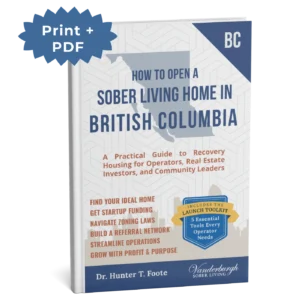
Everything we’ve learned about opening a sober living home, written for British Columbia.
Frequently Asked Questions About Opening a Sober House in British Columbia
Do you need a license to open a sober living home in British Columbia?
No license is needed for a housing-only sober home. A home that provides housing, hospitality services and support services to three or more unrelated adults must register with the Assisted Living Registry, and a home that provides care or treatment needs a community care facility license. Some cities, including Surrey and Abbotsford, also require a recovery house or business license.
Is registration with the Assisted Living Registry required?
Registration is required once a home provides support services such as psychosocial supports to three or more unrelated adults. It costs $250 plus $12.50 per unit, renews each year by March 31, and is what makes residents on income assistance eligible for the $60 daily per diem.
Can a sober living home operate in a BC residential neighborhood?
Yes, subject to city rules. Surrey and Abbotsford license recovery houses, Kelowna caps group homes at 10 persons, and the Human Rights Code bars discrimination in tenancy based on disability. A registered home is not covered by the small-facility zoning rule in section 20 of the Assisted Living Act, which applies to licensed facilities only.
How much does it cost to open a sober living home in British Columbia?
An estimated $22,200 to $53,800 for a leased home, from Kamloops or Abbotsford at the low end to Vancouver or Victoria at the high end. Registry fees for eight units come to about $350, and Surrey’s recovery house license adds $1,066 a year.
Is a sober living home profitable in British Columbia?
It can be. A resident on income assistance in a registered home brings about $1,824 a month at the $60 per diem, but BC rents are the highest of the four provinces and registered homes pay for trained staff, so the home must stay close to full.
How long does it take to open a sober living home in British Columbia?
Plan on four to six months for a registered home. The Registry application needs criminal record checks, references, a floor plan, an overdose plan and a business license or local government letter before review.
Your British Columbia Sober House Startup Checklist
Every item below is covered above, and each one carries a British Columbia-specific consequence.
These evergreen guides cover the fundamentals that apply in every province.
How VSL Helps You Open a Sober House in British Columbia
Vanderburgh Sober Living has helped operators open recovery homes since 2016. In British Columbia the help that matters most is at the points this page kept returning to: deciding the service model, assembling the Registry file, and lining up the city license and referral partners before opening.
The British Columbia book is the self-guided route, and starting with VSL is the done-with-you route. To talk through a specific BC address or a registration question, contact Vanderburgh Sober Living.
Educational only; not legal, financial, or medical advice. Fees, rents, and rules change, and the British Columbia cost and break-even figures above are estimates. Confirm current requirements with your city, the Assisted Living Registry, and qualified professionals before you sign or spend.
Research & Sources
- Statistics Canada. (2026). Canada’s population estimates, second quarter 2026. https://www150.statcan.gc.ca/n1/daily-quotidien/260923/dq260923b-eng.htm
- Canada Mortgage and Housing Corporation. (2025). Rental market report data tables: British Columbia. https://assets.cmhc-schl.gc.ca/sites/cmhc/professional/housing-markets-data-and-research/housing-data-tables/rental-market/rental-market-report-data-tables/2025/rmr-british-columbia-2025-en.xlsx
- BC Coroners Service. (2026). Unregulated drug toxicity deaths in 2025. https://news.gov.bc.ca/releases/2026PSSG0011-000138
- Government of British Columbia. Community Care and Assisted Living Act, SBC 2002, c. 75. https://www.bclaws.gov.bc.ca/civix/document/id/complete/statreg/02075_01
- Government of British Columbia. Assisted Living Regulation, B.C. Reg. 189/2019. https://www.bclaws.gov.bc.ca/civix/document/id/complete/statreg/189_2019
- Assisted Living Registry. (2022). Should I register my residence? Factsheet. https://www2.gov.bc.ca/assets/gov/health/accessing-health-care/assisted-living-registry/should_i_register_my_residence_factsheet_feb_2022.pdf
- Assisted Living Registry. (2025). Confirmed unregistered residence: One Life Recovery. https://connect.health.gov.bc.ca/system/files/2025-04/1310628-Confirmed-Unregistered-Residence-Web-Posting-One-Life-Recovery.pdf
- Assisted Living Registry. Residence registration. https://www2.gov.bc.ca/gov/content/health/assisted-living-in-bc/operating-an-assisted-living-residence/opening-a-residence-registration/residence-registration
- Assisted Living Registry. (2025). Required documents checklist. https://www2.gov.bc.ca/assets/gov/health/accessing-health-care/assisted-living-registry/required-documents-checklist-dec-25.pdf
- Assisted Living Registry. Supportive recovery operator handbook. https://www2.gov.bc.ca/assets/gov/health/accessing-health-care/assisted-living-registry/handbook_supportive_recovery.pdf
- Government of British Columbia. Assisted Living Registrar. https://www2.gov.bc.ca/gov/content/health/accessing-health-care/assisted-living-registrar
- BC Employment and Assistance. Room and board, special care facility and allowances rate table. https://www2.gov.bc.ca/gov/content/governments/policies-for-government/bcea-policy-and-procedure-manual/bc-employment-and-assistance-rate-tables/room-and-board-special-care-facility-and-allowances-rate-table
- Government of British Columbia. (2024). Budget 2024 supportive recovery rate increase. https://news.gov.bc.ca/releases/2024MMHA0015-000334
- City of Surrey. Business License By-law 13680. https://surrey.ca/city-government/bylaws/13680
- City of Abbotsford. Business Licence Bylaw. https://laws.abbotsford.ca/civix/document/id/coa/coabylaws/2006b1551
- City of Kelowna. Zoning Bylaw No. 12375. https://apps.kelowna.ca/CityPage/Docs/PDFs/Bylaws/Zoning%20Bylaw%20No.%2012375.pdf
- BC Registries. Incorporated companies. https://www2.gov.bc.ca/gov/content/employment-business/business/managing-a-business/permits-licences/businesses-incorporated-companies/incorporated-companies
- BC Registries. Incorporate a society. https://www2.gov.bc.ca/gov/content/employment-business/business/not-for-profit-organizations/societies/incorporate-society
- Government of Canada. Canada Business Corporations Regulations, 2001, Schedule 5. https://laws-lois.justice.gc.ca/eng/regulations/SOR-2001-512/page-11.html
- Canada Revenue Agency. Questions and answers about applying for registration. https://www.canada.ca/en/revenue-agency/services/charities-giving/charities/applying-registration/questions-answers-about-applying-registration.html
- Government of British Columbia. Human Rights Code, RSBC 1996, c. 210. https://www.bclaws.gov.bc.ca/civix/document/id/complete/statreg/00_96210_01
- McGill Journal of Law and Health. (2017). Stewart v. Elk Valley Coal Corp, 2017 SCC 30. https://mjlh.mcgill.ca/2017/11/29/stewart-v-elk-valley-coal-corp-2017-scc-30/
- Government of British Columbia. (2024). 2024 edition of the BC codes. https://www2.gov.bc.ca/assets/gov/farming-natural-resources-and-industry/construction-industry/building-codes-and-standards/bulletins/2024-code/b24-05_2024_edition_of_the_bc_codes.pdf
- Building Code Appeal Board. (2016). Decision 1778. https://www2.gov.bc.ca/gov/content/industry/construction-industry/building-codes-standards/building-code-appeal-board/building-code-appeal-board-decisions/bcab-1778
- Government of British Columbia. Residential Tenancy Act, SBC 2002, c. 78. https://www.bclaws.gov.bc.ca/civix/document/id/complete/statreg/02078_01
- Residential Tenancy Branch. Supportive housing. https://www2.gov.bc.ca/gov/content/housing-tenancy/residential-tenancies/calculators-and-resources/tenancy-laws-rules/tenancies-types/supportive-housing
- Government of British Columbia. Regional health authorities. https://www2.gov.bc.ca/gov/content/health/about-bc-s-health-care-system/partners/health-authorities/regional-health-authorities
- Government of British Columbia. Better care. https://www2.gov.bc.ca/bettercare/
- Vancouver Coastal Health. Road to recovery: Service expectations for contracted substance use bed providers. https://www.vch.ca/en/road-recovery-service-expectations-contracted-substance-use-bed-providers
- Government of British Columbia. (2025). New supportive recovery beds in Powell River. https://news.gov.bc.ca/releases/2025HLTH0091-000957
- Government of Canada. (2025). Canada and British Columbia sign an agreement to address homelessness. https://www.canada.ca/en/housing-infrastructure-communities/news/2025/03/the-governments-of-canada-and-british-columbia-sign-an-agreement-to-address-homelessness.html
- Health Canada. (2026). Responding to urgent substance use and addictions needs across northern and western Canada. https://www.canada.ca/en/health-canada/news/2026/02/responding-to-urgent-substance-use-and-addictions-needs-across-northern-and-western-canada.html
- Canada Mortgage and Housing Corporation. Affordable Housing Fund. https://www.cmhc-schl.gc.ca/professionals/project-funding-and-mortgage-financing/funding-programs/all-funding-programs/affordable-housing-fund
- BC Housing. Funding opportunities. https://www.bchousing.org/projects-partners/funding-opportunities
- Greater Vancouver Realtors. (2026). October 2026 statistics package. https://members.gvrealtors.ca/news/GVR-Stats-Package-October-2026.pdf
- Canadian Real Estate Association. (2026). Board statistics: Fraser Valley. https://creastats.crea.ca/board/fras
- Victoria Real Estate Board. (2026). Current statistics. https://vreb.org/current-statistics
- Association of Interior Realtors. (2026). Central Okanagan statistics, August 2026. https://www.interiorrealtors.ca/wp-content/uploads/2025/06/08-CO_NO_SH-Statistics-Aug2026.pdf
- Association of Interior Realtors. (2026). Kamloops media release, August 2026. https://www.interiorrealtors.ca/wp-content/uploads/2026/09/Kamloops_MediaRelease_Aug-2026.pdf
- Provincial Court of British Columbia. Drug Treatment Court of Vancouver. https://provincialcourt.bc.ca/node/264
- BC Corrections. Probation offices. https://www2.gov.bc.ca/gov/content/justice/criminal-justice/corrections/probation-offices
