Opening a sober living home in Mississippi is, on paper, one of the fastest startup paths in the country. The state does not license non-clinical recovery housing, does not impose a bed cap, and does not run an operational ruleset for peer-run homes. A house that provides housing and peer accountability rather than treatment is treated as ordinary residential occupancy, which means the door is open the moment your entity is formed and your lease or purchase closes. Each step below applies the national roadmap for how to start a sober living home to the rules in Mississippi.
The open door leads somewhere unusual, though. Mississippi is the rare state with no recovery-residence certifying body of any kind, no state registry of sober homes, and no state fair housing statute. Population stands at 2,954,160 as of July 1, 2025, spread across 1,369,536 housing units, per U.S. Census Bureau QuickFacts, and Foote (2026) scores the state 5 out of 10 on the composite Operating Climate Score and classifies it as lightly regulated, with a legal climate of 8 and fire and building feasibility of 10 pulled down by a certification value of 1 and resident and operator funding access of 2 each. That profile is the whole story in one line: easy to open, hard to be recognized, hard to get paid by anyone other than the resident.
Quick Answers
Do you need a license to open a sober living home in Mississippi?
No. Mississippi does not license or certify non-clinical recovery residences, and a sober living home that provides no treatment is treated as ordinary residential housing.
The only state credential in this space is Mississippi Department of Mental Health certification, and the DMH Division of Certification certifies providers of mental health, intellectual and developmental disability, and substance use disorder services. A home that adds clinical services crosses into that regime; a home that provides housing, structure, and peer support does not.
Is recovery residence certification required in Mississippi?
No. Mississippi has no NARR affiliate, so there is no in-state recovery-residence certification to pursue in the first place.
The National Alliance for Recovery Residences affiliate directory lists 33 chartered state affiliates and contains no Mississippi entry. NARR does not certify individual homes itself; that work is done only by chartered state affiliates. The nearest listed affiliates are the Alabama Alliance for Recovery Residences and the Tennessee Alliance of Recovery Residences.
What are the biggest early risks?
Three: a categorical medication ban, an unfunded rent roll, and a zoning fight you did not document.
A blanket rule against methadone and buprenorphine is disability discrimination. The Department of Justice’s ADA and opioid use disorder guidance states that prescribed medication taken under the supervision of a licensed health care professional is not illegal drug use, and that categorical exclusion of people using it violates the ADA. Mississippi has no state agency positioned to soften that; enforcement is federal and direct.
How long does it take to open a sober living home in Mississippi?
Sixty to ninety days is a realistic window for a lease-path home, because the credentialing step that slows operators in other states does not exist here.
The pacing items are property control, safety work, insurance binding, and referral relationships, not paperwork. Entity formation with the Mississippi Secretary of State Business Services Division is a same-week task. Homes that take longer usually took longer on purpose, spending the time on the neighborhood relationships and clinical referral introductions that fill beds.
Is a sober living home profitable in Mississippi?
Yes, on private-pay economics, provided you hold occupancy. Mississippi’s low cost basis is the advantage; the absence of any rent subsidy is the constraint.
Median gross rent across all Mississippi rental units is $954 a month, and the median value of an owner-occupied home is $186,500 in the American Community Survey 2024 one-year estimates, so the property cost side of the model is among the lowest in the country. The offset is that residents pay from earned income and family support, with no state recovery-housing rent voucher behind them.
- ✓Policies and house agreements to have signed
- ✓Inspections, insurance, and intake paperwork
- ✓What the first week actually requires
Do You Need a License to Open a Sober House in Mississippi?
The line Mississippi draws is between housing and treatment, and it is drawn cleanly. The Mississippi Department of Mental Health, through its Bureau of Alcohol and Drug Services, runs the state’s public substance use system on the ASAM continuum and describes its residential levels as clinically managed programs, Level 3.1 and Level 3.5. Those are certified clinical services. A peer-run or monitored sober living home that delivers no counseling, no medication management, and no clinical assessment sits outside that framework and outside DMH’s certification scope.
The DMH Division of Certification charges $150 as a nonrefundable initial application fee, $300 for initial certification before a Certificate of Operation is issued, and $300 per renewal period, and its authority runs to providers of mental health, intellectual and developmental disability, and substance use disorder services under the DMH Operational Standards. Nothing in that regime reaches peer recovery housing. Certification becomes relevant only if you decide to bill Medicaid, accept DMH funding, or add clinical services on site.
- Stay non-clinical to stay unregulated: House rules, drug screening, curfews, meeting requirements, and peer accountability are housing operations, not treatment.
- Do not employ clinical staff in the house: Counseling delivered on the premises is the most common way an operator accidentally becomes a provider.
- Refer out rather than provide: Partner with a community mental health center or an outpatient provider instead of bringing the service in-house.
- Watch the funding trigger: Publicly funded or treatment-linked operations can pull DMH certification or health-facility rules into play, so read any grant agreement for service obligations before signing.
- Document everything anyway: With no state inspector, your own records are the only evidence that the home ran well.
Step-by-Step: Starting a Sober Living Home in Mississippi
Nine steps, in the order most Mississippi operators run them.
Step 1. Form the Right Business Entity
File with the Mississippi Secretary of State Business Services Division, which handles all entity formation online. Mississippi is inexpensive on both formation and maintenance, which matters when you are funding a first home from savings.
Those figures come from the Secretary of State’s published services and fees schedule. Two structural notes: Mississippi charges no LLC annual report fee, which is unusual and keeps carrying costs near zero, and nonprofit status is a prerequisite for opioid settlement grant eligibility, so operators planning to chase public dollars often run a nonprofit service entity alongside a separate property-holding entity. Charitable solicitation registration through the Secretary of State’s charities division is required for nonprofits that solicit, subject to exemptions.
| Structure | Formation cost | Annual cost | Best for |
|---|---|---|---|
| LLC | Certificate of Formation, $50 | Annual report, no fee | Private capital and CDFI debt |
| Corporation | Articles of Incorporation, $50 | Annual report, $25 | Operators who want a corporate board |
| Nonprofit corporation | Articles of Incorporation, $50 | Annual report, no fee | Opioid settlement and federal grant eligibility |
| Fictitious business name (DBA) | State registration, $25 | None | A trade name over an existing entity |
- Choose the structure by funding path: An LLC for private capital and CDFI debt; a nonprofit if settlement or federal grant money is the plan.
- Separate property from operations: A holding entity that owns and leases to an operating entity limits exposure.
- File the annual report anyway: No fee still means a filing obligation for LLCs.
Step 2. Review Zoning and Fair Housing Rules
Pull the municipal zoning code for your target city before you make an offer, and read the definition of family and any unrelated-occupant cap. Mississippi is a home-rule state: municipalities and counties set land use, unrelated-persons occupancy caps, and any spacing rules under the local government framework in Title 17 of the Mississippi Code, and no statewide statute deems disability group homes single-family or preempts local spacing ordinances.
Civil-rights protection here is federal, and only federal. Mississippi has no state fair housing statute; the most recent attempt, HB 89 of the 2026 regular session, would have created a Mississippi Fair Housing Act and died in the House Judiciary A committee on February 3, 2026. Protection therefore rests on the federal Fair Housing Act, the Americans with Disabilities Act, and Section 504 of the Rehabilitation Act, enforced by HUD and the Department of Justice rather than by a state agency.
Those federal tools are strong. The DOJ and HUD Joint Statement on group homes, local land use, and the Fair Housing Act states that where a local ordinance defines family to include up to six unrelated people without disabilities, requiring a special use permit of a six-person group home for people with disabilities violates the Act, and that localities must consider reasonable accommodations to zoning rules case by case unless the request imposes an undue financial or administrative burden or fundamentally alters the zoning scheme. Requesting reasonable accommodation in writing, with a stated disability-related need and a specific requested exception, is the single procedural move that most often ends a Mississippi occupancy-cap dispute before it becomes a lawsuit.
Mississippi has a concrete example of what happens when a city ignores that. In United States v. City of Jackson, the Justice Department alleged a pattern or practice of disability discrimination after Jackson’s zoning enforcement forced a group home to close and relocate its residents. The consent decree entered June 26, 2017 required Jackson to revise its zoning ordinance to allow people in recovery to live in all residential zones, adopt a reasonable accommodation policy, train municipal staff, designate a fair housing compliance officer, and pay $100,000 to the operator, a $35,000 civil penalty, and $50,000 into a settlement fund for other victims.
- Get the code in writing: Ask the planning office for the current text, not a phone summary.
- File the accommodation request early: Date it, state the disability-related need, and specify the exception requested.
- Meet the neighbors first: Documented opposition has surfaced in both Jackson and Tupelo, and a home that introduced itself fares better than one discovered.
Step 3. Choose a Property for a Sober House
Mississippi’s housing stock favors this model. There are 691,698 three-bedroom units and 225,613 four-bedroom units statewide in the American Community Survey five-year housing profile, and the median value of an owner-occupied home is $186,500 in the 2024 one-year housing profile. Larger homes carry the model better, and the case for larger houses is mostly arithmetic: fixed costs spread across more beds.
The building and fire posture is the friendliest element of the operating environment, and Foote (2026) scores fire and building feasibility at 10. There is no mandatory statewide building code for private residential construction. Under Miss. Code Ann. § 17-2-3, a county or municipality that chooses to regulate construction must adopt one of the last three editions of the International Building Code, the International Residential Code, or other referenced construction codes as its minimum standard. Critically, Miss. Code Ann. § 17-2-4 excludes from that adoption any provision requiring a multipurpose residential fire protection sprinkler system or other sprinkler system in a new or existing one- or two-family dwelling. A house-scale home in an ordinary dwelling is not pushed into sprinklers by state law.
On the fire side, the Office of the State Fire Marshal within the Mississippi Insurance Department adopted the 2024 International Fire Code and 2024 International Building Code effective July 1, 2024. The state fire code is mandatory only for buildings owned by the state or its agencies, buildings used for public assembly where a locality has not adopted an equally stringent code, and buildings 75 feet or more in height. Miss. Code Ann. § 45-11-103 attaches the automatic sprinkler mandate to new buildings over 75 feet, not to residential homes. Where a state fire inspection does apply, § 45-11-105 sets the inspection fee at not less than $100 plus reasonable travel expenses, and § 45-11-111 makes a knowing and willful violation a misdemeanor punishable by a fine of up to $1,000, with each continuing day treated as a separate offense. The Fire Marshal also offers a building plan review request path for projects that need one.
The variable that actually matters is occupancy classification. A peer-run home with independent, self-preserving residents and no staff-provided care generally sits in R-3, one- and two-family dwelling territory. Adding staff-delivered care can push a local building official toward an I-1 residential board-and-care classification, and that is where alarm and sprinkler upgrades enter the picture. There is no flat state bed-count trigger; the call is made at local plan review. The distinction between IRC vs. IBC treatment is worth understanding before you meet the building official, because how you describe the home shapes how it gets classified.
- Target four bedrooms and up: Five and six bedroom houses with two full baths are the workhorse.
- Check the jurisdiction’s code adoption: Whether the city enforces a building code at all changes your renovation budget.
- Walk egress before you offer: Bedroom windows, second exits, and stair widths decide what the safety budget looks like.
Step 4. Create House Rules, Intake Forms, and Resident Policies
With no state ruleset and no certifying body, your documents are the standard. Write them to the level a certifying body would expect, because eventually a referral partner will ask. Mississippi has no recovery-housing-specific tenancy or discharge statute, so the resident agreement governs, and solid sober house rules are the backbone of the packet.
- Admission criteria and the intake agreement: Who the home serves and what each resident is agreeing to.
- Fee schedule and nonpayment terms: Amounts, due dates, and what happens when rent is late.
- Drug and alcohol testing protocol: Frequency, method, and the consequence schedule.
- A written medication policy neutral toward prescribed medication for opioid use disorder: Under the statewide standing order issued by the Mississippi Board of Pharmacy, a pharmacist may dispense naloxone without an individual prescription to anyone at risk or in a position to assist, and stocking it is cheap and sensible even though no state rule requires it.
- Guest, curfew, and chore expectations: The daily structure residents can hold each other to.
- Grievance procedure: How a resident raises a problem and who answers it.
- Discharge process: Notice, appeal, and return of belongings.
Step 5. Secure Insurance for a Sober Living Home
Bind general liability and property coverage before the first resident moves in, and tell the carrier exactly what the home is. Budget about $2,700 for year-one general liability on a leased home, and about $6,133 in year one on a purchased home where property coverage sits on top. Getting the coverage placed correctly is worth the extra broker conversation.
- Price the coast separately: Gulf Coast properties carry windstorm and flood exposure that materially changes the premium.
- Expect inspection scrutiny: Homes in jurisdictions without an enforced building code often draw a closer carrier look.
- Describe the operation accurately: A policy written for a single family will not answer for a group-occupancy recovery home.
Step 6. Hire and Train Staff or House Leadership
Most Mississippi homes at this scale run with a house mentor living on site rather than shift staff. That keeps the home in residential occupancy territory and keeps payroll off the pro forma. Select for time in recovery, stability, and willingness to document; train on the house rules, the medication policy, incident reporting, and the escalation path to the operator.
- Choose a resident leader, not a clinician: Care delivered on site is what changes how a building official classifies the home.
- Write the role down: Duties, authority limits, and what gets escalated to the operator.
- Do not oversell the model: Describing the home as staffed or supervised in marketing copy can follow you into a building-classification conversation.
Step 7. Build Resident Referral Networks
This is the step that decides whether the home fills, and the referral map is concentrated and reachable. Substance use disorder prevalence runs about 16% of residents aged 12 and older in the 2023-2024 National Survey on Drug Use and Health state estimates, against roughly 540 certified adult alcohol and drug residential treatment beds across 18 facilities on the Department of Mental Health’s adult residential bed capacity list. Thin clinical capacity means the people who complete treatment need somewhere structured to land.
- Community mental health centers: Roughly 15 regional centers run most of the state’s clinical continuum and hold the discharge planners who place people leaving residential treatment.
- DMH gateways: The DMH helpline and the certified provider directory are the state-run front doors, and the Mental Health Mississippi services locator is the consumer-facing one.
- Corrections and reentry: The Mississippi Department of Corrections contracts transitional housing and publishes reentry resources through its Community Corrections Division, with the heaviest flow around Hinds County.
- Peer networks: Oxford House operates a dense Mississippi network that functions as both competitor and overflow partner.
Step 8. Build a Quality Standard Without a State Credential
There is no Mississippi affiliate in the NARR affiliate directory, which means there is no application, no inspection, no fee schedule, and no certified-residence directory listing to earn, and Foote (2026) scores the state’s certification value at 1 because the credential is unavailable rather than merely expensive. In its place, adopt a written standard and publish it: align the home to NARR Standard 3.0 and levels of care, state which level it operates at, publish the code of ethics you follow, and keep inspection-ready records.
Then find a second-party check. One route is a charter. A charter is a membership agreement between a home and a private network whose standards the home agrees to run by. It is not government permission and it is not third-party certification: it comes from the network rather than the state, it is entirely voluntary, and no agency issues or revokes it. Oxford House charters homes that are democratically self-run, financially self-supporting, and required to remove a resident immediately on a return to use, with no paid staff in the house. Vanderburgh Sober Living charters independently operated homes into a cooperative network, where the operator keeps ownership of the business and gains the brand, the operating standards, and the startup and certification support of the Chartered Operator community. In a state with no affiliate, charter membership is one of the few ways a new Mississippi home carries a recognized standard on day one.
- House rules and resident agreement: The documents a referral partner will ask to read first.
- Incident log: Dated, factual, and kept even when nothing goes wrong.
- Testing protocol: Written, applied evenly, and neutral toward prescribed medication.
- Grievance file: Complaints, responses, and outcomes.
- Fire safety documentation: Alarm tests, egress checks, and any local inspection results.
- An annual self-audit against Standard 3.0: In a state with no affiliate, the operator who volunteers to be measured stands out.
Step 9. Budget Startup Costs and Explore Mississippi Funding
Build the budget around the lease-versus-buy decision, then size a reserve that carries the home through ramp-up. The cost tables below give the numbers. Plan the reserve on the assumption that beds fill gradually over the first three to four months, because in Mississippi no subsidy bridges an empty bed.
Resident rent is the funding story, and Foote (2026) scores both resident funding access and operator funding access at 2. There is no statewide substance-use-specific recovery housing rent voucher. The pathways that reach residents are narrow and run through third-party lead agencies: CHOICE rental assistance for people with serious mental illness in the six southernmost counties, Supportive Services for Veteran Families for veteran households, and time-limited HUD Continuum of Care rapid re-housing accessed through coordinated entry. Plan the model on private pay and treat these as supplements.
- Opioid settlement grants: The state-local settlement memorandum of understanding directs 15% to the state general fund, 15% to counties and municipalities, and 70% to the University of Mississippi Medical Center’s Center for Addiction Medicine.
- Nonprofit-only eligibility: The Opioid Settlement Fund Advisory Council reviews applications, and its request for grant applications limits eligibility to 501(c)(3) organizations or nonprofit corporations recognized by the Secretary of State and caps administrative costs at 10% of grant funds.
- Settlement money is real but slow: Mississippi received more than $62 million in settlement payments in 2024 alone according to the Johns Hopkins Bloomberg School of Public Health opioid settlement tracker, and the Legislature appropriates, so a Council recommendation is not yet money.
- Small-business capital is open to for-profit operators: The U.S. Treasury approved up to $86 million in State Small Business Credit Initiative funds for Mississippi, deployed by the Mississippi Development Authority through a $45 million CDFI Small Business Loan Fund and a $15 million loan guarantee program that guarantees up to 80% of a qualifying loan.
- Free help building the loan package: The Mississippi Small Business Development Center provides technical assistance, and the Department of Employment Security runs WIN Job Centers statewide plus the Work Opportunity Tax Credit and Fidelity Bonding programs that reduce an employer’s risk in hiring justice-involved applicants.
- Or skip the purchase entirely: leasing for recovery housing is how a growing number of Mississippi homes get their real estate.
What Does It Cost to Start a Sober Living Home?
Two decisions drive the entire budget: whether you lease or buy, and how many months of reserve you carry. Leasing is the faster and cheaper entry. Statewide, the HUD Fair Market Rent for a three-bedroom unit averages about $1,370 a month (FY2025, weighted by population), and a larger five or six bedroom house suitable for recovery housing leases above that, modeled at $2,192 with a disclosed 60% recovery-housing lease premium, or $6,576 for first, last, and security.
Whichever route you take, the property side of the deal is covered in our recovery housing real estate section: what to look for when buying a sober house, how sober house loans are underwritten, and what a landlord expects on a long term lease.
Buying costs more up front and builds equity. Starting from the $186,500 Census median owner-occupied value for 2024 and escalating it 5.97% to the current quarter with the Federal Housing Finance Agency House Price Index for Mississippi gives a modeled price level of $197,635, and a recovery-suitable four to six bedroom home carries a stated 8% premium above that for the extra bedrooms, or $213,446. That puts 20% down at $42,689 and a $170,757 loan at $1,101 a month in principal and interest at 6.69% over 30 years. Against a modeled monthly cost stack of $2,809, a 14-bed home returns about $3,613 in monthly net operating income before the owner’s labor, a 56% margin, and turns cash-flow positive at about 41% occupancy. The 8% premium is a stated modeling assumption, not a measurement.
Mississippi Market Anchors
| Metro | Median home price | Avg. weekly rent per bed | Demand |
|---|---|---|---|
| Statewide median | $186,500 | $145 | High: about 540 adult treatment beds for 2,954,160 residents |
| Recovery-suitable four to six bedroom home | $213,446 modeled | $145 | High: no certified competition in state |
Estimated Startup Cost Breakdown
| Cost category | Estimated range |
|---|---|
| Entity formation and state filing fee | $50 |
| Lease upfront (three months) or 20% down on a purchase | $6,576 to $42,689 |
| Closing costs, purchase path only | $4,269 to $10,672 |
| Furniture, setup, and 7% sales tax | $8,012 |
| Supplies, linens, and utility deposits | $1,685 |
| Renovation and safety upgrades | $2,500 to $15,000 |
| Local permits, plan review, and inspections | $150 to $700 |
| Marketing and launch | $468 |
| State license and certification fees | $0 |
| Insurance, year one | $2,700 to $6,133 |
| Operating reserve, three months | $6,894 to $9,840 |
| Estimated total, lease path | $31,981 to $45,031 |
| Estimated total, purchase path | $72,850 to $92,303 |
All figures are estimated and rounded to whole dollars. Two categories consistently surprise new Mississippi operators. The first is insurance, which prices a group-occupancy recovery home well above a standard homeowner policy and higher again on the coast. The second is the operating reserve, because Mississippi has no resident rent subsidy to smooth a slow lease-up. Setting per-bed rates realistically against local wages matters here; sober living rent pricing is the lever that decides whether the reserve lasts.
Two lines have published state and municipal sources behind them. The 7% furnishings line is the general retail rate published by the Mississippi Department of Revenue, and the permit range comes from real municipal schedules, including City of Biloxi permit fees at $15 for the first $1,000 of valuation plus $5 per additional thousand.
The City of Gulfport building permit fees schedule sets $24 for the first $1,000 plus $4 per additional thousand, which is the range most house-scale renovations land in. Furniture, supplies, utility deposits, marketing, renovation, and closing costs are estimates, and the reserve is three months of modeled operating expenses with year-one insurance removed because it is budgeted on its own line.
Mississippi City Guides
Recovery housing demand in Mississippi is not spread evenly. It concentrates where the clinical continuum, the reentry pipeline, and the rental stock overlap, which means the market you choose shapes your referral base more than any other early decision. The requirements in this guide apply statewide, so the same licensing, zoning, entity, and funding answers hold wherever in Mississippi you open. City-level guides are added to this map as each local market is covered.
Sober Living Guides Every Operator Needs
These evergreen guides apply in every state and cover the fundamentals every recovery housing operator should know.
About the Book: How to Open in Mississippi
How to Open a Sober Living Home in Mississippi is the state edition of the Opening Doors to Recovery Housing series, written for operators working in a state with no license to apply for and no affiliate to certify with. It carries the entity, zoning, fire code, budget, and referral material in this guide in worked form, with the Mississippi fee schedules, checklists, and resident-document templates laid out to be used rather than read once.
Mississippi asks the operator to be their own inspector, so the book is built around documentation. Dr. Hunter T. Foote, the founder of Vanderburgh Sober Living, wrote it to give a new operator the records, policies, and budget discipline that a certifying body would otherwise demand. It is sold two ways: the Print plus PDF edition, and the Mississippi Sober Living Blueprint, which carries the same material as a working operator membership.
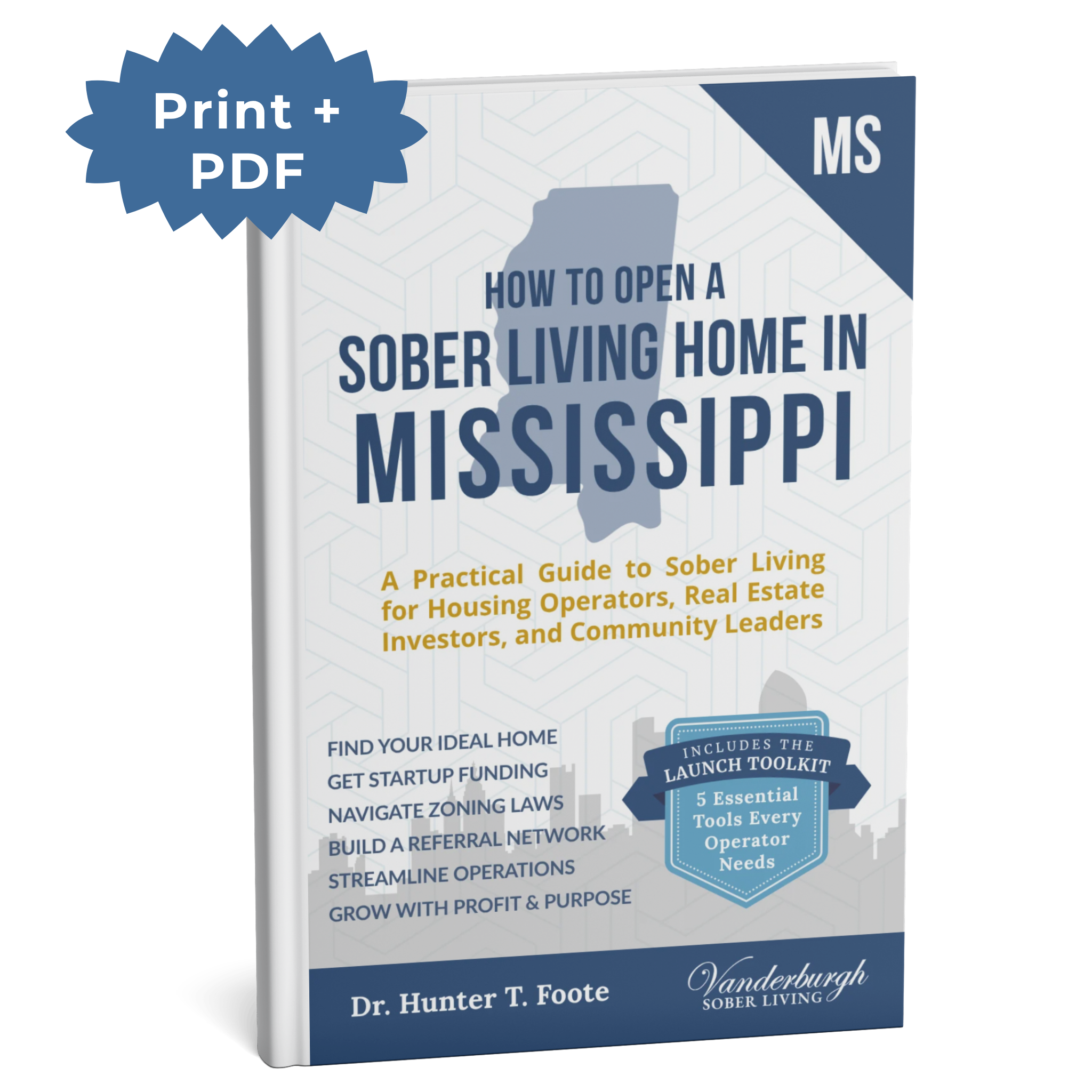
Everything we’ve learned about opening a certified home, written for Mississippi.
Start a Sober Living Home With VSL
Mississippi asks less of you at the front door than almost any state and gives less back once you are inside. No license gates your opening, no certifying body exists to validate the home, and no rent subsidy backs your residents, which puts the entire weight of credibility on your own standards, records, and relationships. Operators who succeed here decide early what standard they run by, write it down, and build the referral relationships that fill beds before the reserve runs out.
If you are working through the entity choice, the property search, or the referral plan for a Mississippi sober living home and want a second set of eyes on it, reach out to the Vanderburgh Sober Living team and tell us where you are in the process.
Learn How Sober Living Works
Understand how sober living works and whether operating is right for you before you commit.
Evaluate Your Property
See whether your property will pencil out with a custom Mississippi financial projection.
Build a Mississippi Home With VSL
Get hands-on startup, certification, and operating support and join the VSL Chartered Operator community.
Research & Sources
Research material and primary sources referenced in this guide:
- Foote, H. T. (2026). Vanderburgh Sober Living Operating Climate Index, 2026 Edition. Vanderburgh Sober Living.
- U.S. Census Bureau. QuickFacts: Mississippi.
- U.S. Census Bureau. American Community Survey 2024 5-Year Estimates, Table DP04: Selected Housing Characteristics.
- U.S. Census Bureau. American Community Survey 2024 1-Year Estimates, Table B25077: Median Value of Owner-Occupied Housing Units.
- U.S. Census Bureau. American Community Survey 2024 1-Year Estimates, Table DP04: Selected Housing Characteristics.
- Federal Housing Finance Agency. House Price Index, state-level purchase-only, quarterly.
- Freddie Mac. Primary Mortgage Market Survey, 30-year fixed average, week ending August 6, 2026.
- National Alliance for Recovery Residences. State Affiliate Organizations.
- National Alliance for Recovery Residences. NARR Standard and Levels of Care.
- Mississippi Department of Mental Health, Division of Certification. Provider Certification.
- Mississippi Department of Mental Health, Bureau of Alcohol and Drug Services. Alcohol and Drug Services.
- Mississippi Department of Mental Health. DMH Operational Standards, 2024 Edition.
- Mississippi Department of Mental Health. Adult Residential Bed Capacity.
- Mississippi Department of Mental Health. Certified Provider Directory.
- Mental Health Mississippi. Find Services.
- Mississippi Secretary of State, Business Services Division. Services and Fees Schedule.
- Mississippi Secretary of State. Business Services Filing Portal.
- Mississippi Secretary of State. Charities Division, Charitable Solicitation Registration.
- Mississippi Insurance Department, Office of the State Fire Marshal. Fire Code Enforcement.
- Mississippi Insurance Department, Office of the State Fire Marshal. Building Plan Review Request.
- Mississippi Code Annotated § 17-2-3, Building Codes Council; statewide minimum codes.
- Mississippi Code Annotated § 17-2-4, State Uniform Construction Code; exclusions.
- LegiScan. Mississippi HB 89 (2026 Regular Session), Mississippi Fair Housing Act.
- U.S. Department of Justice and U.S. Department of Housing and Urban Development. Joint Statement on Group Homes, Local Land Use, and the Fair Housing Act.
- U.S. Department of Justice, Civil Rights Division. United States v. City of Jackson (S.D. Miss.).
- U.S. Department of Justice. The ADA and Opioid Use Disorder.
- U.S. Department of Housing and Urban Development, Office of Policy Development and Research. Fair Market Rents.
- Substance Abuse and Mental Health Services Administration. 2023-2024 NSDUH State Prevalence Estimates.
- Mississippi Department of Revenue. Sales Tax Rates.
- City of Biloxi, Mississippi. Permit Fees.
- City of Gulfport, Mississippi. Building Permit Fees.
- Mississippi Attorney General. State-Local Government Opioid Settlement Memorandum of Understanding.
- Mississippi Attorney General. Opioid Settlement Fund Advisory Council.
- Mississippi Opioid Settlement Fund Advisory Council. Request for Grant Applications.
- Johns Hopkins Bloomberg School of Public Health. Opioid Settlement Expenditures: Mississippi.
- Mississippi Development Authority. Deploying SSBCI Funds for Small Business.
- Mississippi Small Business Development Center. SSBCI Technical Assistance.
- Mississippi Department of Employment Security. WIN Job Centers.
- Mississippi Department of Corrections. Reentry Resources.
- Open Doors Homeless Coalition. CHOICE Rental Assistance.
- U.S. Department of Veterans Affairs. Supportive Services for Veteran Families.
- Mississippi Board of Pharmacy. Naloxone Standing Order.
Pick Your Path
Find the next step that fits where you are right now.
Just getting startedLearn how sober living works and browse Mississippi resources.Already have a propertyEvaluate readiness and run a custom projection.Ready to go deeperGet hands-on startup, certification, and operating support.
Will Your Property Pencil Out?
Get a custom financial projection for your Mississippi sober living property, then compare it with single-family and multifamily returns.