
Opening a sober living home in Kansas means clearing fewer state hurdles than almost anywhere else. There is no state license for non-clinical recovery housing, no mandatory certification, and no state affiliate of the National Alliance for Recovery Residences to apply to. Kansas scores 6 out of 10 on the composite Operating Climate Score, 10 for legal climate, and 1 for certification value, and is classified as lightly regulated (Foote, 2026). Each step below applies the national roadmap for how to start a sober living home to the rules in Kansas.
An open legal lane paired with a missing credential system shapes every decision below, from the entity and the zoning question through the property, the policies, the insurance, the referrals, and the real Kansas numbers.
Quick Answers
Do you need a license to open a sober living home in Kansas?
No. A Kansas sober living home does not need a state license when it operates as non-clinical, peer-supported housing.
The Kansas Department for Aging and Disability Services (KDADS) behavioral health licensing program licenses five categories: residential care facilities, private psychiatric hospitals, substance use disorder treatment facilities, community mental health centers, and psychiatric residential treatment facilities. None describes a house where residents live, pay rent, follow house rules, and get clinical care elsewhere. Add counseling or medication management on site and you are in a licensed category instead.
Is certification required to open a sober house in Kansas?
No, and Kansas has no certifying body to certify with.
NARR’s affiliate directory lists no Kansas organization, and NARR does not certify individual recovery residences, leaving that to state affiliates. Kansas scores 1 for certification value (Foote, 2026), the floor of the ledger. The substitute is adopting NARR Standard 3.0 voluntarily and documenting it.
What are the biggest early risks?
Local zoning, occupancy limits, and building a rent roll on money that does not exist.
Kansas regulates recovery housing city by city, so the risk sits at city hall. Three failures cost the most:
- Misreading the occupancy cap: Wichita permits a sober living home as a Group Home occupied by not more than ten persons total, including eight or fewer persons with a disability and not to exceed two staff residents.
- Drifting into treatment: Clinical services on site move a house into a licensed category and attach the full fire code.
- Underwriting a subsidy that is not there: Kansas has no recovery-residence voucher, and KanCare does not pay room and board.
How long does it take to open a sober living home in Kansas?
There is no state application to wait on, so the property, the city, and the referral ramp set your calendar.
Closing or signing a lease, furnishing 14 beds, and answering a zoning question are the long poles. Filling beds decides year one: the model breaks even at 45% occupancy, about six of 14 beds.
Is a sober living home profitable in Kansas?
Yes, on a private-pay model with beds full.
A 14-bed home at $670 per bed each month, about $155 a week, produces an estimated $6,802 in monthly revenue against $3,350 in expenses: $3,452 in net income, a 51% margin, and $247 net per bed, or about 60% cash-on-cash against $68,783 of startup capital on the purchase path. Rent is the whole engine, with no per-bed government payment behind it.
- ✓Policies and house agreements to have signed
- ✓Inspections, insurance, and intake paperwork
- ✓What the first week actually requires
Do You Need a License to Open a Sober House in Kansas?
Kansas draws the line at care, not at the number of people under the roof. KDADS behavioral health licensing reaches substance use disorder treatment facilities, private psychiatric hospitals, residential care facilities, community mental health centers, and psychiatric residential treatment facilities. A peer-supported house that rents beds, runs house meetings, drug tests, and refers residents out for clinical services is not any of those things, and we found no Kansas licensing or registration requirement for non-clinical recovery residences as of August 2026.
That line is easy to cross by accident. Bringing a counselor on site to run groups, storing and administering medication for residents, or writing treatment plans starts to look like the licensed activity KDADS regulates, and Kansas has a second consequence attached: a house that stops being a plain dwelling loses the fire-code exemption described in Step 3. Keep clinical work referred out to a certified community behavioral health clinic or an outpatient provider, and keep the separation on paper.
The absence of a license is not the absence of rules. Enforcement runs through three doors instead: local zoning and code enforcement, the State Fire Marshal for anything that is not a one- or two-family dwelling, and fair-housing complaints under the Kansas Act Against Discrimination or the federal Fair Housing Act. Nobody inspects a Kansas recovery home for quality, which is exactly why documenting your own standard is worth the effort.
Four compliance points hold the non-clinical position:
- Write the service boundary down: State in your resident agreement and house policies that the home provides housing and peer support, not treatment.
- Refer clinical care out: Keep counseling, MAT prescribing, and assessment with licensed providers and record the referral relationships.
- Keep the dwelling classification: Operate in a single-family home or duplex and do not convert to a rooming-house or care use.
- Hold the occupancy line your city sets: In Wichita that is ten persons total under the Group Home category, and other cities set their own.
No recovery-residence license is on the table:HB 2314 in the 2025-26 session addresses peer-support specialist certification through KDADS, not recovery housing, and we found no Kansas bill creating a recovery-residence license as of August 2026.
Step-by-Step: Starting a Sober Living Home in Kansas
Nine steps take a Kansas home from an idea to a full house, and several look different here than in an affiliate state.
Step 1. Form the Right Business Entity
Your entity decides who lends to you and what happens if a resident sues, and the filing is cheap. The Kansas Secretary of State’s fee regulation, effective February 27, 2026, sets $75 for articles of organization for a domestic limited liability company, $75 for for-profit articles of incorporation, and $20 for a not-for-profit corporation, filed through the Secretary of State’s portal. Reports are biennial at $5 online or $25 on paper, about $2.50 a year, and nonprofits add charitable solicitation registration with the Kansas Attorney General.
Grant access here is not nonprofit-only, so do not pick a structure to reach it. Sunflower Foundation, which administers the state’s opioid-settlement grants, states that “eligibility for all KFA grant opportunities is limited to state entities, municipalities, nonprofit entities, and for-profit private entities that provide services in Kansas.” The nonprofit case rests on Kansas Housing Resources Corporation development capital, philanthropy, and charitable contributions instead. Decide before you acquire property; the capital stack and holding structure are hard to unwind later.
| Structure | Formation cost | Annual cost | Best for | Trade-off |
|---|---|---|---|---|
| LLC | $75 | $5 online biennially, about $2.50 a year | Owner-operators who want liability separation and simple taxes | No donor gifts, charitable contributions, or KHRC development capital |
| Nonprofit 501(c)(3) | $20 | $5 online biennially, about $2.50 a year | Operators pursuing LIHTC, HOME, and NHTF capital through KHRC, plus philanthropy | Board governance, no owner equity, federal exemption work on top of the $20 filing |
| S-Corp | $75 | $5 online biennially, about $2.50 a year | Operators paying themselves a salary from a larger portfolio | Payroll administration and stricter ownership rules |
| Sole proprietorship | No state filing | None | Nobody opening a recovery home | Personal assets exposed to house liability |
- Talk to a Kansas attorney and accountant before you file.
- Open a dedicated bank account so resident rent never mixes with personal money.
- Consider a two-entity structure: a holding company owning the real estate, an operating entity running the home.
Step 2. Review Zoning and Fair Housing Rules
Kansas is a home-rule state, so land use is where the real work happens. There is no statewide zoning of recovery residences, and the most detailed published framework belongs to Wichita, whose planning department regulates any arrangement of six or more unrelated people in one dwelling through three use categories: Group Home, Group Residence Limited, and Group Residence General.
The City of Wichita’s sober living homes and zoning guidance is the clearest statement of how a Kansas city thinks about this. Its Group Home category covers a Group Home occupied by not more than ten persons total, including eight or fewer persons with a disability and not to exceed two staff residents. A typical sober living home does not literally meet that definition, because the definition requires state licensure and no professional treatment or care is provided in the house. Wichita’s answer, following fair-housing case law, is to treat sober living homes as Group Homes by reasonable accommodation, and Group Homes are a permitted use in every residential and commercial district. Exceeding that requires Conditional Use approval as a “Group Residence,” which brings a public hearing. Keeping the home at eight or fewer residents is a separate discipline, aimed at holding the single-family dwelling classification and the fire-code exemption in Step 3.
Read the state statute carefully rather than assuming it protects you. K.S.A. 12-736 bars a municipality from prohibiting a group home in any zone where single-family dwellings are permitted, but its “group home” is a dwelling licensed by a state regulatory agency, and its definition of disability excludes current illegal use of or addiction to a controlled substance. In Keys Youth Services, Inc. v. City of Olathe, 248 F.3d 1267 (10th Cir. 2001), reported in the statute’s own case annotations, the Tenth Circuit held that a proposed juvenile group home did not meet that definition for disability discrimination purposes, which shows how narrow the statutory lane is.
The durable protection is the federal Fair Housing Act plus the state mirror at K.S.A. 44-1016, which makes it unlawful to refuse a reasonable accommodation in rules, policies, practices, or services when one is necessary to give a person with a disability equal use and enjoyment of a dwelling. Complaints run to the Kansas Human Rights Commission, and the same statute preserves the direct-threat exception as the narrow, individualized basis for removing a resident. An operator of the Manchester House in Kansas City, Missouri, sued after the board of zoning adjustments ruled against the home, asserting disability discrimination for the denial of an accommodation; that case sits on the Missouri side of the metro with no publicly reported disposition. Knowing how to go about requesting reasonable accommodation in writing, before a dispute hardens, is the best preparation available.
One Kansas classification trap deserves its own line. Wichita defines a Correctional Placement Residence as a home serving people with an obligation to law enforcement, including work release, parole housing, and court-ordered guidance for chemical dependence, and that use is not permitted in any residential district in the city. Referral mix therefore affects classification, so an operator taking corrections referrals should learn how their city draws the line and how determining maximum occupancy interacts with it.
Actions for this step:
- Pull your city’s zoning code and read the group-living definitions before you make an offer on a property.
- Ask the planning counter, in writing, how a sober living home is classified and keep the answer.
- Prepare a written reasonable-accommodation request template you can file the day a city pushes back.
Step 3. Choose a Property for a Sober House
The property sets your fire-code exposure, which makes it the most consequential choice in Kansas. There is no statewide building code for private buildings, so cities adopt their own IRC and IBC editions. The fire code is statewide, enforced by the State Fire Marshal, and local jurisdictions may only make it more stringent.
One exemption is why most Kansas recovery homes sit in ordinary houses. K.A.R. Article 22-1, the Kansas Fire Prevention Code, does not apply to buildings used wholly as dwelling houses containing no more than two families, and its code-footprint plan review excepts those dwellings too. Convert to a rooming house, multi-family arrangement, or care use and the full code attaches, with a sealed code-footprint submission for R-4 and institutional occupancies. The Fire Marshal’s code listing keys the general fire code to 2006 editions of the International Building Code, International Fire Code, and NFPA 101, so read sprinkler and alarm triggers against those editions. Kansas scores 10 for fire and building feasibility (Foote, 2026), the top of the ledger.
Classification follows use, not intent: residents capable of self-preservation with no staff-provided care read as an ordinary residential occupancy, while custodial care for more than five residents starts to read as R-4. That is why IRC vs. IBC is the conversation to have with a code official before a purchase. Kansas inventory supports the model, with a median single-family home near 2,020 square feet at roughly $137 per square foot and 97,222 units carrying five or more bedrooms.
- Confirm the adopted building-code edition with the building official before closing.
- Buy or lease a one- or two-family dwelling and keep it in that classification.
- Count bedrooms, bathrooms, and parking against your target bed count.
Step 4. Create House Rules, Intake Forms, and Resident Policies
Kansas has no recovery-housing-specific discharge or tenancy statute, and no state agency reviews your paperwork. Your documents are both your liability protection and your proof of a bona fide recovery residence if a city challenges it. Put five things in writing:
- Resident agreement: Rent, fees, length of stay, responsibilities, and the grounds and process for discharge.
- Substance-free environment: Testing protocol and how a return to use is handled.
- Medication policy: Kansas imposes no medication-storage or self-administration rule on non-clinical recovery residences, so set it yourself.
- Grievance process: With no certifying body to appeal to, an internal process matters more.
- Emergency procedures: Overdose response, naloxone on hand, after-hours contacts, none of it required by Kansas.
One policy carries real legal risk. Kansas has enacted nothing on residents taking medications for opioid use disorder, so federal law governs, and a categorical refusal to admit anyone prescribed methadone or buprenorphine is a disability-discrimination exposure under the ADA and the Fair Housing Act. SAMHSA’s review of housing options for people with opioid use disorder explains why individualized assessment holds up. Assess one resident at a time; do not write a ban.
Step 5. Secure Insurance for a Sober Living Home
Insurance is the line Kansas operators underestimate most, because a homeowner policy is cheap here and a recovery home does not run on one. The Insurance Information Institute puts the Kansas average annual homeowner premium at $1,491 as of 2021, while the model prices property coverage at $224 a month and general liability at $250, roughly $5,688 in year one. Four coverages belong in the file:
- Property coverage on the building and contents, written for the actual use.
- General liability covering resident and visitor injury claims.
- Professional or operations liability covering intake and discharge decisions.
- Workers’ compensation once you pay anyone.
Ask how wind and hail deductibles are calculated, because on the Plains that clause moves the cost of a claim more than the premium does, and tell the carrier plainly that the home is non-clinical recovery housing with unrelated adult residents. Sorting out sober house insurance first saves an underwriting round.
Step 6. Hire and Train Staff or House Leadership
A Level II home in Kansas runs on a house mentor who lives in the home, not a clinical staff roster. The Kansas model carries one mentor bed at $670 a month: you trade a rent-paying bed for the person who holds the culture. KDADS certifies a Kansas Certified Peer Mentor for substance use disorder, which in a state with no recovery-residence credential is one signal a referral source can verify.
- Define the role in writing: Responsibilities, authority, compensation, and what gets escalated.
- Train on the hard moments: Return to use, conflict between residents, and overdose response.
- Build a bench: Identify a second resident leader before you need one.
Step 7. Build Resident Referral Networks
This step carries the weight Kansas takes away from certification. With no certified-residence directory to be listed in, beds come one relationship at a time, and a handful of doors open onto most of the volume in the state.
- Heartland RADAC:The regional alcohol and drug assessment center is the statewide assessment and referral gateway, covering 76 of Kansas’s 105 counties.
- Certified community behavioral health clinics: Kansas was the first state to adopt the CCBHC model in legislation, and their discharge planners place people who need housing.
- Corrections and reentry:Kansas Department of Corrections reentry and the Kansas Supportive Housing for Offenders Program are motivated referrers, subject to Step 2’s zoning caveat.
- Treatment providers: SAMHSA counted 199 substance use treatment facilities in Kansas in its 2023 national survey.
- The peer network: Oxford House of Kansas and Friends of Recovery Association run the state’s densest recovery-housing network.
Work the referral sources that matter in your metro before you open. Reliability is the Kansas credential: answer the phone, take the placement, report back, repeat.
Step 8. Adopt a Recognized Standard and Pick a Credential Path
There is no Kansas certification to earn. NARR’s affiliate list includes Missouri, Oklahoma, and Colorado but not Kansas, and NARR does not certify individual residences, leaving that to state affiliates. No national direct-certification route exists for a single house, and no in-state application, fee, inspection, or renewal exists either. Three paths remain.
- Self-adopt NARR Standard 3.0:The national standard covers resident rights, a home-like environment, participative governance, recovery orientation, community relations, and a code of ethics. Self-assessing against it annually documents the bona fide recovery residence a fair-housing argument needs.
- Charter with a network: A charter is a membership agreement between a home and a private network whose standards it agrees to run by. It is not government permission and not third-party certification, and no agency issues or revokes it. Oxford House charters homes that are democratically self-run, financially self-supporting, and required to remove a resident immediately on a return to use, with no paid staff in the house. Vanderburgh Sober Living charters independently operated homes into a cooperative network, where the operator keeps ownership and gains the brand, the operating standards, and the startup support of the Chartered Operator community.
- Cross-certify out of state, with a caveat: The Missouri Coalition of Recovery Support Providers certifies recovery residences in Missouri, which matters for a Missouri-sited property in the Kansas City metro. Confirm directly with MCRSP before assuming it covers a Kansas-sited house.
Pick the matching level first: Level I is peer-run with no paid staff, Level II adds house rules and an owner-appointed house mentor, and Level III adds structured programming and credentialed staff, the intensity that raises licensing questions.
Step 9. Budget Startup Costs and Explore Kansas Funding
Kansas scores 9 for startup burden and 7 for return on capital (Foote, 2026). Startup lands at an estimated $68,783 on the purchase path and $15,815 on the lease path, detailed in the cost tables below.
Funding rests on the opioid settlement. Kansas is receiving more than $340 million over roughly 18 years, and K.S.A. 75-777 sends 75% of each deposit to the Kansas Fights Addiction Fund and 25% to the Municipalities Fight Addiction Fund, which makes a county commission a second, closer door. The state share runs through the Kansas Fights Addiction Grant Review Board with Sunflower Foundation as administrator, and the RFP-3 and RFP-4 award summaries show recovery housing funded repeatedly: Cardinal Housing Network at $168,900 in Douglas County, Be Able, Inc. at $112,040 in Riley County, Heartland RADAC at $98,742, and the Rotary Against Human Trafficking Foundation at $60,203 for up to four weeks of sober living housing for people leaving the Shawnee County jail.
Three 2026 Kansas Fights Addiction rounds, open to for-profit operators: $5 million for expanding medications for opioid use disorder at up to $500,000 a year for up to two years, $4,050,000 for peer support and community health workers, and $3 million through the rolling Responsive Grant Program, paused for 30 days on July 10, 2026 while the board refined eligibility.
Three other doors matter:
- State Opioid Response through a RADAC: SOR dollars pay for sober-living stays through subgrantees; the Kansas SOR brief reported 351 people living in recovery housing among 6,632 served in FY23, from October 1, 2022 through September 30, 2023.
- Oxford House revolving loan: The Kansas state association lends $4,000 and $6,500 to peer-run houses over two years, with dues of $7 per chartered bed per month.
- NetWork Kansas:StartUp Kansas gap financing reaches $45,000 per project and is open to for-profit businesses.
Plan around one hard limit. KanCare pays for services, never room and board, and Kansas has not adopted the Affordable Care Act Medicaid expansion: KDHE’s eligibility guidelines cover pregnant women, parents and caregivers of children under 19, people 65 and over, and people with disabilities, with no group for non-disabled adults without dependent children. Kansas scores 4 for resident-funding access (Foote, 2026), so resident wages plus grant-funded scholarship beds carry the rent roll.
What Does It Cost to Start a Sober Living Home?
Two numbers move a Kansas budget: the property, and how long the ramp to stable occupancy takes. Buying at the state’s adjusted recovery-home purchase price of $298,800 means a $59,760 down payment and a $1,511 monthly mortgage, and it builds equity. Leasing means $6,792 up front for three months on a $2,264 monthly lease and opens the doors for under a quarter of the capital. Size the reserve to the ramp: expenses run an estimated $3,350 a month, so three to six months is $10,050 to $20,100.
Whichever route you take, the property side of the deal is covered in our recovery housing real estate section: what to look for when buying a sober house, how sober house loans are underwritten, and what a landlord expects on a long term lease.
Kansas Market Snapshot by Metro
Demand and referral density cluster in eastern Kansas, and entry cost varies more across these five metros than anything else. Rent figures apply HUD’s rule of adding 15% of the four-bedroom Fair Market Rent per bedroom above four.
| Metro | Median home value (ACS 2024) | Rent, 5 to 6 bedrooms (HUD FY2026) | Referral density |
|---|---|---|---|
| Kansas City (Wyandotte County) | $167,400 | $2,418 to $2,734 | High: Heartland RADAC, Wyandot Behavioral Health Network, KDOC reentry |
| Overland Park (Johnson County) | $413,600 | $2,418 to $2,734 | Moderate: Johnson County Mental Health, dense private-pay market |
| Wichita | $190,800 | $2,052 to $2,319 | High: largest city, published zoning guidance, F.O.R.A. outreach |
| Topeka | $144,200 | $1,623 to $1,834 | Moderate: Family Service and Guidance Center, Shawnee County reentry |
| Lawrence | $292,700 | $2,280 to $2,578 | Moderate: Bert Nash CMHC, DCCCA, funded women’s housing network |
Sources: HUD Fair Market Rents for FY2026, with Wichita figures published by the City of Wichita, and ACS 2024 5-Year DP04 for median owner-occupied home value. Kansas City and Overland Park share one HUD rent area, so their rent ranges match while home values do not.
Kansas Startup Cost Breakdown
Figures below are estimated from the Kansas cost model, scaled to the state’s cost of living index of 87.6 for the first quarter of 2026, as published by the Missouri Economic Research and Information Center.
| Cost category | Lease path | Purchase path | Kansas note |
|---|---|---|---|
| Entity formation | $75 | $75 | Single Secretary of State fee; $20 for a nonprofit corporation |
| Lease upfront or down payment | $6,792 | $59,760 | Three months at $2,264 (the statewide average HUD FY2025 three-bedroom Fair Market Rent of $1,415 plus a 60% recovery-housing premium), or 20% of a $298,800 purchase |
| Furniture and setup | $7,008 | $7,008 | Beds, common areas, and appliances for 14 residents |
| Utility deposits | $526 | $526 | Electric, gas, water, and internet |
| Supplies and linens | $1,051 | $1,051 | First stock of bedding, kitchen, and cleaning supplies |
| Marketing and launch | $438 | $438 | Listings, signage, and referral outreach materials |
| Certification and state license fees | $0 | $0 | No Kansas license or certification to buy |
| Estimated total | $15,815 | $68,783 | Before the operating reserve below |
| Operating reserve, three to six months | $10,050 to $20,100 | $10,050 to $20,100 | Three to six months at $3,350 in monthly expenses |
Most Kansas operators land between roughly $26,000 and $90,000 all in. Two categories surprise people: insurance, at an estimated $474 a month across property and general liability, and the reserve, since no per-bed government payment bridges the ramp. Building a sober living pro forma first shows which path your capital supports.
Kansas City Guides
Local rules differ city to city in a home-rule state, and the gap between Wichita’s published Group Home cap and another city’s silence changes your timeline.
Sober Living Guides Every Operator Needs
These evergreen guides apply in every state and cover the fundamentals every recovery housing operator should know.
About the Book: How to Open in Kansas
Vanderburgh Sober Living operates the largest network of Level II recovery housing in the United States, supported by the Vanderburgh Foundation, a 501(c)(3) charitable foundation.
Founder Dr. Hunter T. Foote has written more than 30 operator titles, including the Kansas volume, which covers these nine steps at book length with the forms and checklists for year one.
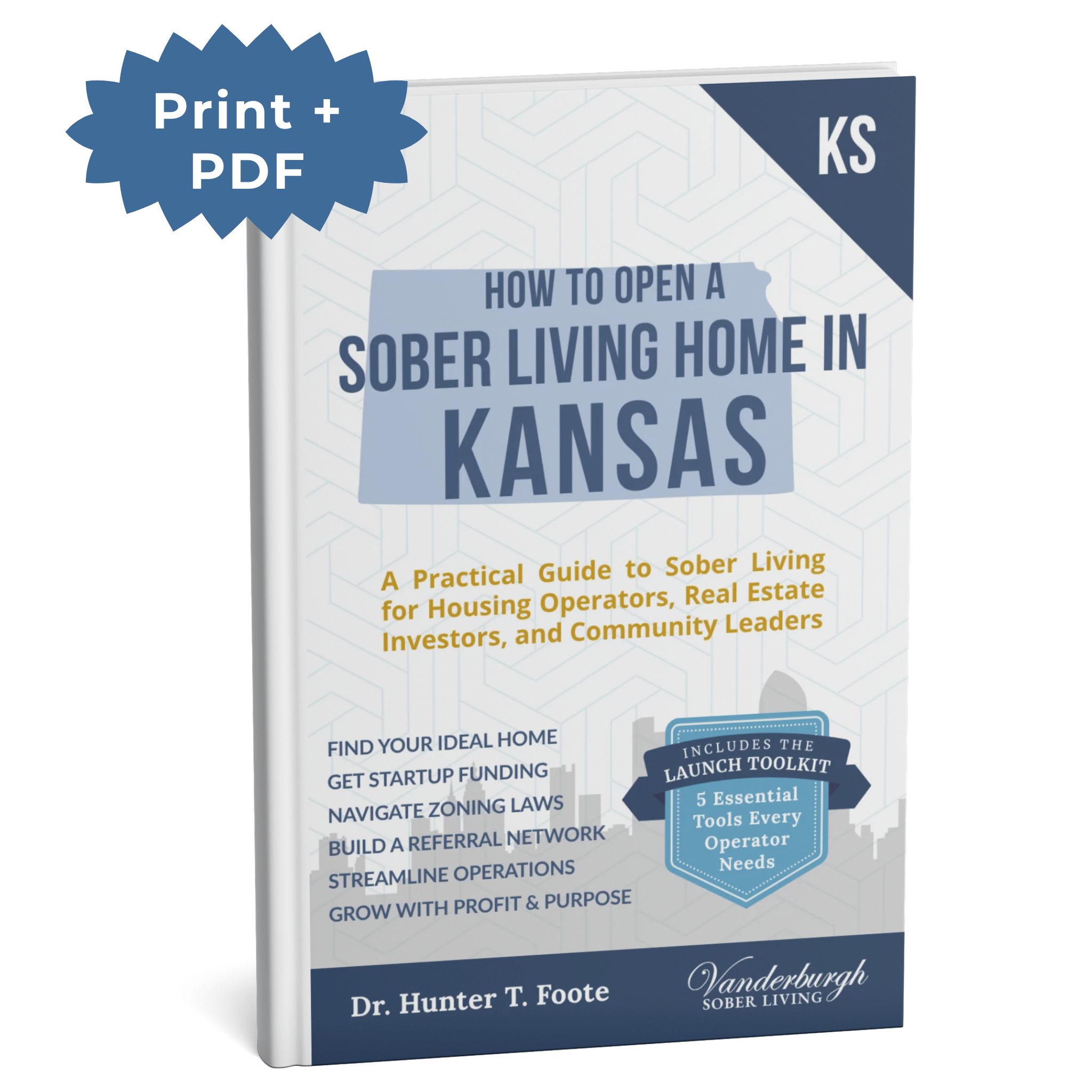
Everything we’ve learned about opening a certified home, written for Kansas.
Start a Sober Living Home With VSL
Kansas asks less of a new operator than almost any state: no license, no certification, no application fee, and a fire code that leaves an ordinary house alone. What it withholds is a credential to point at and a payer to bill, so the outcome rests on the property, the city, the paperwork, and the calls that fill beds. Whether you are comparing metros, reading a zoning code, or lining up a first referral partner, we can help. Contact Vanderburgh Sober Living to talk through your plan.
Learn How Sober Living Works
Understand how sober living works and whether operating is right for you before you commit.
Evaluate Your Property
See whether your property will pencil out with a custom Kansas financial projection.
Build a Kansas Home With VSL
Get hands-on startup, certification, and operating support and join the VSL Chartered Operator community.
Research & Sources
Research material and primary sources referenced in this guide:
- Foote, H. T. (2026). Vanderburgh Sober Living Operating Climate Index, 2026 Edition. Vanderburgh Sober Living.
- Kansas Department for Aging and Disability Services, Behavioral Health Licensing.
- Kansas Office of Revisor of Statutes, K.S.A. 12-736, Group Homes.
- Kansas Office of Revisor of Statutes, K.S.A. 44-1016, Kansas Act Against Discrimination.
- Kansas Office of Revisor of Statutes, K.S.A. 75-777, Kansas Fights Addiction Fund.
- City of Wichita, Sober Living Homes and Zoning.
- Kansas State Fire Marshal, K.A.R. Article 22-1, Kansas Fire Prevention Code.
- Kansas State Fire Marshal, Code Listing.
- Kansas Secretary of State, Kansas Register Volume 45, Issue 7, Business Filing Fees.
- Kansas Attorney General, Kansas Fights Addiction Act Grant Review Board.
- Sunflower Foundation, Kansas Fights Addiction Grant Program.
- Kansas Department of Health and Environment, KanCare Eligibility Guidelines.
- National Alliance for Recovery Residences, Affiliates.
- U.S. Department of Housing and Urban Development, Fair Market Rents.
- U.S. Census Bureau, American Community Survey 2024 5-Year Estimates, DP04 and DP05.
- Substance Abuse and Mental Health Services Administration, 2023 N-SUMHSS State Profiles.
- U.S. Census Bureau, State population totals and components of change: 2020–2025, Vintage 2025 (July 1, 2025 estimates)
Pick Your Path
Find the next step that fits where you are right now.
Just getting startedLearn how sober living works and browse Kansas resources.Already have a propertyEvaluate readiness and run a custom projection.Ready to go deeperGet hands-on startup, certification, and operating support.
Will Your Property Pencil Out?
Get a custom financial projection for your Kansas sober living property, then compare it with single-family and multifamily returns.