Opening a sober living home in Idaho starts from an unusually open position. Idaho does not license non-clinical recovery housing, there is no state registry, and there is no recovery-residence credential to earn. What Idaho does have is a state statute that treats a supervised home of eight or fewer residents as a single-family dwelling, a sprinkler exemption that keeps renovation costs down, and two contracting networks that decide whether public dollars ever reach your beds. The steps below cover entity formation, zoning and Fair Housing, property selection, house policies, insurance, house leadership, referrals, the network contract that stands where certification would sit in most other states, and a startup budget built from Idaho figures rather than national averages. Each step below applies the national roadmap for how to start a sober living home to the rules in Idaho.
Quick Answers
Do you need a license to open a sober living home in Idaho?
No. Idaho licenses clinical substance use disorder treatment, not housing.
Idaho Code §39-302(19) classifies “safe and sober housing” as a nonclinical recovery support service, which places it outside the treatment-licensing track that the Idaho Department of Health and Welfare (IDHW) Division of Behavioral Health administers for residential treatment, detoxification, partial hospitalization, and intensive outpatient services. As of August 2026 we found no Idaho statute or administrative rule requiring a license, permit, or registration to operate a home that provides housing and peer accountability only.
Is certification required for an Idaho recovery residence?
There is no certification to require, and none to earn.
The National Alliance for Recovery Residences (NARR) affiliate directory lists no Idaho affiliate, and NARR does not certify individual residences directly, so there is no recovery-residence credential an Idaho operator can obtain. The functional substitute is a contract, not a credential: enrollment in the BPA Health Safe & Sober Housing network, credentialing into Magellan of Idaho, and voluntary self-adoption of the NARR Standard 3.0 as a quality posture.
What are the biggest early risks?
Crossing the clinical line and outgrowing the eight-resident zoning shield.
Adding on-site treatment moves the home into IDHW’s licensed-treatment track and into a fire and building classification that carries sprinklers, commercial alarms, and State Fire Marshal plan review. Going above eight residents gives up the protection of Idaho Code §67-6531 and leaves the home relying on federal Fair Housing Act accommodation alone against local occupancy caps.
How long does it take to open a sober living home in Idaho?
Roughly 60 to 120 days from entity filing to first resident, in most Idaho markets.
Entity formation with the Idaho Secretary of State is same-week online. The variable stretches are property search, any safety work the house needs, and building the referral relationships that actually fill beds. Operators who plan to serve publicly funded residents should add time for network enrollment, since BPA Health reports a one to three week turnaround on funding approval once a resident is screened.
Is a sober living home profitable in Idaho?
A 14-bed Idaho home modeled at $735 per bed per month produces an estimated $3,170 in monthly net income.
That estimate assumes an 18% vacancy factor, one bed given to the house mentor, a purchased property carrying a mortgage, and no paid clinical staff. It works out to a 42% net margin against $7,493 in monthly revenue and $4,322 in monthly expenses, with break-even occupancy at 51% of beds. Idaho’s cost side is close to the national middle, with a cost-of-living index of 101.7, ranking 33rd in the first quarter of 2026.
- ✓Policies and house agreements to have signed
- ✓Inspections, insurance, and intake paperwork
- ✓What the first week actually requires
Do You Need a License to Open a Sober House in Idaho?
Idaho draws its regulatory line at clinical services, not at the front door. A home that provides a substance-free residence, house rules, peer accountability, and referrals to outside treatment sits outside state licensure entirely. A home that delivers counseling, medication management, detoxification, or any structured treatment on site becomes a treatment facility and falls under IDHW licensure. The statutory hook is Idaho Code §39-302, last amended in 2025, chapter 178, which places “safe and sober housing” inside the definition of recovery support services, defined as ancillary, nonclinical services a person needs to maintain recovery. The distinction is functional: what happens inside the house decides which side of the line the house lands on.
Foote (2026) gives Idaho a composite Operating Climate Score of 6, classifies the state as lightly regulated, and rates its mandatory operating license status as none. Idaho scores 10 for legal climate and 10 for fire and building feasibility, the top band on both, and 8 for market strength. That standing is real, but it is not the whole picture. The same Index scores Idaho’s certification value at 1, because no recovery residence credential is obtainable from any source here, so there is no credential-gated referral advantage to capture. Resident-funding access scores 4 and operator-funding access scores 5, which is the honest counterweight to the easy entry.
- The clinical line: Keep treatment off site and document that residents receive clinical care from outside providers.
- Local zoning and occupancy: Confirm your city’s definitions before you sign anything, since city codes differ sharply from one another.
- Fire and building code: Stay in the residential classification by keeping resident count and care level below the escalation thresholds.
- Funding-network standards: If you want publicly funded residents, BPA Health’s Safe & Sober Housing requirements function as your operating rulebook.
Step-by-Step: Starting a Sober Living Home in Idaho
These nine steps run in the order an Idaho operator actually encounters them. Each one carries the Idaho specifics that change the answer, including the dated code and land-use changes from 2025 and 2026 that alter how a home is sited and built.
Step 1. Form the Right Business Entity
Idaho entity formation is cheap and fast. The Idaho Secretary of State’s business filings office charges $100 to file a Certificate of Organization online for an LLC, or $120 on paper, and $100 online to file Articles of Incorporation for a corporation. Nonprofit incorporation costs $30 online or $50 on paper. Annual maintenance is close to nothing: the annual report is free when filed online and $20 on paper, and Idaho has no statewide charitable-solicitation registration.
Most single-house operators start with an LLC taxed as a pass-through. Operators planning to pursue Idaho Housing and Finance Association HOME or National Housing Trust Fund capital, foundation grants, or Supportive Services for Veteran Families sub-awards should look hard at a nonprofit structure or a nonprofit sister entity, because those capital sources are effectively nonprofit-gated while the Magellan and BPA service-billing routes are open regardless of tax status. Many Idaho operators hold the real estate in one entity and the operating business in another, so a resident dispute or an operating liability does not reach the property.
| Structure | Formation cost | Annual cost | Best for |
|---|---|---|---|
| LLC | $100 online / $120 paper | $0 online / $20 paper | Single-house operator, private-pay or network-billed |
| Nonprofit corporation | $30 online / $50 paper | $0 online / $20 paper | Grant and foundation capital, IHFA programs |
| S-Corp election | $100 online (corporation filing) | $0 online / $20 paper | Multi-home operator paying themselves a salary |
| Sole proprietorship | $25 online assumed-name filing | None | Rarely appropriate, no liability separation |
- File online: The online Certificate of Organization is $20 cheaper and clears in days rather than weeks.
- Split property from operations: Hold the real estate in one entity and run the home from another.
- Decide the tax-status fork early: It determines which capital sources are open to you.
Step 2. Review Zoning and Fair Housing Rules
Idaho gives small recovery homes an unusually strong state-level protection, built from two statutes rather than one. Idaho Code §67-6531 provides that for any zoning law, ordinance, or code, “single family dwelling” includes any group residence in which eight or fewer unrelated persons with disabilities or elderly persons reside and are supervised in connection with their disability, plus up to two resident staff. Idaho Code §67-6532(2)-(3) then supplies the prohibition: no conditional use permit, zoning variance, or other zoning clearance may be required of a qualifying group residence that is not required of a single-family dwelling in the same zone, and no local ordinance or spacing restriction may be applied to it that is not applied to a single-family dwelling in the same zone.
City codes still differ underneath that shield. Boise’s zoning code allows a dwelling unit to be occupied by up to five unrelated individuals, while its separate household definition extends to groups protected by the Fair Housing Act with no numeric cap. Coeur d’Alene §17.02.055(B) caps unrelated occupancy at four persons generally but allows eight or fewer unrelated persons who are handicapped or elderly. Nampa’s Title 10, Chapter 1, updated in December 2025, makes a group residence a permitted use anywhere a residential use has been entitled, with no numeric cap in the current text. Federal law sits on top of all of it: the joint DOJ and HUD statement on group homes, local land use, and the Fair Housing Act establishes that municipalities must consider reasonable accommodation requests, and the Department of Justice resolved a 2003 case against the City of Payette by consent decree after the city refused to allow a group home for people in recovery.
- Confirm the city definition first: Pull the actual unrelated-persons and household language before you sign a lease or purchase agreement.
- Size to the shield: Eight or fewer residents keeps §67-6531 available in every Idaho jurisdiction.
- Put accommodation requests in writing: Ninth Circuit case law expects operators to use the city’s own procedure, and requesting reasonable accommodation is a documented process, not an argument.
- Know the state complaint route: The Idaho Human Rights Commission handles housing discrimination under Idaho Code §67-5909.
Step 3. Choose a Property for a Sober House
In Idaho, property selection is mostly a code-classification decision. Idaho’s adopted building codes are the 2018 International Building Code and the 2018 International Residential Code as amended into the Idaho Residential Code, and the fire code is the 2018 International Fire Code administered by the Idaho State Fire Marshal. The Idaho Building Code Board held a public hearing in August 2025 on moving to the 2024 editions, and the 2018 editions remain in force. A home that provides housing and peer support but no custodial or personal care is generally treated as a dwelling; providing personal care to six to 16 occupants pushes the property toward Group R-4 with enhanced alarms, sprinklers, and plan review.
The financial consequence is direct. Idaho Code §39-4116(3), last amended in 2026, chapter 320, exempts all single-family homes and multiple-family dwellings up to two units from any code provision requiring automatic fire sprinklers. A home that stays a dwelling cannot be forced to sprinkler; a home that escalates loses that exemption and takes on the retrofit cost. The same statute makes building-code enforcement a local option, so which office issues your permits varies by city while the substantive code stays uniform statewide. The distinction between IRC vs. IBC classification is the single largest swing factor in an Idaho renovation budget.
- Target four to six bedrooms: Idaho’s housing stock supports it, with roughly 230,000 four-bedroom-plus units statewide.
- Confirm classification with the building official early: Classification is fact-specific and locally determined.
- Check parking and driveway capacity: Neighbor complaints in Idaho recovery-housing disputes start with street parking more often than with anything else.
Step 4. Create House Rules, Intake Forms, and Resident Policies
Idaho imposes no state content requirements on house rules, which means your documents are doing all the work. There is no Idaho statute governing medication storage or self-administration in non-clinical homes, and no recovery-housing-specific discharge or tenancy law, so resident agreements and general contract and landlord-tenant principles govern. Medication policy deserves particular care: under the ADA as applied to opioid use disorder, use of prescribed methadone, buprenorphine, or naltrexone under clinical supervision is not illegal drug use, and excluding someone from housing on that basis creates federal liability. Idaho has no statute that changes this.
- Admissions and testing: Written criteria, drug and alcohol testing policy, and a medication-supportive stance applied consistently.
- Daily operations: Guest and curfew rules, chores, fees, and the meeting or accountability expectation.
- Exit: A written grievance procedure and a documented discharge process, since no Idaho statute supplies one.
Step 5. Secure Insurance for a Sober Living Home
Insurance is the line item Idaho operators most often underestimate. A sober living home needs general liability coverage, property coverage written for the actual use rather than a standard owner-occupied policy, and, once anyone is paid, workers’ compensation. The VSL operating model budgets $3,250 per year in general liability premium for a 14-bed Idaho home, which lands at roughly $275 per month, and applies an uplift over a standard homeowners premium on the property side because carriers price group residential use above single-family use. Disclose the use to the carrier in writing: a policy written for a single-family rental and later found to cover a congregate recovery residence is the failure mode that ends homes.
- General liability: Roughly $3,250 per year at 14 beds in the Idaho model.
- Property: Written for group residential use, not a standard homeowners form.
- Workers’ compensation: Required once you have employees, such as a paid part-time operator.
Step 6. Hire and Train Staff or House Leadership
A Level II home in Idaho runs on a house mentor, a resident with sustained recovery time who lives in the home, holds the standard, and handles day-to-day accountability. That is a leadership role, not a clinical one, and it does not imply around-the-clock staffing. House mentors typically receive free or reduced rent in exchange for the role, which is how the Idaho model treats one of the 14 beds. Staffing expectations change if you take public dollars: BPA Health’s Safe & Sober Housing standards call for staff availability to residents around the clock, daily site visits, a designated housing coordinator who may be off site, a certified home inspection for each location, and dated weekly staff safety inspections.
- Choose the tier before you hire: Safe & Sober and Enhanced Safe & Sober differ mainly in the staffing model.
- Document the inspections: Dated weekly safety records are a funding-network expectation, not a formality.
- Train for the role you named: A house mentor holds standards and escalates; they do not deliver treatment.
Step 7. Build Resident Referral Networks
Idaho has no statewide coordinated-entry portal for recovery housing, so placement is regional and relationship-driven. That favors operators who show up in person. Idaho counted 98 substance use treatment facilities in SAMHSA’s 2023 National Substance Use and Mental Health Services Survey state profile, a small enough number that an operator can build a named relationship with every relevant discharge planner in their region within a year. Working several channels at once is what protects occupancy when any one of them slows down.
- Drug and treatment courts:Idaho Supreme Court treatment courts operate in every judicial district.
- Corrections and reentry:Idaho Department of Correction reentry services run five Community Reentry Centers.
- Clinical discharge planners: Outpatient clinics inside the BPA Health and Magellan networks, concentrated in the Treasure Valley and Coeur d’Alene.
- Regional boards: Idaho’s seven regional behavioral health boards are where local gaps get documented.
Step 8. Contract Into the BPA Health Safe & Sober Housing Network
In most states this step reads “get certified.” In Idaho there is nothing to get certified by, so the step is a contract instead. NARR’s affiliate directory lists no Idaho affiliate, and NARR does not certify individual residences directly, so no recovery-residence credential exists for an Idaho operator to earn. Waiting for one is the most common strategic error in this market.
What exists instead are two separate networks, and an operator serving publicly funded residents generally needs both. BPA Health is the state’s managed services contractor, administering substance use disorder funding for the Idaho Department of Correction, the Idaho Supreme Court’s treatment courts, and the Department of Juvenile Corrections, and its Safe & Sober Housing network is the gate through which justice-referred housing dollars flow. Magellan of Idaho manages the Idaho Behavioral Health Plan and credentials the providers who deliver Safe & Sober Housing and Enhanced Safe & Sober Housing. Neither is a certification. The quality signal you can control is voluntary: the NARR Standard 3.0 defines four residence levels and six social-model domains, and self-adopting it gives an Idaho home a defensible quality posture without any certifier involved. A charter network is a third option: Oxford House and Vanderburgh Sober Living are the two established examples of independent homes operating under shared standards and support rather than a state credential.
- Apply to both networks: BPA Health for justice-referred beds, Magellan of Idaho for plan members.
- Never market a credential: Describe network membership as a contract, because that is what it is.
- Self-adopt the NARR Standard 3.0: Document against it and follow the NARR Code of Ethics as your quality posture.
Step 9. Budget Startup Costs and Explore Idaho Funding
Idaho’s public funding picture is honest about its limits. Medicaid, administered through the Idaho Behavioral Health Plan, reimburses clinical treatment and peer and recovery-coaching services but does not pay recovery-residence room and board. Resident rent leans instead on Safe & Sober Housing and Enhanced Safe & Sober Housing, which Magellan of Idaho describes as funded through Other State Funds, requiring pre-authorization, and available only until funding runs out. Treat that stream as a supplement, never as the base case.
The larger pool is settlement money. Idaho’s opioid settlement award totals approximately $120 million paid over 18 years under the Idaho Attorney General’s intrastate allocation agreement, split 40% to the state-directed fund, 40% to local governments, and 20% to public health districts. The Attorney General’s settlement page reports $73,176,709 received to date, and the Idaho Behavioral Health Council runs the annual proposal cycle for the state share. Recovery housing is an approved abatement use, but the state share reaches operators indirectly through funded agency programs rather than as a direct grant. Operator-facing opportunities are posted on IDHW’s behavioral health funding opportunities page, and Idaho’s State Opioid Response grant explicitly funds sober living activities through Magellan-network providers.
- Budget the reserve separately: $12,967 covers three months of the modeled $4,322 in operating expenses.
- Do not model Medicaid room and board: It does not exist in Idaho.
- Watch the local settlement shares: County and health-district processes are separate from the state cycle.
What Does It Cost to Start a Sober Living Home?
The first budget decision is lease or buy, and in Idaho it swings the total by roughly $91,000. Leasing gets a home open on a fraction of the capital, and the statewide average HUD three-bedroom Fair Market Rent of $2,015 keeps the lease path reachable, though recovery-suitable properties with five or more bedrooms lease well above that. Buying costs far more up front, builds equity, and removes the risk of a landlord declining to renew once neighbors start asking questions. The second decision is reserve size, because homes do not fill on day one and undercapitalizing the reserve is the most common reason first-time homes close in their first year. Idaho’s cost base helps: the MERIC cost-of-living index of 101.7 in the first quarter of 2026 sits near the national average, and per capita personal income of $64,846 in 2025 supports a private-pay rent tier alongside publicly funded beds.
Whichever route you take, the property side of the deal is covered in our recovery housing real estate section: what to look for when buying a sober house, how sober house loans are underwritten, and what a landlord expects on a long term lease.
Idaho Market Snapshot by Metro
| Metro | Median home price | Avg. weekly rent per bed | Demand |
|---|---|---|---|
| Boise | $500,000–$750,000 | $185–$215 | High |
| Meridian | $525,000–$775,000 | $185–$215 | High |
| Nampa | $400,000–$550,000 | $160–$185 | Moderate |
| Caldwell | $375,000–$525,000 | $155–$180 | Moderate |
| Coeur d’Alene | $500,000–$725,000 | $175–$205 | Moderate |
| Idaho Falls | $350,000–$500,000 | $150–$175 | Moderate |
| Twin Falls | $325,000–$450,000 | $145–$170 | Low |
| Pocatello | $300,000–$425,000 | $140–$165 | Low |
Idaho Startup Cost Breakdown
| Cost category | Estimated range |
|---|---|
| Furniture and setup | $8,136 |
| Certification and registration fees | $0 |
| Utility deposits | $610 |
| Supplies and linens | $1,220 |
| Marketing and launch | $509 |
| Fixed startup subtotal | $10,475 |
| Lease upfront, lease path | $9,672 |
| Down payment, purchase path | $100,888 |
| Estimated total, lease path | $20,147 |
| Estimated total, purchase path | $111,363 |
Every fixed line above is scaled to Idaho’s cost-of-living index of 101.7, and the certification line is $0 because no Idaho credential exists to pay for. Three real costs sit outside those totals and should be budgeted separately: entity formation at $100 to file online with the Secretary of State, renovation and safety work that is property-specific, and a three-month operating reserve of $12,967 based on the modeled $4,322 in monthly operating expenses. The model’s purchase input is an Idaho median sale price of $467,073 as of May 2026 plus an 8% recovery-housing premium, giving an adjusted purchase price of $504,439, a 20% down payment of $100,888, and a monthly mortgage of $2,551 over 30 years at 6.5%; the lease path assumes three months upfront at an estimated $3,224, the statewide average HUD FY2025 three-bedroom Fair Market Rent of $2,015 plus a 60% recovery-housing premium. For public-authority context, the American Community Survey puts the median value of owner-occupied Idaho housing units at $418,600, a different measure than a current sale price and not an input to the model. Market-snapshot rent and price figures are estimated bands anchored to the statewide HUD FY2025 three-bedroom Fair Market Rent average of $2,015 and to the modeled statewide rate of $170 per bed per week.
Idaho City Guides
Idaho’s recovery housing demand concentrates in eight cities, and conditions in each differ enough to change an operator’s plan. The Treasure Valley cluster of Boise, Meridian, Nampa, and Caldwell holds the densest supply and the deepest referral base. Coeur d’Alene anchors the north, Idaho Falls and Pocatello serve the east, and Twin Falls covers the Magic Valley. Statewide, the Idaho Behavioral Health Council has identified less-restrictive step-down housing as the priority gap, which is precisely the space a well-run Level II home occupies.
- Boise, ID · Largest market, deepest referral base, most competition
- Meridian, ID · Fastest-growing Treasure Valley submarket, newer stock, higher prices
- Nampa, ID · Strong demand, lower entry cost, most permissive group-residence language
- Caldwell, ID · Lowest Treasure Valley entry cost, same regional referral network
- Coeur d’Alene, ID · North Idaho’s clinical anchor, four-person general unrelated cap
- Idaho Falls, ID · Underserved eastern market, active regional behavioral health board
- Twin Falls, ID · Magic Valley hub with a BPA Health office, limited existing supply
- Pocatello, ID · Thin supply, low acquisition cost, recovery community center presence
Sober Living Guides Every Operator Needs
These evergreen guides apply in every state and cover the fundamentals every recovery housing operator should know.
About the Book: How to Open in Idaho
Vanderburgh Sober Living operates the largest network of Level II Chartered sober living homes in the country, supported by the Vanderburgh Foundation, a 501(c)(3) charitable foundation. That operating base is where this material comes from: real homes, real occupancy, and real conversations with referral partners and building officials.
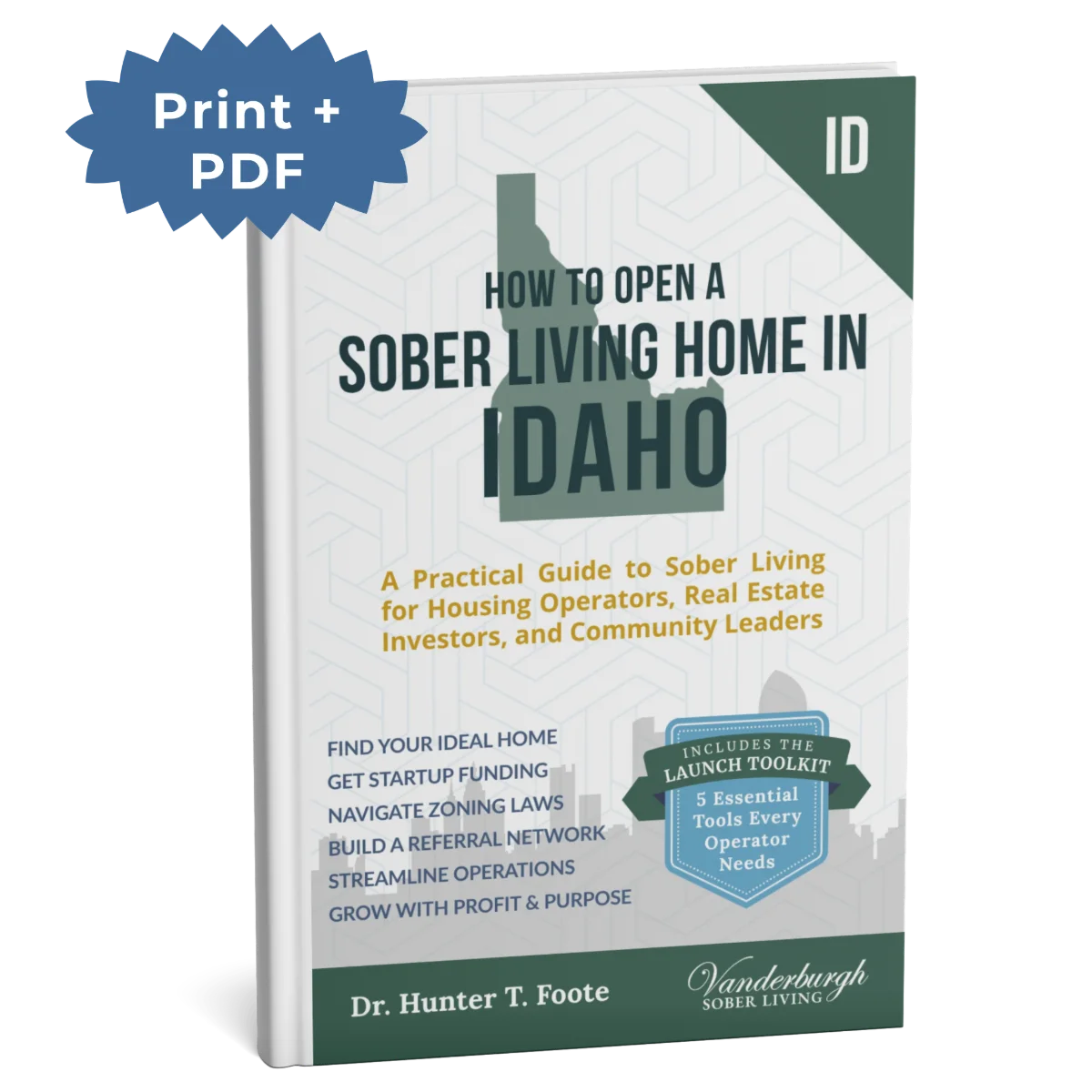
How to Open a Sober Living Home in Idaho is written by Dr. Hunter T. Foote, founder of Vanderburgh Sober Living, and it works the same nine steps this page outlines at book length: entity formation and the Idaho filing fees, the §67-6531 zoning shield and the city codes underneath it, the §39-4116(3) sprinkler exemption and what breaks it, house policies, insurance, house leadership, referral building, the BPA Health and Magellan network contracts that stand where certification sits elsewhere, and a startup budget built on Idaho figures.
Everything we’ve learned about opening a certified home, written for Idaho.
Start a Sober Living Home With VSL
Idaho asks less of a new operator at the front door than almost any state and gives less back in the way of credentials, referrals, and reliable rent support. That trade favors operators who build quality deliberately: size the home to the eight-resident zoning shield, keep the property a dwelling, write policies that hold up without a regulator forcing them, and treat the BPA Health and Magellan networks as contracts to earn rather than certifications to wait for. To talk through your Idaho property, market, and timeline with someone who has done it, reach out to the VSL team.
Learn How Sober Living Works
Understand how sober living works and whether operating is right for you before you commit.
Evaluate Your Property
See whether your property will pencil out with a custom Idaho financial projection.
Build an Idaho Home With VSL
Get hands-on startup, certification, and operating support and join the VSL Chartered Operator community.
Research & Sources
Research material and primary sources referenced in this guide:
- Foote, H. T. (2026). Vanderburgh Sober Living Operating Climate Index, 2026 Edition. Vanderburgh Sober Living.
- Idaho State Legislature — Idaho Code §67-6531, Single Family Dwelling
- Idaho State Legislature — Idaho Code §67-6532, Group Residence Zoning Prohibitions
- Idaho State Legislature — Idaho Code §39-4116, Local Enforcement and Sprinkler Exemption
- Idaho State Legislature — Idaho Code §39-302, Alcoholism and Intoxication Treatment Act Definitions
- Idaho State Legislature — Idaho Code §67-5909, Idaho Fair Housing Law
- Idaho Department of Health and Welfare — Division of Behavioral Health, About Substance Use Disorder Services
- Idaho Department of Health and Welfare — Behavioral Health Provider Funding Opportunities
- Idaho Department of Health and Welfare — Idaho’s State Opioid Response
- Idaho Office of the Attorney General — Opioid Settlement
- Idaho Office of the Attorney General — Intrastate Allocation Agreement FAQs
- Idaho Behavioral Health Council — Idaho Opioid Settlement Fund
- Idaho Secretary of State — Business Filing Forms and Fees
- Idaho Division of Occupational and Professional Licenses — Idaho Adopted Codes, 2025 Update
- Idaho State Fire Marshal — Statutes, Rules, Codes and Standards
- Idaho Human Rights Commission — Housing Discrimination
- Idaho Supreme Court — Treatment Courts
- Idaho Department of Correction — Reentry Services
- National Alliance for Recovery Residences — State Affiliate Directory
- National Alliance for Recovery Residences — NARR Standard 3.0
- U.S. Department of Justice and U.S. Department of Housing and Urban Development — Joint Statement on Group Homes, Local Land Use, and the Fair Housing Act
- U.S. Department of Justice, Civil Rights Division — Housing Cases Summary, United States v. City of Payette
- ADA.gov — The ADA and Opioid Use Disorder
- SAMHSA — 2023 N-SUMHSS State Profiles
- SAMHSA — 2023-2024 NSDUH State Prevalence Estimates
- U.S. Census Bureau — American Community Survey 2024 5-Year, Idaho DP05
- U.S. Census Bureau — American Community Survey 2024 5-Year, Idaho DP04
- U.S. Department of Housing and Urban Development — Fair Market Rents
- Federal Reserve Bank of St. Louis — Per Capita Personal Income in Idaho
- Missouri Economic Research and Information Center — Cost of Living Data Series
- Magellan of Idaho — Covered Services for Adults
- Magellan of Idaho — Join the Network
- BPA Health — Substance Use Disorder Support for Idaho
- BPA Health — Join Our Network
- City of Boise — Zoning Code, Household and Dwelling Definitions
- City of Coeur d’Alene — Municipal Code §17.02.055
- City of Nampa — Title 10, Chapter 1, General Provisions, updated December 16, 2025
- U.S. Census Bureau, State population totals and components of change: 2020–2025, Vintage 2025 (July 1, 2025 estimates)
Pick Your Path
Find the next step that fits where you are right now.
Just getting startedLearn how sober living works and browse Idaho resources.Already have a propertyEvaluate readiness and run a custom projection.Ready to go deeperGet hands-on startup, certification, and operating support.
Will Your Property Pencil Out?
Get a custom financial projection for your Idaho sober living property, then compare it with single-family and multifamily returns.