Minnesota is entering a major shift in recovery housing policy, and operators who act early will be best positioned as changes take hold. The voluntary DHS certification program, established under Special Session Law 2025, offers a clear framework to organize policies, safety practices, resident expectations, and referral processes ahead of the January 1, 2027, effective date. Whether you already operate a sober house in Minnesota or plan to open one, understanding these requirements is a critical step right now. DHS certification runs alongside the national framework that governs how to certify a sober house through a NARR affiliate.
What Is DHS Sober Living Certification in Minnesota?
The Minnesota Department of Human Services Certified Recovery Residence Program is a voluntary state certification program that reviews how a sober living home operates, how it supports residents, and how it manages its policies and safety practices. It is not a clinical licensing program, and certification does not transform a Minnesota sober house into a treatment facility. The program is grounded in Minnesota Statutes §§254B.21 through 254B.216, which were enacted through the 2025 special legislative session.
Certification under this program signals to residents, families, courts, and treatment providers that a sober living home in Minnesota meets established standards in four broad areas:
- Resident rights and protections, including the formal Minnesota Resident Bill of Rights
- Physical safety and emergency preparedness
- Written operational policies that are consistent and documented
- Financial practices that protect residents from exploitation
One detail that matters immediately: beginning January 1, 2027, the terms “sober home” and “recovery residence” become legally protected titles in Minnesota. Only operators who meet the statutory definition of a recovery residence may use either phrase in advertising, marketing, or public communications. Operators who want to use those terms and access Housing Support Program funding need to understand what the DHS certification program requires.
Audit every web page, directory listing, and printed flyer that calls your home a “sober home” or “recovery residence.” If the home does not meet Minnesota’s statutory definition by January 1, 2027, change the wording or plan to certify before that date.
How to Certify a Sober Living Home in Minnesota With DHS
Getting ready for DHS certification is best understood as a readiness process rather than a single filing event. The program involves an application submission, a policy and documentation review, and an initial on-site inspection conducted by the Commissioner of Human Services. Preparing in advance means your application moves efficiently and your on-site inspection reflects an operation that is already running well.
Before starting, operators may benefit from understanding the two certification levels the program establishes, reviewing every written policy the sober living home maintains, and confirming that all resident documents are consistent with what Minnesota law now requires. Here is where most operators begin:
- Identify whether the sober living home qualifies as a Level 1 or Level 2 residence
- Confirm the property owner has provided written permission to operate if the space is leased
- Verify that background checks are completed for the operator and all staff
- Confirm insurance coverage meets the program’s minimum thresholds
- Gather all resident-facing documents in one organized location
- Decide who within the organization will serve as the primary operator responsible for compliance

The state-specific playbook covering certification, zoning, and setup from start to finish.
Minnesota DHS Certification Steps, Levels, and Renewal
The DHS certification process moves in a defined sequence: application submission, review, on-site inspection, and issuance of a proof of certification. Certification is valid for three years from the date of issuance, and the Commissioner conducts an on-site review at the three-year mark to determine whether renewal is appropriate. Operators also carry an ongoing obligation to report changes in staffing, services, or quality assurance procedures within 15 days of those changes occurring.
Two certification levels exist under the program:
| Level | How the home is run | Staffing | Extra records DHS expects |
|---|---|---|---|
| Level 1 | Peer-run: residents make all decisions | No paid staff or operators work or live in the residence | Standard policies, resident documents, and signed code of ethics |
| Level 2 | Staff-managed: trained staff model and teach recovery skills | Trained staff on site | Written job descriptions, staff performance development policies, and annual staff training records |
Written Policies DHS Reviews Before Certifying a Sober Home
Written policies are central to both the application process and the on-site inspection. If your Minnesota sober house does not have documented policies in key areas, the certification process surfaces those gaps early. Reviewing your house rules and your broader policy library before applying is one of the most practical things an operator can do.
Policies that the certification process may scrutinize include:
- Residency termination procedures, including how the length of stay is determined and what happens in the event of an eviction
- Medication access and storage policies, including written standards for prescribed pharmacotherapies approved for opioid use disorder
- Drug screening procedures, if the program uses toxicology testing
- Refund policies and the fee schedule provided to residents
- Person and room search procedures
- Policies prohibiting financial exploitation and requiring the separation of resident funds from program funds
What May DHS Review During the Certification Process?
The on-site inspection and application review are not limited to paperwork. The Commissioner has the authority to access the physical facility, speak with residents and staff, and review operational records in detail. Operators who understand the breadth of what may be reviewed are better prepared to present an operation that is consistent from the front door to the filing cabinet.
Operational areas that may receive attention during the process include:
- Whether the Minnesota sober house complies with local ordinances governing maximum occupancy, fire safety, and sanitation, including fire safety codes applicable to residential settings
- Whether the residence maintains a supply of an opiate antagonist and has trained staff in its use
- Whether the residence posts emergency procedures in common areas and maintains community crisis resource contacts, including the 988 Lifeline
- Whether resident rights documents, the grievance process, and the resident bill of rights are posted and distributed to incoming residents
- Whether the operator has confirmed zoning compliance and that the property’s use is consistent with applicable local land use rules
- Whether all owners, operators, staff, and volunteers have read and signed the code of ethics aligned with the requirements in the statute
- Whether the residence can demonstrate, through documentation, that residents arriving on day one received orientation to emergency procedures, house rules, refund policies, and their rights
How Can DHS Certification Support Referrals and Community Trust?
Certification through the Minnesota Department of Human Services creates a consistent, documented basis for communicating with courts, treatment centers, healthcare providers, and county agencies. It does not guarantee referrals, but it gives referral sources a concrete, verifiable reason to recommend a sober living home in Minnesota to the people they serve.
Consider what certification communicates to the people and organizations a Minnesota sober house interacts with regularly:
- Courts and probation departments have documented evidence that the home meets minimum standards for safety and structure
- Treatment centers and discharge planners can point to state certification as a quality indicator when placing clients in need of post-treatment housing
- Family members and prospective residents have access to publicly posted inspection results, since the Commissioner is required to make certification review outcomes publicly available on the DHS website
- County and tribal agencies, which previously managed Housing Support Program agreements, will interact with certified residences directly through DHS beginning January 1, 2027
- Community neighbors and local officials have a formal accountability structure to reference when questions arise about how the sober living home is managed
How Can Operators Prepare Documentation for DHS Certification?
Operators prepare by making sure that what a Minnesota sober house already does is written down, organized, and accessible when the Commissioner’s office reviews the application or conducts an inspection. Operators who organize documents in advance tend to move through the process with less friction.
The broad categories of documentation that certification requires include:
- Written policies for each area specified in Minnesota Statutes Chapter 254B
- Resident-facing forms covering medications, drug testing, return-to-use, refunds, and evictions
- Proof of insurance at the minimum thresholds required by the program
- Completed background check documentation for the operator and all staff
- Signed code of ethics documentation from all persons associated with the operation
Resident Documents Minnesota Requires on Day One
Resident-facing documents are the materials that residents receive on or before their first day in the sober living home. Minnesota law requires that certified residences maintain signed documentation confirming each resident received these materials, which means this paperwork needs to be standardized, consistently executed, and retrievable on request.
Key resident documents to prepare include:
- The Minnesota Resident Bill of Rights, formatted for distribution and posting
- A written financial agreement describing fees, refund policies, and any third-party payment arrangements
- Relapse policies and resident rules, reviewed for clarity and consistency with operations
- A service description that accurately reflects what the sober house provides
Operational Records to Keep Ready for DHS Inspection
Operational records demonstrate that the sober living home runs consistently over time, not just during a review.
Operational records to organize include:
- Written job descriptions for each staff position in Level 2 residences, with responsibilities and qualifications documented
- Policies and procedures for staff performance development in staff-managed homes
- Documentation showing that residents were linked to community resources such as job search programs, education, family services, and health care
- Records of referrals made for residents seeking additional services
- Emergency resource contact lists, including mental health crisis services and the 988 Lifeline
- Contact information for each resident’s emergency contacts, retained in the resident file
- Documentation of incidents reported in compliance with applicable reporting obligations
- Records confirming that annual staff training was completed, for Level 2 residences
What Certification Mistakes Can Minnesota Sober House Operators Avoid?
The certification process surfaces operational problems that might otherwise go unnoticed until they become compliance issues. Operators who understand common preparation mistakes can address them proactively, before they slow down an application or generate follow-up requirements from the Commissioner’s office.
Mistakes that frequently create friction during certification preparation include:
- Maintaining policies that exist on paper but are not reflected in day-to-day operations, creating a gap that an on-site inspection can expose
- Failing to document that residents received orientation materials on or before their first day of residency, which the statute requires certified residences to demonstrate
- Allowing medication policies to be vague or silent on prescribed pharmacotherapies, including medications for opioid use disorder, which the statute explicitly protects
- Overlooking the insurance requirements before submitting an application, since proof of coverage is a required submission document
- Skipping background checks for all staff and volunteers, not just the primary operator
- Using the terms “sober home” or “recovery residence” in marketing without confirming the home meets the statutory definition, particularly once title protection takes effect on January 1, 2027
- Failing to establish a process for reporting changes in staffing, services, or quality assurance procedures to the Commissioner within the 15-day window the statute provides
- Treating the code of ethics as a one-time signature form rather than an ongoing standard that all persons associated with the operation understand and follow
- Assuming that certification for one location automatically extends to additional homes opened after the initial certification is issued
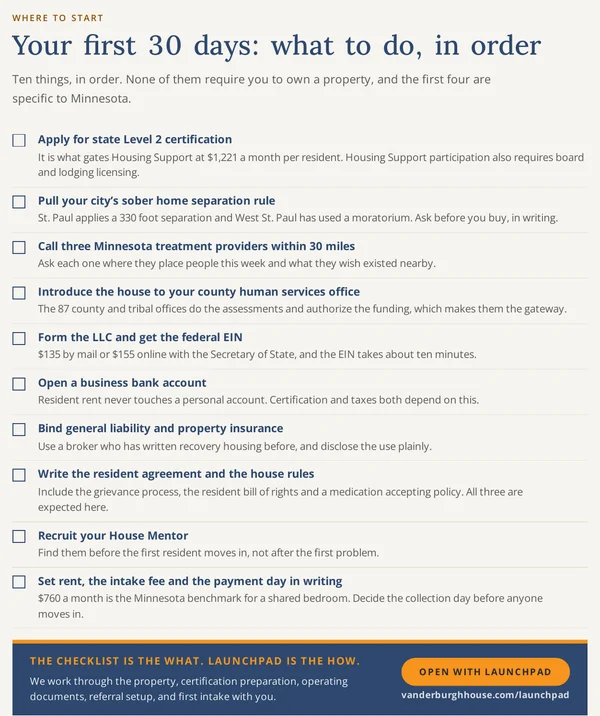
Most people ask whether they are allowed to open a recovery home. The better first question is whether the need and the money are there. This answers both, for your state.
- How many people need a bed, and how few beds exist
- Who actually pays the rent, and which programs are real
- What it costs to open on the purchase path and the lease path
Frequently Asked Questions About Minnesota DHS Sober Living Certification
When should I start preparing for Minnesota DHS certification?
Starting early gives you time to align policies, organize documents, and fix gaps before applying. Since the effective date is January 1, 2027, early preparation helps avoid delays and inspection issues. Operators who begin now typically move through the process more smoothly.
Do I need certification for every sober living property I operate?
Yes, certification applies to each individual location. Even if one property is certified, new or additional homes require their own application and review. Each site must independently meet all standards.
How long does DHS certification last once approved?
Certification is valid for three years from the date it is issued. After that period, an on-site review is conducted to determine if renewal is appropriate. Ongoing compliance is required during that time.
What happens if my policies do not match daily operations?
Any gap between written policies and actual practices can create problems during inspection. Reviewers look for consistency across documentation and real-world operations. Aligning both ahead of time reduces the risk of delays or follow-up requirements.
How does certification affect relationships with referral sources?
Certification gives courts, treatment providers, and agencies a clear standard to rely on. It helps them feel more confident recommending your program. While it does not guarantee referrals, it strengthens credibility and trust.
Next Steps to Certify a Minnesota Sober House With DHS
The January 1, 2027, effective date gives operators a meaningful window to prepare, and the operators who use that time well will be the ones who move through the certification process with the least friction. Getting your sober living home in Minnesota certification-ready now is a practical investment in the long-term stability of your operation.
Vanderburgh Sober Living works with operators across the country who are building structured, accountable sober living homes. If you want support preparing for DHS certification in Minnesota, reach out to our team to start the conversation.
Support for every stage
Pick the level of support that fits where you are.
Just getting startedSee how the sober living opportunity works and what starting with VSL looks like.LaunchpadGuided pre-launch program: one-on-one strategy, Academy training, weekly coaching, and templates.MasteryHands-on startup, certification, and operating support inside the Chartered Operator community.Questions first? Call (844) 762-3747, weekdays 8a to 5p.
Research & Sources
- Foote, H. T. (2026). Vanderburgh Sober Living Operating Climate Index, 2026 edition. Vanderburgh Sober Living. https://www.vanderburghhouse.com/research/operating-climate-index-2026/
- Minnesota Department of Human Services. (2025). Side-by-side legislative changes 2025: Recovery residences. https://mn.gov/dhs/assets/Recovery%20Residences_tcm1053-699185.pdf
- Minnesota Office of the Revisor of Statutes. (2025a). Minnesota Statutes, section 254B.211: Recovery residence requirements and resident rights. https://www.revisor.mn.gov/statutes/cite/254B.211
- Minnesota Office of the Revisor of Statutes. (2025b). Minnesota Statutes, section 254B.213: Certification. https://www.revisor.mn.gov/statutes/cite/254B.213
- Minnesota Office of the Revisor of Statutes. (2025c). Minnesota Statutes, section 254B.214: Monitoring and oversight of certified recovery residences. https://www.revisor.mn.gov/statutes/cite/254B.214
- Minnesota Office of the Revisor of Statutes. (2025d). Minnesota Statutes, section 254B.215: Certification levels. https://www.revisor.mn.gov/statutes/cite/254B.215