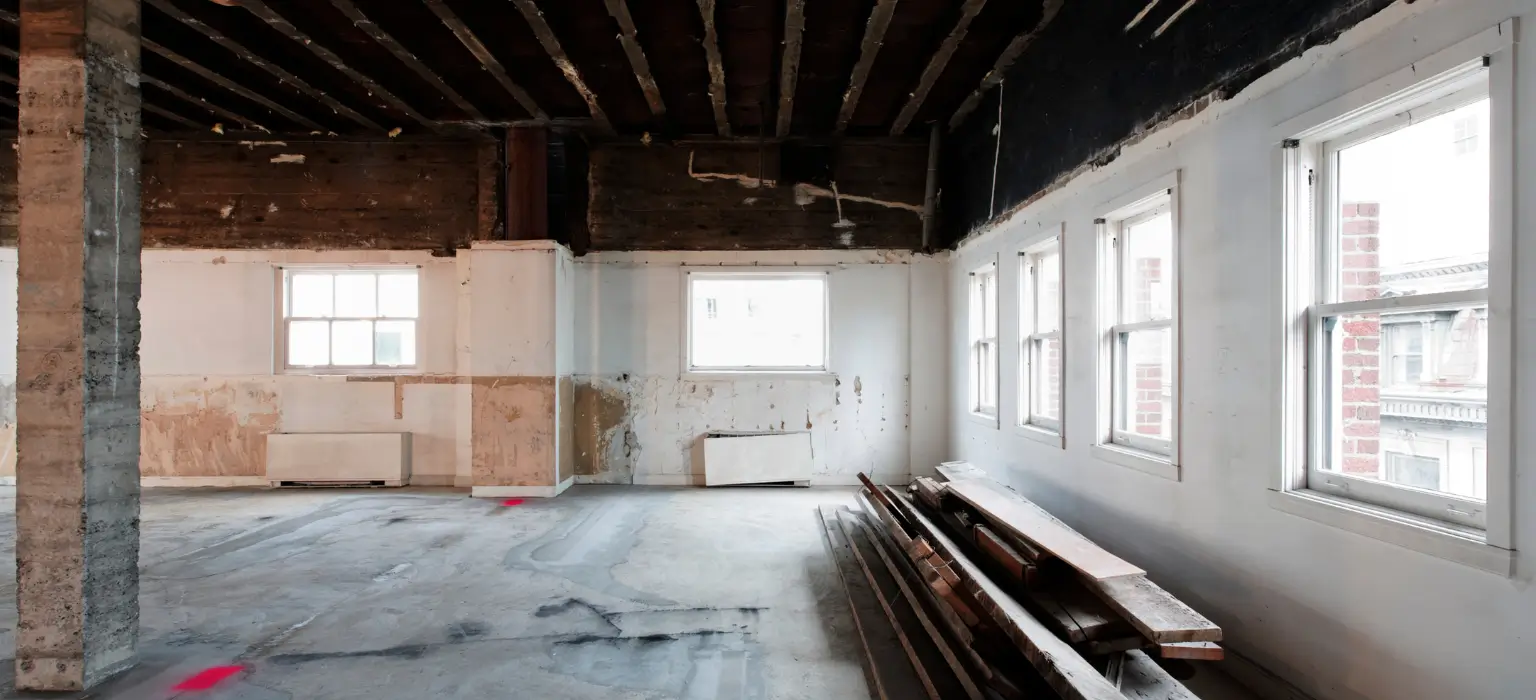
A church coming up at auction, a vacant storefront on a main street, a small office building priced below the houses around it. Operators keep bringing these buildings, and the arithmetic looks excellent until the code review starts. Anyone planning to convert commercial building to sober living housing is buying a change of use, not a renovation, and that distinction sets the budget.
A house that becomes a recovery residence stays a dwelling. A church that becomes a recovery residence changes what the building legally is, and the building code treats that as a new question about the whole structure. Four things follow from it, and all four cost money.
What Change of Use Means for a Commercial Building
Change of use is a formal reclassification of a building from one occupancy group to another, and it is the mechanism that governs every conversion in this post. New York’s Department of State explains the general process for a change of occupancy classification, where the building must be evaluated against current requirements for the new use rather than grandfathered on the old one.
Buildings arrive in this process carrying a classification from their previous life.
| Building you are buying | Current classification | What the conversion has to overcome |
|---|---|---|
| Church or place of worship | Group A-3, assembly | Large open volume, assembly egress design, and a use that zoning often treats as institutional |
| Storefront or retail | Group M, mercantile | Street-front glazing, no residential plumbing or separation, and commercial-only zoning |
| Small office building | Group B, business | Open floor plates without bedroom egress, and parking standards written for daytime use |
| Existing apartment building | Group R-2, residential | The lightest path, since it is already residential and often already sprinklered |
The target classification matters as much as the starting one. IBC Section 310 places residential care arrangements serving five or fewer people in Group R-3, and supervised residential care for more than five and not more than 16 occupants, excluding staff, in Group R-4. R-4 is constructed to R-3 standards while carrying additional administrative requirements, and crossing 16 occupants, or housing residents who could not respond to an emergency without assistance, pushes the building further into classifications with substantially heavier obligations.
A house conversion keeps the building in the same occupancy group. A church, storefront or office conversion changes the group, and the building code evaluates the whole structure against current requirements for the new use. That is the entire cost difference between the two projects.
Why the IRC Argument Gets Harder Here
Operators converting houses often make a well-founded argument that a recovery residence should be reviewed under the residential code rather than the commercial building code. That argument is materially weaker for a building that was never residential, and the reason is the residential code’s own scope.
IRC Section R101.2 scopes the code to detached one- and two-family dwellings and townhouses not more than three stories above grade plane with a separate means of egress. The scope is defined by what the building is, not by how it will be used. A former sanctuary or retail space does not meet that description, and adding residents does not bring it inside the scope.
The residential code also has no change of occupancy mechanism, because it was not written to govern one. That function belongs to the building code and the existing building code. That argument holds for a house being converted. It does not survive the move to a building that was never a dwelling.
Keep reading Applying the International Residential Code (IRC), not the IBC, to Sober Living Homes When the residential code governs a recovery residence, and when it does not. →Sprinklers: The Line Item That Decides the Deal
The single largest cost in most commercial conversions is fire suppression, and it is close to unavoidable once the reclassification lands.
IBC Section 903.2.8 requires that an automatic sprinkler system be provided throughout all buildings with a Group R fire area. Wisconsin’s Department of Safety and Professional Services reproduces the provision in its fire suppression enforcement guidance. Unlike most occupancy groups in Section 903.2, the residential trigger carries no minimum building size and no occupant threshold.
Do not assume a residential sprinkler exemption carries over. Many states amend the sprinkler requirement out of the residential code for single-family homes, but that relief lives in a code the converted commercial building cannot use.
Price the water supply before the sprinkler heads. A building on an undersized service line may need a new tap, a larger main or a fire pump, and those costs are site-specific and can exceed the sprinkler system itself. This is a question for a fire protection engineer during due diligence, not after closing. The wider property evaluation belongs in a due diligence checklist before an offer goes in.
The filter we use before we ever call an agent: what makes a property work as a Level II home, the zoning and occupancy questions to ask before you tour, and the red flags that should end a showing in five minutes.
Get the guide free →When a Conversion Triggers Accessibility Obligations
Purely residential recovery housing is governed by the Fair Housing Act rather than by ADA Title III. A converted commercial building is likelier to cross into obligations a single-family conversion never reaches, for three reasons.
- Unit count: The Fair Housing Act’s design and construction requirements reach buildings with four or more dwelling units first occupied after March 13, 1991, per the HUD and DOJ joint statement on accessibility. Detached houses, duplexes and triplexes are outside that rule, and a subdivided commercial building may not be.
- First occupancy: A gut renovation of a non-residential shell can be treated as producing a building with a first occupancy date after 1991, which an adapted older house generally is not.
- Services delivered: A residence delivering a significant level of social services can be treated as a place of public accommodation under ADA Title III, a distinction the Department of Justice draws in its Title III technical assistance manual.
The practical implication is that program design and building design interact here. A property that stays residential in substance, with occupancy agreements and long stays, sits more comfortably under fair housing rules than one structured around short stays and on-site programming.
Financing a Building That Is Not Yet Residential
Conventional residential mortgage products are underwritten against a property’s current legal use and classification. A building still classified and assessed as commercial does not meet those criteria regardless of what it will become, which removes the cheapest financing from the table at exactly the moment the renovation budget is largest.
The realistic paths are commercial: a bank term loan, a construction-to-permanent facility, or bridge financing refinanced once the certificate of occupancy reflects the new use. The SBA 504 program permits the purchase, construction or renovation of existing buildings and currently caps a 504 loan at $5.5 million, while excluding speculation or investment in rental real estate, so an owner-operated model and a passive landlord model are treated very differently. Confirm eligibility and the owner-occupancy threshold with a certified development company before underwriting a deal around it. Residential sober house financing runs on different rules, so price a conversion against a house purchase before committing.
Zoning, and What to Do With a Denial
A change of use almost always requires a zoning approval, and that is where recovery housing conversions most often stall. A commercial parcel may not permit residential use at all, which turns the project into a rezoning or a conditional use application heard in public.
Federal law constrains how that discretion is exercised. In City of Edmonds v. Oxford House, 514 U.S. 725 (1995), the Supreme Court held that the Fair Housing Act’s exemption for maximum occupancy restrictions does not cover a zoning rule defining who may compose a family, leaving such rules subject to the Act. The 2016 HUD and DOJ joint statement on land use adds that a jurisdiction must modify rules as a reasonable accommodation unless doing so would impose an undue financial and administrative burden or fundamentally alter its zoning scheme.
Build the record as you go. Put the accommodation request in writing before a decision, not after it, because the obligation only attaches once the jurisdiction is on notice. Requesting reasonable accommodation is the mechanism, and sober living zoning protections apply at the land use stage.
Keep reading The Federal Fair Housing Act and Sober Living: Everything You Need to Know The federal protections every operator, neighbor, and local official should understand. →A conversion that clears zoning and classification is a building project. One that does not is a legal project, and the two need very different budgets.
What would your property do?
Start with the numbers, or start the conversation.
Run a custom income projectionFree calculator: see the numbers for your specific property. Get the investor book seriesDr. Foote’s guides to buying, financing, and upfitting recovery housing. Talk to VSL about your propertyExplore leasing to a vetted operator, no operating required.Or call (844) 762-3747, weekdays 8a to 5p.
Get those answers in writing during due diligence, while walking away is still cheap.
Educational only; not legal, financial, or medical advice. Figures and rules reflect conditions as of mid-2026 and change. Confirm current requirements and consult qualified professionals.
Frequently Asked Questions About Commercial Conversions for Recovery Housing
Can you turn a church into a sober living home?
Yes, but not under the residential code. A church is classified as assembly, so the conversion runs through a change of occupancy to a residential group under the building code. That path usually brings sprinklers, accessibility review and a zoning approval that a house conversion never triggers.
Why does the IRC-not-IBC argument fail for a commercial building?
Because the residential code is scoped to detached one- and two-family dwellings and townhouses. A former church or storefront was never built as one, so it falls outside that scope. Changing the use does not change what the building is, and the building code governs the conversion.
Will converting a commercial building trigger a sprinkler requirement?
Usually yes. IBC Section 903.2.8 requires an automatic sprinkler system throughout any building with a Group R fire area, with no small-building exception. Once the property is reclassified to residential under the building code, that requirement applies and is typically the largest single cost.
What is the difference between R-3 and R-4 classification?
Headcount and supervision. R-3 covers residential uses including care arrangements serving five or fewer people. R-4 covers supervised residential care for more than five and not more than 16 occupants, excluding staff. R-4 is built to R-3 standards but carries additional administrative requirements.
Does a recovery residence have to be ADA accessible?
Purely residential recovery housing is governed by the Fair Housing Act rather than ADA Title III. A converted commercial building is more likely to cross into ADA coverage, and into the Fair Housing Act’s design and construction rules, once it has four or more dwelling units.
Can a city deny a change of use permit for recovery housing?
A city can apply neutral standards, but a denial aimed at housing for people with disabilities can violate the Fair Housing Act. Under the 2016 HUD and DOJ joint statement, a jurisdiction must consider a reasonable accommodation unless it would impose an undue burden or fundamentally alter its zoning scheme.
Pricing the Conversion Before You Bid
Three answers decide whether a commercial building works as recovery housing, and all three are available before an offer: what the zoning permits, what classification the building department will assign, and what a fire protection engineer says about water supply. A building that clears those three is often a genuine bargain. One that clears two is where operators lose deposits. If you are looking at a church, a storefront or a small commercial building and want the conversion priced before you bid, tell us about the property.
Research and Sources
- Minnesota Office of the Revisor of Statutes. Minnesota Rules 1305.0310: Group R (adopted International Building Code, Section 310). https://www.revisor.mn.gov
- International Code Council. International Residential Code, Section R101.2: Scope. https://www3.iccsafe.org
- Wisconsin Department of Safety and Professional Services. Fire Suppression Enforcement (International Building Code Section 903.2.8). https://dsps.wi.gov
- New York State Department of State. Change of Use or Change of Occupancy Classification. https://dos.ny.gov
- U.S. Department of Justice. ADA Title III Technical Assistance Manual. https://archive.ada.gov
- U.S. Department of Housing and Urban Development & U.S. Department of Justice. (2013). Joint Statement on Accessibility (Design and Construction) Requirements for Covered Multifamily Dwellings. https://www.justice.gov
- U.S. Department of Housing and Urban Development & U.S. Department of Justice. (2016). Joint Statement on State and Local Land Use Laws and Practices and the Application of the Fair Housing Act. https://www.justice.gov
- City of Edmonds v. Oxford House, Inc., 514 U.S. 725 (1995). https://tile.loc.gov
- U.S. Small Business Administration. 504 Loans. https://www.sba.gov