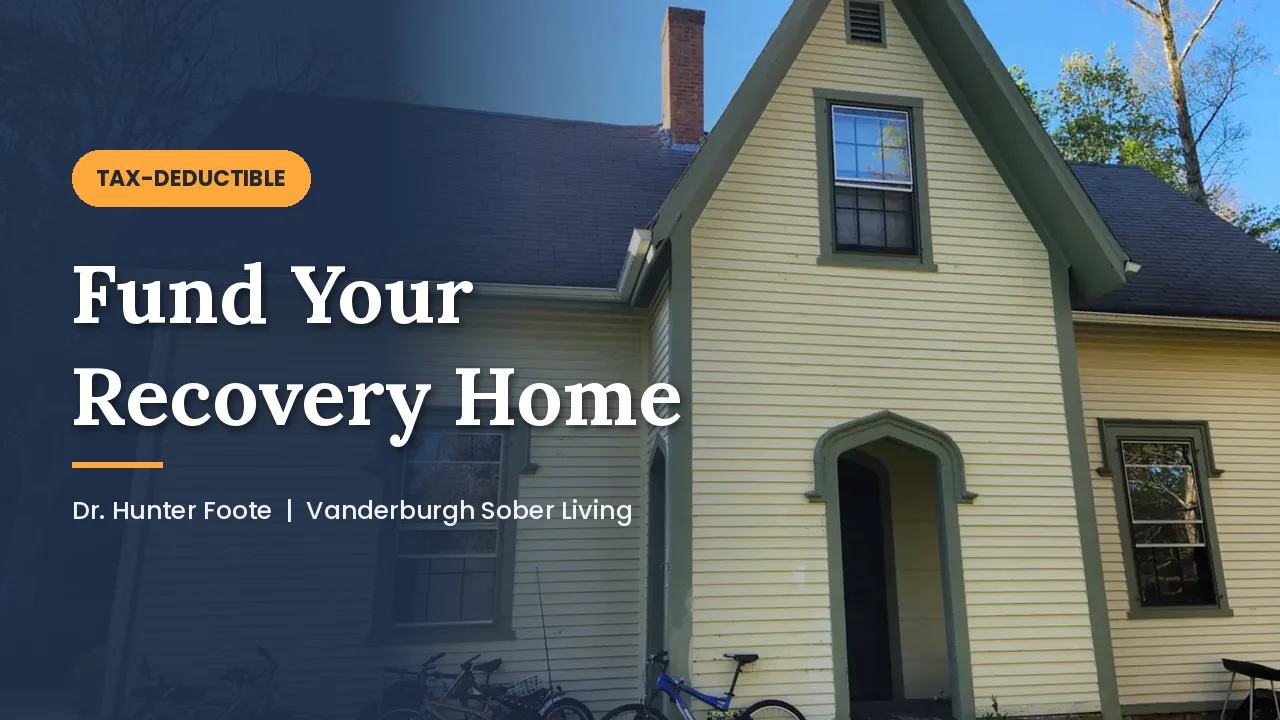
The Vanderburgh Foundation provides the charitable structure and the oversight that make gifts to your project tax deductible. You bring the donors. The gate on this route is not willingness, it is who you can actually bring.
Maybe you’re opening a recovery home. Maybe you’re already running one, and you know exactly what it needs: fire safety upgrades, better beds, certification, training for your house staff. And there are people around you who would gladly help pay for it.
I’m Dr. Hunter Foote, founder of Vanderburgh Sober Living.
What a sponsored campaign is. A sponsored campaign gives them a way to give. The Vanderburgh Foundation, a 501(c)(3) public charity, opens a campaign for your home. Your donors give to the Foundation, they get a tax-deductible receipt, and 93 cents of every dollar goes to your approved budget.
What a campaign can pay for. Getting a new home open, with the deposit, the first month and the furnishings. Code work and safety upgrades, like smoke and carbon monoxide detection or better exits. New beds and furniture. Certification fees and inspections. Training for your house staff. Or a reserve to carry a new home while it fills.
How to raise it. Start with the people who already believe in what you do. Ask your church to take up a special collection. Invite your home group and alumni to a dinner or a recovery celebration. Ask a local business to sponsor a bed or a room. Reach out to a family foundation, or rally your community online on a giving day. Every gift runs through the Foundation, so every donor gets a receipt.
How it works.
Will the Foundation raise the money for me? No. You bring the donors, and we give them a structure they can trust.
Can my LLC receive the funds? Yes, under a signed grant agreement that keeps them for charitable use.
Your next step. If you’re a Chartered Operator with people ready to give, start your application. Tell us about the home, what the money would pay for, and who your donors are.
A fiscal sponsor is a 501(c)(3) public charity that raises, holds, and disburses charitable funds for a project that advances the charity’s own mission. The Vanderburgh Foundation, Inc. is a 501(c)(3) public charity whose mission is expanding access to safe, structured, and supportive recovery housing. Opening a new certified recovery home in a community that does not have enough of them advances that mission directly, which is what makes a sponsored campaign possible in the first place.
This is the route for an operator who has people willing to give: a home group, a church, a family foundation, a local employer, a community that has lost too many people and wants to do something about it. You bring the donors. The Foundation provides the charitable structure that lets those gifts be tax deductible, and the oversight that keeps them charitable.
Five steps from application to open doors
You bring the home and the people who want to help. The Foundation brings the charitable structure, the campaign page, the donor receipts and the oversight.
You submit the project: what the home will be, where it will be, the community need it serves, your certification plan, and a sources and uses budget showing what the campaign would fund and what is already covered.
Projects are approved on written charitable criteria. Not every application is accepted. A specific home, a defined community need, a certification plan and a realistic budget move fastest.
The campaign is the Foundation’s, described in the Foundation’s name, for a defined recovery housing purpose. Donors see the community your home will serve, your story, the budget and a give button, and every donor gets a receipt from the Foundation.
You introduce donors to the campaign and fundraise on the Foundation’s behalf. Donors give to the Foundation and receive the Foundation’s acknowledgement letter.
When the campaign reaches its goal, the Foundation disburses in stages against a written grant agreement and documented charitable-use expenses, not as a lump sum.
See what a live campaign looks like: view current campaigns.
Every gift is made to The Vanderburgh Foundation, Inc. and becomes the Foundation’s property when it is received. Donors may tell the Foundation which project they hope to support, and that preference is recorded. A preference is not a direction.
The Foundation keeps full discretion over its charitable funds, including the right to apply them to other recovery housing work if a project does not proceed, does not meet its conditions, or raises more than it needs. That discretion is not fine print. It is the condition that makes a gift to the campaign tax deductible for the donor in the first place.
The Foundation keeps 7% of each gift as an administrative fee. It covers solicitation, payment processing, donor receipts, compliance, grant administration and reporting. The fee is written into every grant agreement and shown on every campaign page, so donors and operators see the same number.
Picture your own campaign page: the community your home will serve, your story, the budget, a donate button and a tax receipt for every donor. Bring the home, the budget and the people who already want to help, and the Foundation can review your project right away.
Start Your ApplicationSponsored campaigns are open to VSL Chartered Operators. The Mastery Program takes you through opening, certification and the VSL Charter, and operators approved for a campaign may have certain upfront VSL startup costs and fees waived.
Explore the Mastery ProgramMost VSL operators run their homes through an LLC, and that does not disqualify a project. The Foundation is not funding a company’s profits. It is funding charitable use, and the money is restricted to charitable-use expenses by a written grant agreement that both sides sign before a dollar moves.
| Sponsored Funds Can Cover | Sponsored Funds Cannot Cover |
|---|---|
| Deposit, first month, or initial occupancy costs | Owner distributions, salary draws, or profit |
| Habitability, safety, and code work on the home | Undocumented or unapproved expenses |
| Beds, furnishings, smoke and CO detection, egress | Mortgage payments or debt service on owned real estate |
| Certification fees, inspections, and staff training | Costs of any business unrelated to the sponsored home |
| Operating reserve through the home’s opening months | Anything after the grant term without written approval |
The quality bar is membership. Sponsored campaigns are open to Chartered Operators in good standing, because the Charter is what gives the Foundation a standard to hold the home to and a way to know the money produced what it was raised for:
Operators approved for a sponsored campaign may have certain upfront VSL startup costs and fees waived. Raising charitable money for the home is work, and the Charter is meant to make that work cheaper to begin, not more expensive. Ask which fees apply to your situation when you submit the project.
Being direct about the limits is better for everyone involved, and it is what separates a defensible charitable structure from one that costs donors their deduction:
Sponsorship review runs alongside the normal VSL process for opening a sober living home, since chartering and sponsorship ask for much of the same project detail. Operators who have not settled on a building should do that first, because a campaign is built around a specific home serving a specific community.
A sponsored campaign runs weeks to months and is the only route that funds habitability work, certification and an operating reserve. It is also the route most likely to fail at review, and almost always for the same reason: the applicant is willing to raise charitable money but has no donors behind them. Willingness is common. Donors are not. Be honest with yourself about that before you start, and if the answer is no today, the funding qualifier will show you the routes that do not depend on it.
Before you apply
No, and this is the most common misunderstanding. The Foundation provides the charitable structure, the oversight and the receipting. The donors are yours to bring. An application with a thin answer on donors is not a live project.
Yes. The Foundation keeps 7% of each gift to cover the cost of running the campaign: processing gifts, issuing receipts, compliance, grant administration and reporting. The other 93% is available for the approved budget, released against receipts and invoices.
Funds are released against a written grant agreement restricting them to charitable use, and most VSL operators run their homes through an LLC. Being for-profit does not disqualify a project. Owner distributions and debt service are not eligible for funding. All expenditures require Foundation approval under a written charitable-use agreement.
Weeks to months, and it depends heavily on how complete the project is when it arrives. A specific building, a defined community need, a certification plan and a sources and uses budget move quickly. An idea does not.
← Back to all startup funding routes
Educational only, and not legal, tax, or financial advice. Nothing on this page is an application, an approval, or a promise of funding. Program terms and figures reflect conditions as of September 2026 and change. Confirm current requirements with the administering agency and consult qualified professionals.