Sober living zoning in South Dakota is decided almost entirely at the counter of a city planning office, not in Pierre. The state has no license, no certification, and no registration for recovery housing, which makes it one of the easiest places in the country to open a sober living home on paper. What actually decides whether a specific address works is a single line in a municipal code: the local definition of “family,” and how many unrelated adults it allows under one roof. Every South Dakota rule sits on top of the federal sober living zoning laws that apply in all 50 states, starting with the Fair Housing Act.
That line is tighter in South Dakota’s largest markets than most operators expect, and the categories above it were written for state-licensed programs that South Dakota does not license. The result is a gap an operator has to plan around from the first showing, not discover at a public hearing. What follows is how the federal floor, the state statutes, and the actual ordinance text in Sioux Falls, Minnehaha County, and Rapid City fit together, and what to do at each step.
Before you read onHow to Open a Sober Living Home in South DakotaThis post covers one piece of the process. The complete South Dakota guide walks through every step, from planning to your first resident.→Can You Open a Sober Living Home in a Residential Neighborhood in South Dakota?
Yes. Under the federal Fair Housing Act, a sober living home occupied by people in recovery is a residential use, not an institutional one, and no South Dakota statute bars it from a residential district. The constraint is local: each city’s definition of “family” sets how many unrelated adults may share a dwelling before a permit or an accommodation is required.
The federal floor is the same everywhere, and South Dakota adds a second layer on top of it. The South Dakota Human Relations Act makes it an unfair or discriminatory housing practice to discriminate on the basis of disability under SDCL 20-13-20, and the statute reaches the terms, conditions, and privileges of a housing transaction, not only outright refusals. What neither layer does is set an occupancy number. That is left entirely to municipalities, which is why two addresses twenty minutes apart can carry completely different answers.
South Dakota rates well on the legal side of that equation. Foote (2026) scores the state 10 for legal climate and 10 for fire and building feasibility, with a composite Operating Climate Score of 6 and a “Lightly Regulated” classification. Those scores reflect the absence of a state gate. They do not reflect the local occupancy math, which is where South Dakota operators actually get stopped.
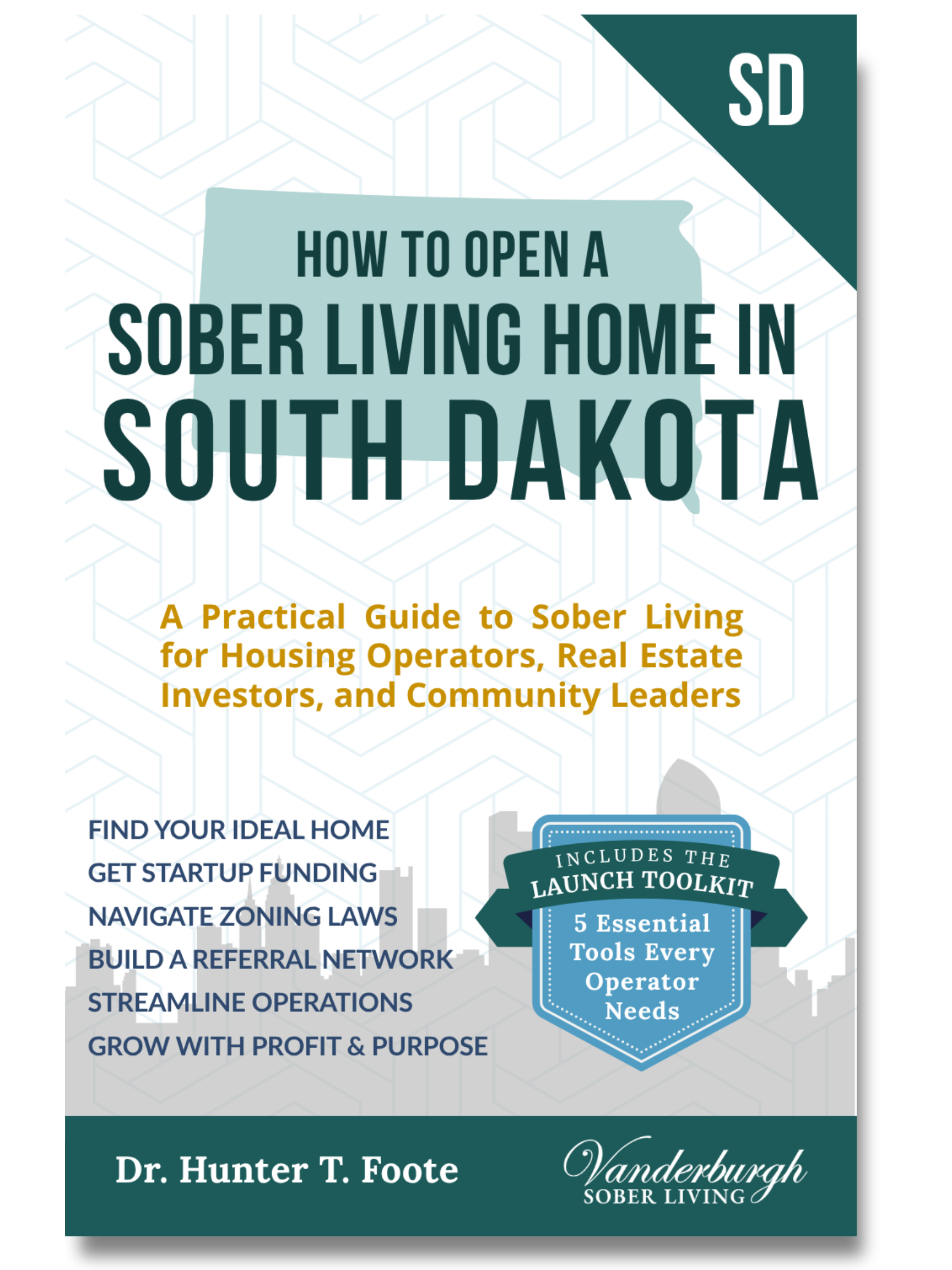
The book gives you the map to open a home in South Dakota. When you are ready to launch, certify, and sustain, the Blueprint is the full playbook covering zoning, licensing, certification, funding, legal, insurance, and operations.
How Fair Housing Law Protects South Dakota Sober Living
People recovering from substance use disorder are protected as individuals with disabilities under the Fair Housing Act and the Americans with Disabilities Act, provided they are not currently using illegal drugs. That protection reaches zoning directly. The 2016 joint statement from the U.S. Department of Justice and the U.S. Department of Housing and Urban Development on state and local land use laws sets out the rule plainly: a local government may not apply a land use rule to a home for people with disabilities in a way that treats it worse than comparable housing, and it must grant a reasonable accommodation when one is necessary to give people with disabilities an equal opportunity to use and enjoy a dwelling.
The state layer runs through SDCL 20-13-20 and is enforced by the Division of Human Rights at the South Dakota Department of Labor and Regulation in Pierre. Neither layer gives a sober living home a blank check. Both give an operator a specific, usable argument, and the federal one is what South Dakota operators lean on most, because there is no state recovery-housing statute standing in front of it.
Keep readingThe Federal Fair Housing Act and Sober Living: Everything You Need to KnowThe federal protections every operator, neighbor, and local official should understand.→Where South Dakota Sober Living Homes Can Operate
Zoning authority in South Dakota is delegated, not centralized. Municipalities regulate land use under SDCL chapter 11-4, which authorizes a city to divide itself into districts and regulate the use of buildings and the density of population within them, and counties operate under chapter 11-2. No statewide provision requires a South Dakota city to treat a small recovery home as a single-family use, so the rules differ market by market. Three jurisdictions cover most of the state’s recovery housing demand, and they take three different postures.
Inside Sioux Falls, the definition of family has three doors. Section 160.005 of the zoning ordinance defines a family as a nonprofit household unit sharing common living, sleeping, cooking, and sanitary facilities that includes a person living alone, any number of people related by blood, marriage, adoption, guardianship, or foster care, three unrelated adults, or up to seven under the ordinance’s Fair Housing Act disability clause, which tracks the definition of “handicapped” at 42 U.S.C. § 3602(h). That third door carries a condition: prior to occupancy, planning and development services must be provided with proof of a record of impairment issued by a state licensed or accredited agency. The same section states that a family does not include temporary or emergency shelters or halfway houses, and the next category up, a “community residential home,” is defined as a state of South Dakota licensed facility with eight or more individuals who are handicapped. South Dakota licenses no recovery residences, so that category is closed to a sober living home on its own terms. Written house rules describing an open-ended, self-pay, resident-governed household do a lot of work in keeping a home on the family side of that line.
In the joint jurisdiction, the same problem arrives as a condition of approval. The Revised Joint Zoning Ordinance for Minnehaha County and the City of Sioux Falls permits group homes as conditional or special uses across its residential districts, including RR (§ 4.04(d)), RS-1 (§ 5.04(c)), RS-2 (§ 6.04(d)), RD (§ 7.04(e)), and RA-1 (§ 8.03(b)), and as a permissive use in the C commercial district (§ 9.02(c)). The RA-1 standards carry two conditions worth memorizing: the distance between the proposed use and any existing group home, measured lot line to lot line, must be not less than 1,000 feet, and the use “shall be permitted only so long as the facility continues to be licensed by the State of South Dakota.” That second condition is the trap, because a sober living home cannot hold a license the state does not issue. Applied literally, it is not a standard the applicant failed to meet; it is a standard no applicant of this type can meet, which is exactly the situation the reasonable-accommodation duty exists to solve.
| Municipality | Zoning posture | Unrelated-occupancy cap | Governing instrument | As of |
|---|---|---|---|---|
| Sioux Falls (city) | By right as a “family” up to the cap; larger homes fall outside the definition | Three unrelated adults, or up to seven under the ordinance’s Fair Housing Act disability clause, with documentation filed before occupancy | Sioux Falls Code § 160.005 | August 2026 |
| Sioux Falls / Minnehaha County joint jurisdiction | Special or conditional use in residential districts, with spacing and a licensing condition | Governed by the group-home use standards rather than a headcount | Revised Joint Zoning Ordinance §§ 4.04, 5.04, 6.04, 7.04, 8.03(b), 9.02(c) | August 2026 |
| Rapid City | Conditional use in low density residential and general commercial districts | Five unrelated persons as a “family”; six or more receiving personal assistance is a “group home” | Rapid City Municipal Code §§ 17.04.250, 17.04.350, 17.10.030 | August 2026 |
| Rural / unincorporated | Often no adopted zoning or building code beyond state-mandated categories; county zoning where adopted | Set by county ordinance where one exists | SDCL ch. 11-2 (county planning and zoning) | August 2026 |
Zoning and fair housing, answered
Know where sober homes can operate, and the federal protections that back you up.
Read the South Dakota licensing guideWhether a peer-run recovery home needs a license in South Dakota, and what lodging rules apply.Understand your Fair Housing rightsHow the federal Fair Housing Act protects sober living homes.Get zoning support in the LaunchpadIncludes an FHA zoning exemption request template and one-on-one strategy.Permitted by Right vs. Special Use Permits
Whether a home opens quietly or goes to a public hearing depends on which side of the local definition it lands on. Rapid City is the cleaner of the two metros to read. A “family” there is one or more persons related by blood, marriage, or adoption, or a group not to exceed five unrelated persons living as a single nonprofit housekeeping unit, under § 17.04.250. A “group home” is defined at § 17.04.350 as an activity providing personal assistance to six or more individuals unrelated by blood or marriage who, by reason of disability including addiction to drugs or alcohol, require specialized attention and care. A peer-run home that provides no personal assistance has a real argument that it is a household. A home that provides structure, curfews, and mentoring at eight to 16 beds will usually be reviewed as a group home, a conditional use in the LDR-1 low density residential district under § 17.10.030(L).
The distinction is worth settling before making an offer on a property. To read a specific South Dakota address, work through it in order.
- Find the parcel’s zoning district. Confirm the jurisdiction first, because a Sioux Falls mailing address does not always mean city zoning; parcels in the joint jurisdiction area are governed by the Minnehaha County and Sioux Falls joint ordinance, and the rules are materially different. Then pull the district from the city or county GIS map.
- Read how the code defines “family” or household. Open the definitions chapter and count your planned residents against it, noting which door of the definition you intend to use.
- Check whether group residential use is allowed by right. Open the district’s permitted and conditional use list and find where a household, a group home, or a community residence appears.
- Look for special or conditional use permit triggers. Check the categories above “family” for a licensing or capacity condition your home cannot meet, which is where the South Dakota problem usually hides.
- Confirm any spacing, density, or occupancy limits. Ask planning staff a written question rather than a phone question. A short email describing the household and asking how the department classifies it produces a record you can rely on later.
If the home fits the family definitionand the property sits in a residential district, open. No permit, no hearing, and in Sioux Falls no more than the disability documentation the ordinance already requires before occupancy.
If the home exceeds the definitionand the use is conditional in that district, file the conditional use application and pair it with a reasonable accommodation request in the same submission rather than holding it back for an appeal.
If the use is not listed at allin the district, the accommodation request becomes the primary path rather than a supplement, and the written record you build with staff becomes the case.
Spacing conditions deserve a realistic read. South Dakota sits in the U.S. Court of Appeals for the Eighth Circuit, and the controlling precedent is favorable to cities: in Familystyle of St. Paul, Inc. v. City of St. Paul, 923 F.2d 91 (8th Cir. 1991), the court upheld a quarter-mile dispersal requirement between group homes for people with mental illness against a Fair Housing Amendments Act challenge, reasoning that the state’s goal of integrating residents into the community was legitimate and that clustering homes in one neighborhood would work against it. The 1,000-foot separation in the joint jurisdiction ordinance is the same species of rule, so treat it as a siting constraint to design around rather than a provision to attack first. Pulling a parcel map and confirming that no existing group home sits within 1,000 feet, before signing, removes the strongest defensible objection a reviewer has. The continuing state-licensure condition is the far better target: Familystyle blessed dispersal aimed at integration, not a condition that an entire category of protected applicants can never satisfy. And because this circuit accepts that municipalities may pursue integration goals, the winning posture is a specific request tied to this home, these residents, and this address, not a broad argument that spacing rules violate federal law.
| Factor | Permitted by right | Special / conditional use permit |
|---|---|---|
| When it applies | Occupancy fits the local “family” definition and no additional services trigger another category | Resident count or services push the home into a group home, community residence, or similar use class |
| Advance approval needed | None beyond ordinary permits and inspections | Application, staff review, and a decision by the planning commission or council |
| Public hearing | No | Yes, with notice to surrounding property owners |
| Typical timeline | Weeks, tied to any renovation permits | One to three months, tied to the hearing calendar |
| Fair-housing risk | Low; the home is treated as a household | Higher; conditions, denials, and neighbor testimony create the record for a fair housing claim |
How to Request a Reasonable Accommodation
A reasonable accommodation request asks a local government to make an exception to a rule, policy, or practice when the exception is necessary to give people with disabilities an equal opportunity to use and enjoy a dwelling, a duty codified at 42 U.S.C. § 3604(f)(3)(B) and explained at length in the HUD and DOJ joint statement on land use. It is not a variance, it is not a hardship appeal, and it does not require proving the ordinance is invalid.
In South Dakota it is the practical workaround for both the occupancy cap and the state-licensure condition, and requesting reasonable accommodation is a step most operators should plan for rather than hold in reserve.
- Put the request in writing. File it with the conditional use application rather than after a denial, so the record shows planning rather than protest.
- Send it to the right official. Address it to the zoning administrator or planning director and copy the city attorney, who is usually the person who decides how much risk the city wants to carry.
- Tie the request to the disability. Connect it to the residents’ need, not to your business plan. Shared, peer-supported housing at a viable household size is what makes the housing usable by people in recovery, and a home held to the three-unrelated-adult door is not economically sustainable, which puts the housing out of reach.
- Ask for something specific and necessary. Name the provision by section number, whether that is the seven-person ceiling in the family definition or the continuing state-licensure condition in the joint ordinance, and state exactly what you want waived or modified. Where the code requires state licensure, say plainly that South Dakota issues no license for recovery residences, so no applicant of this type can satisfy it, and offer a substitute the city can verify: self-adopted National Alliance for Recovery Residences standards, an Oxford House charter, or a Vanderburgh Sober Living charter, with the house rules, resident agreement, and good-neighbor commitments attached.
- Request a written decision and keep records. Describe the household and its structure without disclosing individual medical information beyond what the code actually requires, ask for a written decision by a stated date, and keep every reply. Cities are expected to engage in an interactive process, and the paper trail is what supports everything after it.
Most requests that arrive early, in writing, and with a substitute standard attached are resolved at staff level without a hearing. That is the outcome to aim for.
South Dakota Lodging-House and Sprinkler Triggers to Watch
South Dakota has no mandatory statewide building code and no lodging-house licensing gate that a peer-run recovery residence has to clear. Adoption and enforcement sit with cities and counties, and where a jurisdiction adopts new-construction standards, state law points them at the current International Building Code edition, with the State Fire Marshal administering the adopted fire code for a limited set of occupancies rather than ordinary dwellings. For a realistic eight- to 16-bed home, that leaves four thresholds worth tracking, and a home of that size clears the ones that matter.
- Occupancy classification. A no-care home operating as a single housekeeping unit sits in the International Residential Code or IBC Group R-3 lane, the ordinary dwelling category. Staying there is the largest single cost avoidance available, which is why IRC vs. IBC classification is the first conversation to have with a building official.
- The custodial care trigger. Group R-4 covers residential care occupancies with five to 16 residents receiving custodial care under 2021 IBC chapter 3. The resident count is not what pulls a home into R-4; providing custodial care is. Peer support, house meetings, and rules are not custodial care, and the services list in an application should say so.
- The 17-resident line. Group I-1 begins at 17 or more residents receiving custodial care, with stricter egress and fire separation requirements. A home built to eight to 16 beds stays below it.
- Sprinklers. IBC § 903.2.8 requires automatic sprinklers throughout all Group R fire areas with no minimum area threshold, so sprinkler exposure follows commercial classification rather than bed count. On the residential side, SDCL 11-10-12 bars a municipality from mandating residential sprinkler systems or imposing standards stricter than the 2021 International Residential Code, so an IRC-classified home faces no retrofit mandate.
The occupancy cap in the local “family” definition, not the fire code, is what actually limits bed count in South Dakota’s two metros. The other lever is whether the town has adopted a stricter code edition at all. Retrofit budgeting belongs with the startup cost figures rather than here.
South Dakota guideSober Living Startup Costs in South DakotaOne-time costs to open, including any sprinkler or fire-code retrofit a larger home may need.→Which Local Bodies Review a South Dakota Sober Home
Because the state is not in this process, everyone who signs off is local. Knowing who checks what prevents an operator from answering the wrong question to the wrong office.
- Planning and zoning department. Classifies the use, applies the “family” definition, and receives the conditional use application and the accommodation request.
- Planning commission. Holds the public hearing on a conditional or special use and makes a recommendation, which is often where a well-prepared application succeeds.
- City council or county commission. Takes the final vote where the code requires it, and is the body most exposed to neighbor testimony.
- Building services. Issues permits and the certificate of occupancy under the locally adopted code, and confirms the occupancy classification.
- Local fire authority. Inspects for egress, alarms, and any requirements attached to the adopted fire code.
- Board of adjustment. Hears appeals and variances under the framework in SDCL ch. 11-4, and is the venue where an unresolved accommodation dispute usually surfaces.
None of these bodies asks for a state credential, because there is none to ask for. What they do ask for is a clear description of the household, the bed count, and the services, and those three answers should be identical in every document you file.
South Dakota guideDo You Need a License to Open a Sober Living Home in South Dakota?What South Dakota actually requires, and where voluntary certification fits instead.→How to Handle Neighborhood or Municipal Pushback
Opposition in South Dakota tends to arrive as a permit condition or a council reversal rather than an organized campaign. Handle it in sequence, and keep the tone that of a housing provider, not an adversary.
- Stay calm and document everything. Answer the actual concerns first. Parking, occupancy, and property upkeep are what neighbors raise, so bring the house rules, the number of beds, the parking plan, and a named local contact.
- Get the specific rule or objection in writing. Denials, conditions, and staff opinions become the record. A verbal “we don’t allow those here” is worth far less than an email saying the same thing. Show the standard you run to as well, because a charter or a self-adopted NARR standard gives a council something verifiable to point at and reframes the conversation from who lives there to how it is run.
- Submit a reasonable accommodation request. Renew it formally if conditions are imposed that make operation impractical, and ask for the specific reason each condition is necessary.
- Escalate to the state fair-housing or human-rights agency. The Division of Human Rights at the South Dakota Department of Labor and Regulation enforces SDCL ch. 20-13 and requires a housing complaint to be filed within 180 days of the discriminatory act. The office is in Pierre and reachable at 605-773-3681.
- File a complaint with HUD FHEO. A housing discrimination complaint to the HUD Office of Fair Housing and Equal Opportunity may be filed within one year of the act, and costs nothing.
- Bring in a fair-housing attorney. Do this once a denial is final, a condition is impossible to satisfy, or the record shows the decision turned on who the residents are.
That last path is live in this state. Community Connections, Inc. v. City of Winner was filed in the U.S. District Court for the District of South Dakota (No. 3:26-cv-03015) after the Winner city council rejected a conditional use permit for a five-resident disability group home that the planning commission had recommended for approval. The docket is pending, so it settles nothing, but it is a useful signal of how a South Dakota council can behave and how operators respond. Cities benefit from getting this right as well: recovery housing policy that treats these homes as households reduces both litigation exposure and the housing shortage the council is already trying to solve.
Choosing a Defensible Location in South Dakota
Location screening in South Dakota is a legal exercise as much as a real estate one. A property that clears these tests rarely produces a hearing.
- Residential district, verified on the parcel map. Confirm the district and whether the parcel sits in city or joint jurisdiction before making an offer.
- Occupancy fit. Match the planned bed count to the local “family” definition, and know which door you are using.
- 1,000-foot clearance. In the joint jurisdiction, confirm that no existing group home sits within 1,000 feet lot line to lot line.
- Bedroom count and layout. Determining maximum occupancy from the actual floor plan keeps the application and the pro forma aligned.
- Off-street parking. The most common neighbor objection, and the cheapest one to solve before it is raised.
- Proximity to work, transit, and meetings. Residents self-pay in South Dakota, so walkable employment and recovery support directly affect occupancy.
Read the deed and any subdivision covenants before closing as well. Private restrictions travel with the land, and while the Fair Housing Act reaches discriminatory enforcement of them, discovering one after the offer is accepted is an expensive way to learn that.
Classification, Fair Housing protection, reasonable accommodation, and handling a city that says no.
Claim your free copySouth Dakota Zoning and Fair Housing at a Glance
Four layers of authority decide what a South Dakota address will allow, and only the bottom one changes address to address.
| Layer | Rule | What It Means |
|---|---|---|
| Federal | The Fair Housing Act and the ADA protect people in recovery as individuals with disabilities, and local governments must consider reasonable accommodations | A city cannot treat a recovery home worse than other households, and must consider bending a rule when the exception is needed |
| State | SDCL 20-13-20 bars disability discrimination in housing; enforced by the Division of Human Rights on a 180-day filing window | South Dakota gives you a second complaint route besides HUD, closer to home and faster to reach |
| State zoning preemption | No preemption statute found as of August 2026; zoning is delegated to municipalities and counties under SDCL ch. 11-4 and ch. 11-2, and nothing overrides local occupancy caps or spacing rules | No state law overrides a restrictive local ordinance for you, so the federal accommodation duty is the tool you use |
| Restrictive covenants | No statute voiding private covenants or deed restrictions against community or recovery residences found as of August 2026 | Read the deed and any subdivision covenants before closing; the Fair Housing Act still reaches discriminatory enforcement of them |
| Circuit precedent | Familystyle of St. Paul, Inc. v. City of St. Paul, 923 F.2d 91 (8th Cir. 1991) upheld group-home dispersal spacing | Spacing rules are defensible in South Dakota; design around them rather than challenging them first |
| Local: Sioux Falls | Family means three unrelated adults, or up to seven under the ordinance’s Fair Housing Act disability clause, with documentation before occupancy (§ 160.005) | Four to seven residents can open by right if you file the paperwork; above seven you need an accommodation |
| Local: joint jurisdiction | Group homes are conditional or special uses, with 1,000-foot spacing and a continuing state-licensure condition (§ 8.03(b)) | The licensing condition cannot be met by a sober living home, which is why the accommodation request goes in with the application |
| Local: Rapid City | Family means up to five unrelated persons; six or more receiving personal assistance is a group home, a conditional use in LDR-1 (§ 17.10.030) | Plan on a hearing at a realistic bed count, and bring a services plan |
Sober Living Guides Every Operator Needs
These evergreen guides apply in every state and cover what pairs with getting your zoning right: choosing a defensible property, the standards you operate to, the coverage you carry, and the referrals that keep the home full.
Frequently Asked Questions About Sober Living Zoning in South Dakota
Is a sober house allowed in residential zones in South Dakota?
Yes. No South Dakota statute excludes recovery housing from residential districts, and zoning authority rests with cities and counties under SDCL ch. 11-4 and ch. 11-2. Whether a specific home opens without a permit depends on the local “family” definition and how many unrelated adults it allows.
Do I need a conditional use permit for a sober living home in South Dakota?
Sometimes. Sioux Falls Code § 160.005 sets the family limit at three unrelated adults, or up to seven under the ordinance’s Fair Housing Act disability clause, so a home at that size fits by right. In Rapid City, six or more unrelated residents receiving personal assistance is a group home, a conditional use in LDR-1 under § 17.10.030(L).
Can a South Dakota city require my sober living home to be licensed or registered?
It can write the condition, as the Minnehaha County and Sioux Falls joint ordinance does at § 8.03(b), but South Dakota issues no license for recovery residences. A condition that no applicant of that type can satisfy is the strongest basis for a reasonable accommodation request under the Fair Housing Act.
Do HOA rules or deed restrictions apply to a sober living home in South Dakota?
They can. No South Dakota statute voiding private covenants against community residences was found as of August 2026, so read the deed before closing. The Fair Housing Act still reaches discriminatory enforcement of covenants, which is the argument HOAs and sober living turns on.
Can a historic district block a sober living home in South Dakota?
Not on its own. Historic district review in South Dakota municipalities governs exterior alterations, additions, and demolition, not who lives inside a dwelling. Under the HUD and DOJ joint statement on land use, design review cannot be used to exclude a household of people with disabilities that the underlying zoning otherwise permits.
Are spacing requirements between sober living homes legal in South Dakota?
Generally yes in this circuit. Familystyle of St. Paul, Inc. v. City of St. Paul, 923 F.2d 91 (8th Cir. 1991), upheld a dispersal requirement between group homes as serving integration. The 1,000-foot separation at § 8.03(b) of the Sioux Falls and Minnehaha County joint ordinance should be treated as a siting constraint.
How many residents can live in a South Dakota sober living home, and what if neighbors object?
The local occupancy definition decides it. Sioux Falls allows three unrelated adults, or up to seven under the ordinance’s Fair Housing Act disability clause; Rapid City sets the family limit at five unrelated persons. If neighbors object at a hearing, answer bed count, parking, and house rules, and ask that every condition be given a written reason.
Open a South Dakota Sober Living Home With Confidence
South Dakota gives operators an unusually clear runway at the state level and an unusually specific obstacle at the local one. The work is knowing which definition your home falls under, choosing an address that clears the spacing rule, and filing a reasonable accommodation request early enough that it reads as planning rather than protest. Pick the next step that matches where you are.
Disclaimer: The information provided in this article and all articles in the Laws & Regulations category is presented for informational purposes only and is not intended as legal advice. Laws and regulations regarding recovery housing vary by state and locality, and their interpretation can change over time. This content is meant to discuss general legal and regulatory topics related to sober living and recovery housing. For specific legal guidance, please consult a qualified attorney or legal professional.
Research & Sources
- Foote, H. T. (2026). Vanderburgh Sober Living Operating Climate Index, 2026 Edition. Vanderburgh Sober Living. https://www.vanderburghhouse.com/research/operating-climate-index-2026/
- South Dakota Legislature. (n.d.). SDCL 20-13-20: Unfair or discriminatory housing practices. https://law.justia.com/codes/south-dakota/title-20/chapter-13/section-20-13-20/
- South Dakota Legislature. (n.d.). SDCL chapter 11-4: Municipal planning and zoning. https://law.justia.com/codes/south-dakota/title-11/chapter-04/
- South Dakota Legislature. (n.d.). SDCL 11-10-12: Residential fire sprinkler systems, municipal requirements limited. https://law.justia.com/codes/south-dakota/title-11/chapter-10/section-11-10-12/
- South Dakota Department of Labor and Regulation. (n.d.). Division of Human Rights. https://dlr.sd.gov/human_rights/default.aspx
- South Dakota Department of Labor and Regulation, Division of Human Rights. (n.d.). Housing discrimination: Laws and rules. https://dlr.sd.gov/human_rights/laws_rules.aspx
- City of Sioux Falls. (n.d.). Code of ordinances § 160.005: Definitions. https://codelibrary.amlegal.com/codes/siouxfalls/latest/siouxfalls_sd/0-0-0-69517
- Minnehaha County & City of Sioux Falls. (2025). Revised joint zoning ordinance. https://minnweb.minnehahacounty.gov/wp-content/uploads/2025/05/CompleteSFJointZoningOrdinance.pdf
- City of Rapid City. (n.d.). Rapid City Municipal Code § 17.04.250: Family. https://rapidcity.municipal.codes/RCMC/17.04.250
- City of Rapid City. (n.d.). Rapid City Municipal Code § 17.04.350: Group home. https://rapidcity.municipal.codes/RCMC/17.04.350
- City of Rapid City. (n.d.). Rapid City Municipal Code § 17.10.030: LDR-1 low density residential district. https://rapidcity.municipal.codes/RCMC/17.10.030
- U.S. Court of Appeals for the Eighth Circuit. (1991). Familystyle of St. Paul, Inc. v. City of St. Paul, 923 F.2d 91. https://law.justia.com/cases/federal/appellate-courts/F2/923/91/127336/
- International Code Council. (2021). International building code, chapter 3: Occupancy classification and use. https://codes.iccsafe.org/content/IBC2021P1/chapter-3-occupancy-classification-and-use
- U.S. Department of Housing and Urban Development. (n.d.). Housing discrimination complaint process. https://www.hud.gov/program_offices/fair_housing_equal_opp/online-complaint
- U.S. Department of Housing and Urban Development & U.S. Department of Justice. (2016). Joint statement: State and local land use laws and practices and the application of the Fair Housing Act. https://www.hudexchange.info/resource/6668/hud-doj-joint-statement-and-q-a-state-and-local-use-laws-and-practices/
- Justia. (n.d.). Fair housing laws: 50-state survey. https://www.justia.com/civil-rights/housing-discrimination/fair-housing-laws-50-state-survey/