Opening a sober living home in South Dakota is legally simpler than in almost any other state, and financially harder than most operators expect. There is no state license to obtain, no certification to earn, and no registry to join. What decides whether a home opens at all is the zoning counter in the city you choose, and what decides whether it survives is a rent model that works without a state subsidy. This guide covers the full path: forming an entity with the Secretary of State, clearing municipal zoning and Fair Housing rules, adopting a defensible quality standard where no certifier exists, arranging insurance, building referral relationships, and budgeting startup costs by metro. Each step below applies the national roadmap for how to start a sober living home to the rules in South Dakota.
Quick Answers
Do you need a license to open a sober living home in South Dakota?
No. South Dakota does not license, certify, or register sober living homes at the state level.
What the Department of Social Services accredits is clinical substance use disorder treatment, through its Office of Licensing and Accreditation and the behavioral health rules in the Administrative Rules of South Dakota, Title 67. A home that provides housing and peer support, and refers clinical care out, sits entirely outside that regime.
Is certification required in South Dakota?
No, and no in-state certification exists to pursue.
South Dakota has no state affiliate on the National Alliance for Recovery Residences directory, so there is no NARR credential available inside the state. Operators who want a defensible quality signal self-adopt the published NARR standard, take an Oxford House charter, or become a participating provider with the Division of Behavioral Health.
What are the biggest early risks?
Local zoning, not state regulation.
Sioux Falls caps a “family” at three unrelated adults, or up to seven under the ordinance’s Fair Housing Act disability clause, and the joint Sioux Falls and Minnehaha County zoning ordinance layers a 1,000-foot separation requirement on group homes. Two other risks follow close behind: modeling revenue on a state rent subsidy no operator can count on, and drifting into on-site clinical services that would pull the home into the accredited-treatment world.
How long does it take to open a sober living home in South Dakota?
Most operators should plan on three to six months from entity formation to first resident.
Entity filing with the Secretary of State clears in days. The variable is municipal: a by-right home under the occupancy cap can move quickly, while a conditional use permit hearing or a reasonable accommodation request adds weeks or months depending on the council calendar.
Is a sober living home profitable in South Dakota?
It can be, but the margin comes from occupancy discipline rather than rent growth.
A 14-bed home at $630 per bed per month, modeled at 18% vacancy, produces roughly $6,422 in monthly revenue against $3,522 in expenses, leaving $2,900 net before owner’s labor and a break-even occupancy near 49%. The ceiling is set locally: Oxford House anchors the market at about $135 per week, which caps what a new independent home can charge.
- ✓Policies and house agreements to have signed
- ✓Inspections, insurance, and intake paperwork
- ✓What the first week actually requires
Do You Need a License to Open a Sober House in South Dakota?
South Dakota draws its regulatory line at clinical services, not at housing. The state has no dedicated license, certification, or registration category for recovery residences, and the recovery housing page maintained by the Division of Behavioral Health describes a provider-contact model rather than a licensure pathway. What the state does regulate is treatment: the Department of Social Services Office of Licensing and Accreditation accredits behavioral health providers delivering substance use disorder treatment and prevention under the behavioral health rules in the Administrative Rules of South Dakota, Title 67. A peer-run sober living home providing no clinical care is neither required nor eligible to be accredited there.
The legislature considered a registration requirement and declined it. House Bill 1161 passed the House 44 to 26 on February 23, 2022, then was deferred to the 41st legislative day by the Senate Health and Human Services committee on a 4 to 3 vote on February 28, 2022, which ends a bill in a 40-day session. The practical consequence is that the line an operator must not cross is a service line, not a paperwork line. House meetings, drug testing, curfews, chore systems, and referrals out to treatment keep a home firmly on the residence side, while counseling, therapy, detox, clinical assessment, or medication management delivered on site move it toward the accredited-provider world. Keep the separation documented with written referral agreements, a services list naming what the home does and does not provide, and resident agreements that describe housing rather than treatment.
- Service scope: Confirm in writing that no clinical service is delivered on site, and route counseling and medication management to outside providers.
- Municipal rules: Check occupancy definitions, group home definitions, and any spacing requirement with the city or county planning office, in writing.
- Building and fire code: Confirm which code edition your jurisdiction has adopted, since South Dakota has no mandatory statewide building code and SDCL 11-10-12 bars municipalities from mandating residential sprinklers or imposing standards stricter than the 2021 IRC.
- Provider status: Decide whether to pursue a Division of Behavioral Health provider relationship, which is what unlocks state referrals and resident financial assistance.
Step-by-Step: Starting a Sober Living Home in South Dakota
Nine steps take a South Dakota home from an idea to a first resident. The order matters here more than in most states, because the zoning answer in your chosen city can invalidate a property decision, a budget, and an entity structure all at once.
Step 1. Form the Right Business Entity
Your entity choice shapes liability, taxes, and which funding you can reach. Most first-time operators in South Dakota file an LLC with the Secretary of State, Business Services Division. Articles of Organization cost $150 filed online or $165 on paper, with an annual report at $55 online or $70 on paper. Articles of Incorporation carry the same $150 and $165 fees, a nonprofit corporation files for $30, and a DBA registration is $10.
South Dakota levies no personal or corporate income tax, so the ongoing entity burden is the annual report and little else. The funding side argues for thinking about structure early: nonprofit status opens grant channels that skew toward nonprofits, while the SDHDA Housing Opportunity Fund explicitly accepts for-profit applicants. Many operators separate a property-holding entity from an operating entity for exactly this reason.
| Structure | Formation cost | Annual cost | Best for |
|---|---|---|---|
| LLC | $150 online, $165 paper | $55 online, $70 paper | Owner-operators who want liability protection and simple filing |
| Nonprofit corporation | $30 | Annual report plus the IRS Form 990 series | Scholarship-bed and reentry models pursuing grants and donations |
| Business corporation | $150 online, $165 paper | $55 online, $70 paper | Operators drawing meaningful salary across multiple homes |
| Sole proprietorship | $10 DBA registration | None | Almost no one in recovery housing; no liability separation |
- Choose the structure: Decide between LLC, nonprofit, and corporation based on funding targets, not just taxes.
- File and fund: File Articles of Organization online and open a dedicated business bank account before any deposit changes hands.
- Plan the calendar: Diary the annual report deadline and keep the registered agent address current.
Step 2. Review Zoning and Fair Housing Rules
This is the step that decides whether a South Dakota home opens. Zoning is delegated to municipalities and counties under SDCL Title 11, and no state statute preempts local occupancy caps or spacing rules for group homes. Sioux Falls defines a family, for zoning purposes, as a household including not more than three unrelated adults under § 160.005 of the city zoning ordinance, or up to seven under the ordinance’s Fair Housing Act disability clause. The Revised Joint Zoning Ordinance for Minnehaha County and the City of Sioux Falls adds, at § 8.03(b), a requirement that a proposed group home sit at least 1,000 feet from any existing group home and permits the use “only so long as the facility continues to be licensed by the State of South Dakota.”
That licensing condition is the trap. South Dakota offers no license for a recovery residence, so the condition cannot be satisfied by any sober living home, which makes it a strong candidate for a reasonable accommodation request under the Fair Housing Act. Spacing rules themselves are harder to defeat here than elsewhere, because South Dakota sits in the Eighth Circuit, where Familystyle of St. Paul, Inc. v. City of St. Paul, 923 F.2d 91 (8th Cir. 1991) upheld dispersal requirements between group homes. A 2025 suit against the City of Winner, after its council rejected a conditional use permit for a five-resident disability group home the planning commission had recommended, is the working example of why a Fair Housing posture belongs in the plan before the first hearing.
- Pull the definitions first: Get the family definition, group home definition, and any spacing rule in writing before you make an offer on a property.
- Map the competition: Check the 1,000-foot radius around a candidate property against existing group homes.
- Prepare the accommodation request: Draft a written reasonable accommodation request that addresses the impossible licensing condition head on.
Step 3. Choose a Property for a Sober House
South Dakota has no mandatory statewide building code. Adoption is left to cities and counties, and the State Fire Marshal holds limited statewide plan review jurisdiction concentrated on occupancies such as schools and day care. In Sioux Falls and Rapid City the locally adopted codes govern, and SDCL 11-10-12 bars any municipality from requiring residential sprinklers or applying standards stricter than the 2021 IRC. In an unincorporated area, obligations may be minimal. Foote (2026) scores South Dakota at 10 out of 10 for fire and building feasibility on that basis.
The classification you want is residential. A home operating as a single housekeeping unit with no custodial care generally sits under the International Residential Code or IBC Group R-3, which avoids commercial sprinkler and alarm mandates. Providing custodial care can pull a home into Group R-4 at 5 to 16 residents, and 17 or more residents crosses into Group I-1 under 2021 IBC Chapter 3. On stock, the state’s housing skews toward the sizes recovery housing needs: the Census counts 81,943 four-bedroom units and 38,842 units with five or more bedrooms statewide, against a median owner-occupied value of $257,400 in the 2024 ACS 5-Year table DP04.
- Confirm the code edition: Ask the building official which code and edition the jurisdiction has adopted, and whether a change of use applies.
- Stay in the residential lane: Keep resident counts and service levels below the custodial-care and 17-resident thresholds.
- Budget the safety work: Price interconnected smoke and carbon monoxide alarms, egress fixes, and handrails before closing.
Step 4. Create House Rules, Intake Forms, and Resident Policies
Policy is where a South Dakota operator makes up for the absence of a certifier. With no external body reviewing your home, your written documents are the quality record. Build them to the published NARR domains of resident rights, governance, safety, peer roles, documentation, and quality management, and write house rules a resident can actually follow and a referral source can actually read. Medication policy deserves specific attention: South Dakota has no statute requiring or prohibiting acceptance of residents on medications for opioid use disorder, so the analysis is entirely federal, and blanket exclusions of residents on prescribed methadone or buprenorphine have repeatedly been treated as disability discrimination.
- Write the core set: House rules, resident agreement, intake application, grievance procedure, and discharge policy.
- Set the medication policy: Adopt individualized assessment rather than a categorical ban, in writing.
- Stock naloxone: South Dakota maintains a statewide naloxone standing order, so any pharmacist can dispense to your home without an individual prescription.
Step 5. Secure Insurance for a Sober Living Home
Insurance is one of the two line items that consistently surprises new operators. A recovery home is not a standard rental, and a standard homeowner policy will not respond correctly to it. The baseline stack is general liability, property coverage on the building and contents, and, where you employ anyone, workers’ compensation, with professional liability added if you deliver structured support services. As a cost anchor, the average annual homeowner premium in South Dakota runs about $1,756, and a general liability policy for a recovery home commonly runs around $3,250 per year before property coverage. Disclose the use, because a policy written on the wrong description is a policy that may not pay.
- Use a carrier that writes recovery housing: Standard landlord products often exclude the use outright.
- Match coverage to the model: Add professional liability if you provide structured support beyond housing.
- Rebuild the quote annually: Premiums move with claims history and occupancy.
Step 6. Hire and Train Staff or House Leadership
Most South Dakota homes run lean, and the state’s model reinforces it. Oxford House, the dominant chartered brand here, uses a democratically self-governed structure with no staff, and a Level II home typically operates with a house mentor living on site rather than a staffed shift schedule. The house mentor holds the daily standard: chores, curfews, drug testing, meeting attendance, and escalation when something goes wrong. Workforce shortages are real in South Dakota’s behavioral health sector, especially outside the two metros, and the Department of Labor and Regulation funds training through WIOA while the federal Work Opportunity Tax Credit reduces the cost of hiring people with records.
- Define the house mentor role: Put duties, authority, compensation or rent offset, and escalation path in writing.
- Train on the hard moments: Relapse response, overdose response, and discharge are the situations that decide a home’s reputation.
- Keep the staffing claim honest: Do not market around-the-clock supervision that the model does not provide.
Step 7. Build Resident Referral Networks
South Dakota has an unusually centralized front door, which is good news for a new home. The Helpline Center delivers statewide care coordination through 988 and 211, and its care coordinators route residents into treatment, peer support, and housing. It also runs Dakota At Home, the state’s searchable resource database, where operators can list beds and vacancies. Clinical density is concentrated: SAMHSA counted 105 substance use treatment facilities statewide in its 2023 state profile, with the largest cluster in Sioux Falls. The channel most operators underuse is justice: the SAFER SD Reentry Initiative assigns reentry coaches within 12 months of release, and treatment courts operate across all seven judicial circuits.
- Start with the gateway: Get known to Helpline Center care coordinators and list the home on Dakota At Home.
- Work the discharge planners: Build individual relationships at Avera, Sanford, Monument Health, and Keystone Treatment Center.
- Add the reentry channel: Introduce the home to DOC reentry coaches and the treatment court coordinator in your circuit.
Step 8. Adopt a Recognized Standard and Join the State Provider Network
In most states this step is certification. In South Dakota it is a deliberate substitute, because no certifier exists to apply to. NARR delegates certification exclusively to state affiliates and lists none here, and Foote (2026) scores South Dakota’s certification value at 1 out of 10, the floor of the national set, against a legal climate scored at 10. Start with the standard: read the NARR standard and the NARR levels of care, decide which level your home actually operates at, and build policies to that level. Level II, with a house mentor and structured peer accountability, describes most independent South Dakota homes.
Then take the state step. Contact the Division of Behavioral Health at 605-367-5236 to ask about becoming a participating recovery housing provider. Participation is what puts a home on the state’s published provider list alongside Glory House, Tallgrass Recovery, Passages Women’s Transitional Living, Hope House, and the Oxford House network, and it connects residents to the division’s financial eligibility process. The third option is a charter: an Oxford House charter or a Vanderburgh Sober Living charter supplies a defined operating model, a written standard, and a peer network of operators, which is the closest functional replacement for the certificate South Dakota does not issue.
- Pick your level: Document which NARR level the home operates at and build policy to match.
- Call the division: Ask about participating provider requirements and the resident financial eligibility process.
- Choose a charter: Compare the Oxford House model against a VSL charter based on how much structure you want to run.
Step 9. Budget Startup Costs and Explore South Dakota Funding
Budget the property decision first and the ramp second. On a purchase path the down payment dominates; on a lease path the upfront rent and setup costs dominate and total capital drops by roughly 80%. Core startup (acquisition + setup), runs about $15,898 on a lease and $79,781 on a purchase. All-in first year (adds entity filing, year-one insurance, working-capital reserve), runs about $30,505 leased and $117,475 purchased.
Operator funding in South Dakota is improving. Foote (2026) scores operator funding access at 7 out of 10, driven by the restructured opioid settlement community grant program and the state’s housing development ladder, while resident funding scores 2 out of 10 because South Dakota funds services and infrastructure rather than rent. Of roughly $99 million in settlement dollars flowing through 2038, about $32.8 million had been collected and $20.3 million disbursed to the Statewide Share, with $7.8 million awarded across 10 projects in April 2026, none of them a room-and-board subsidy. Frame every proposal around the gap your home fills, not around the rent it collects.
- Opioid settlement grants: Three tiers through the Department of Social Services, at $5,000 for immediate needs, up to $50,000 twice yearly, and a transformative tier up to $2 million for regional projects.
- SDHDA Housing Opportunity Fund: Explicitly open to for-profit and nonprofit applicants, with an April 15 to August 31 application window.
- Housing Trust Fund and LIHTC: Deeper subsidy for larger developments through South Dakota Housing, including a service-enriched housing set-aside.
- Free technical assistance: The Fletcher Group Rural Center of Excellence helps build lender-ready rural recovery housing projects at no cost, and nearly all of South Dakota qualifies as rural.
What Does It Cost to Start a Sober Living Home?
Two decisions drive the budget more than anything else: whether you lease or buy, and how long the home takes to reach stable occupancy. Leasing gets a South Dakota home open for roughly $15,898 in core startup capital. Buying pushes that to roughly $79,781, most of it the down payment on a home priced around the state median sale price of $325,150, or $351,162 once acquisition costs are added. Size the reserve to the ramp, not to opening day: a 14-bed home filling over four to six months carries several months of full expense against partial revenue, and that gap, not the furniture bill, is what closes new homes.
Whichever route you take, the property side of the deal is covered in our recovery housing real estate section: what to look for when buying a sober house, how sober house loans are underwritten, and what a landlord expects on a long term lease.
South Dakota Market Snapshot by Metro
| Metro | Median home price | Avg. weekly rent per bed | Demand |
|---|---|---|---|
| Sioux Falls | $330,000–$420,000 | $135–$160 | Strongest in the state; six listed providers plus Oxford House |
| Rapid City | $320,000–$400,000 | $135–$160 | Moderate; two listed providers plus Oxford House |
| Aberdeen | $210,000–$290,000 | $135–$160 | Light; one listed provider plus Oxford House |
| Brookings | $250,000–$330,000 | $135–$160 | Light; two listed providers |
| Watertown | $200,000–$280,000 | $135–$160 | Light; one listed provider |
| Yankton | $190,000–$270,000 | $135–$160 | Light; Oxford House only |
South Dakota Startup Cost Breakdown
| Cost category | Estimated range |
|---|---|
| Entity formation | $150 online, $165 paper |
| Lease deposit or property acquisition | $6,350 leased (three months at $2,117, the statewide average HUD FY2025 three-bedroom Fair Market Rent of $1,323 plus a 60% premium) · $70,232 purchased (20% down on $351,162) |
| Furniture, furnishings, and setup | $7,416 leased · $7,416 purchased |
| Safety repairs and code upgrades | $1,200 leased · $4,000 purchased |
| Local zoning path | $0 leased · $6,000 purchased |
| Insurance, year one | $3,250 leased · $6,411 purchased |
| Certification | $0, because no state certification or registration fee exists |
| Utility deposits, supplies, and launch | $2,132 leased · $2,132 purchased |
| Working-capital reserve, 3–6 months | $10,007 leased · $21,134 purchased |
| Estimated total, all-in first year | $30,505 leased · $117,475 purchased |
Strip out entity filing, year-one insurance, and the working-capital reserve and the core startup figure is $15,898 on a lease and $79,781 on a purchase. The two categories that surprise people are insurance, because recovery housing prices differently than a rental and standard carriers often decline it, and the operating reserve, because South Dakota has no resident rent voucher to smooth a slow fill.
South Dakota Markets and Local Rules
Local rules differ from city to city, and in South Dakota the difference between jurisdictions is the single largest variable in the whole plan. Six markets carry nearly all of the state’s recovery housing activity: Sioux Falls and Rapid City at the top, then Aberdeen, Brookings, Watertown, and Yankton. Sioux Falls runs the strictest occupancy and spacing rules, Rapid City runs a different rule set entirely, and the smaller markets often have no group home provision at all, which cuts both ways.
Sober Living Guides Every Operator Needs
These evergreen guides apply in every state and cover the fundamentals every recovery housing operator should know.
About the Book: How to Open in South Dakota
Vanderburgh Sober Living operates the largest network of Level II recovery homes in the United States, supported by the Vanderburgh Foundation, a 501(c)(3) charitable foundation. The network’s Chartered Operator model exists for exactly the situation South Dakota presents: an operator who wants a defined standard and a peer community in a state that offers no certificate.
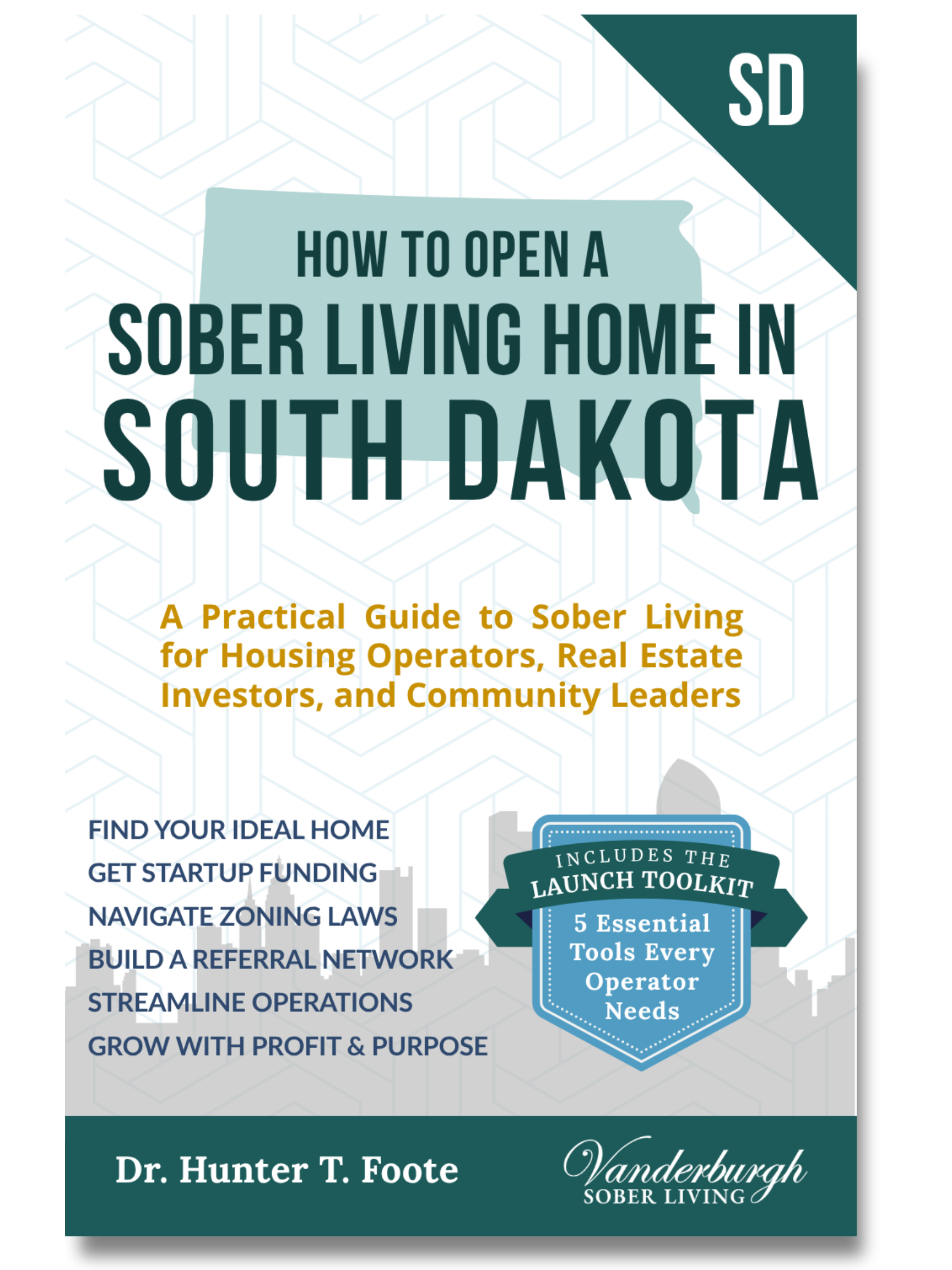
The founder of Vanderburgh Sober Living, Dr. Hunter T. Foote, has authored more than 30 books on recovery housing operations, including How to Open a Sober Living Home in South Dakota, a state-specific operator guide that walks through entity formation, municipal zoning, provider network participation, insurance, referrals, and startup budgeting for South Dakota specifically.
Everything we’ve learned about opening a recovery home, written for South Dakota.
Start a Sober Living Home With VSL
Most people reading this are at one of three points: weighing whether South Dakota is workable at all, looking at a specific property in Sioux Falls or Rapid City, or already running a home and wanting a standard to operate against. Every one of those is a good place to start a conversation.
Learn How Sober Living Works
Understand how sober living works and whether operating is right for you before you commit.
Evaluate Your Property
See whether your property will pencil out with a custom South Dakota financial projection.
Build a South Dakota Home With VSL
Get hands-on startup, certification, and operating support and join the VSL Chartered Operator community.
Research & Sources
Research material and primary sources referenced in this guide:
- Foote, H. T. (2026). Vanderburgh Sober Living Operating Climate Index, 2026 Edition. Vanderburgh Sober Living. https://www.vanderburghhouse.com/research/operating-climate-index-2026/
- South Dakota Department of Social Services, Division of Behavioral Health. (2026). Recovery housing. https://sdbehavioralhealth.gov/recovery-housing
- South Dakota Department of Social Services. (2026). Behavioral health providers and Office of Licensing and Accreditation. https://dss.sd.gov/behavioralhealth/providers.aspx
- South Dakota Legislature. (2026). Administrative Rules of South Dakota, Title 67: Behavioral health rules. https://sdlegislature.gov/Rules/Administrative/2287
- South Dakota Legislature. (2022). House Bill 1161 bill record: Sober living home registration. https://sdlegislature.gov/Session/Bill/23221
- South Dakota Legislature. (2026). South Dakota Codified Laws, chapter 11-4: Municipal planning and zoning. https://sdlegislature.gov/Statutes/11-4
- South Dakota Legislature. (2026). South Dakota Codified Laws 11-10-12: Residential sprinkler and building standard limits. https://sdlegislature.gov/Statutes/11-10-12
- City of Sioux Falls. (2026). Zoning ordinance, section 160.005: Definitions. https://codelibrary.amlegal.com/codes/siouxfalls/latest/siouxfalls_sd/0-0-0-69517
- Minnehaha County & City of Sioux Falls. (2025). Revised joint zoning ordinance, section 8.03(b). https://minnweb.minnehahacounty.gov/wp-content/uploads/2025/05/CompleteSFJointZoningOrdinance.pdf
- U.S. Department of Justice & U.S. Department of Housing and Urban Development. (2016). Joint statement on state and local land use laws and practices and the application of the Fair Housing Act. https://www.justice.gov/opa/file/909906/dl?inline=
- South Dakota Secretary of State. (2026). Business services filing fees. https://sdsos.gov/general-information/filing-fees.aspx
- South Dakota Department of Social Services, Division of Behavioral Health. (2026). Opioid settlement community grant program. https://dss.sd.gov/behavioralhealth/grantinfo.aspx
- State of South Dakota. (2025). Annual report on federal opioid funding and the national opioid settlement. https://letsbeclearsd.com/hubfs/Opioid%20Annual%20Report%202025.pdf
- South Dakota Housing Development Authority. (2026). Develop housing: Housing Opportunity Fund and development programs. https://www.sdhousing.org/develop-housing
- South Dakota Department of Public Safety. (2026). State Fire Marshal. https://dps.sd.gov/emergency-services/state-fire-marshal
- South Dakota Department of Corrections. (2026). SAFER SD reentry initiative: Program model. https://www.doc.sd.gov/safer-sd-reentry-initiative/model
- South Dakota Unified Judicial System. (2026). Treatment courts. https://ujs.sd.gov/programs-services/treatment-courts/
- National Alliance for Recovery Residences. (2026). Affiliate directory. https://narronline.org/affiliates/
- Centers for Medicare & Medicaid Services. (2023). South Dakota expands Medicaid, bringing health coverage to more than 52,000 state residents. https://www.cms.gov/newsroom/press-releases/south-dakota-expands-medicaid-bringing-health-coverage-more-52000-state-residents
- U.S. Census Bureau. (2024). American Community Survey 5-year estimates, Tables DP04 and DP05: Selected housing and demographic characteristics. https://data.census.gov/table/ACSDP5Y2024.DP05
- U.S. Department of Housing and Urban Development. (2026). Fair market rents. https://www.huduser.gov/portal/datasets/fmr.html
- Substance Abuse and Mental Health Services Administration. (2023). National Substance Use and Mental Health Services Survey: State profiles. https://www.samhsa.gov/data/report/2023-n-sumhss-state-profiles
- Zillow. (2026). South Dakota home values. https://www.zillow.com/home-values/52/sd/
- U.S. Census Bureau. (2026). State population totals and components of change: 2020–2025, Vintage 2025 (July 1, 2025 estimates). https://www.census.gov/data/tables/time-series/demo/popest/2020s-state-total.html
Pick Your Path
Find the next step that fits where you are right now.
Just getting startedLearn how sober living works and browse South Dakota resources.Already have a propertyEvaluate readiness and run a custom projection.Ready to go deeperGet hands-on startup, certification, and operating support.
Will Your Property Pencil Out?
Get a custom financial projection for your South Dakota sober living property, then compare it with single-family and multifamily returns.