Opening a sober living home in Memphis means clearing three layers of rule at once, and only one of them is a state matter. Tennessee requires no operating license for a non-clinical recovery residence, because Tenn. Code Ann. § 33-2-1401(7) defines a recovery residence as peer-supported, substance-free housing that provides no on-site treatment, and § 33-2-405 licenses only the facilities that do. Shelby County and the City of Memphis share one zoning code, the Memphis and Shelby County Unified Development Code, whose definition of family admits four unrelated adults, or eight people with disabilities plus three staff so long as the home is not “operated on a commercial basis.” Memphis enforces that last clause, and in 2024 it cited a Cooper-Young operator under it. The demand behind the question is real: Shelby County recorded 342 drug overdose deaths in 2024, down from 499 the year before, and the 2025 point-in-time count found 626 people experiencing homelessness in Memphis and Shelby County, 59 of them reporting chronic substance use.
Everything on this page is Memphis-specific: how the Unified Development Code classifies a house, the federal fair housing case the city is defending right now, the building and fire requirements Construction Enforcement and the Memphis Fire Department actually apply, local purchase and lease prices, and the agencies that decide which homes fill. Statewide rules, the TN-ARR certification process and the full cost model live in the Tennessee guide, and the figures they carry are restated here rather than recalculated.
Before you read onHow to Open a Sober Living Home in TennesseeThis post covers one piece of the process. The complete Tennessee guide walks through every step, from planning to your first resident.→Watch: How to Start a Sober Living Home in Tennessee
The video walks the statewide path: the line between housing and treatment that decides whether a home needs a license at all, how TN-ARR certification works, what a zoning review asks for, and how to plan a startup budget. Everything below applies those steps to one market, where the zoning question is sharper than it is almost anywhere else in Tennessee.
The Tennessee book covers the same ground in print, with the checklists and templates an operator needs on day one.
Is Memphis a Good Place to Open a Sober Living Home?
Yes, with one caveat that matters more in Memphis than anywhere else in the state. The demand is documented, the housing stock is the cheapest of any large Tennessee metro, and Tennessee asks for no license. The caveat is classification: Memphis reads its own family definition strictly, and the question of whether a sober living home is a household or a commercial use is being litigated in federal court as you read this.
Recovery Housing Demand in Shelby County
Residents reach a Memphis sober living home through three doors, and none of them is a phone book. Each one is a relationship an operator builds before the house opens.
- Treatment discharge: Residential and intensive outpatient providers across the county move people out on a schedule, and discharge planners place them with homes they already know.
- The courts: Shelby County runs a recovery court, a veterans treatment court and a mental health court in the same judicial district, and each makes housing a condition of supervision.
- Reentry and the street: The county Office of Reentry buys placements for people leaving custody, and the continuum of care routes people out of shelter into recovery-supportive housing.
Four figures come up in every conversation with a lender or a referral partner here, and each one points the same direction.
| Indicator | Memphis figure | Why it matters to an operator |
|---|---|---|
| Shelby County overdose deaths, 2024 | 342, a rate of 39 per 100,000, down from 499 in 2023 | Demand is large and falling, so a business case built on a rising curve is the wrong case. Build on the size of the base. |
| Fentanyl and stimulants, 2024 | Fentanyl in 244 deaths, stimulants in 224, with 157 involving both | A polysubstance population needs a house that screens for stimulants, not just opioids. |
| Provisional deaths through September 2026 | 138 suspected opioid deaths year to date against 192 at the same point in 2025 | The county publishes this weekly, which is the single best local slide for a referral meeting. |
| People experiencing homelessness, January 2025 | 626 counted, 59 reporting chronic substance use | Small relative to the overdose numbers, so shelter exits alone will not fill a house. |
| Shelby County population | 910,226 against 609,647 in the city | A third of the county lives outside Memphis, and the same zoning code follows them. |
Tennessee scores 9 out of 10 on the Operating Climate Score and ranks first in the country, tied with Michigan and Ohio (Foote, 2026). The state earns that standing on legal climate, market strength, fire and building feasibility and operator funding access, each rated 10. Memphis sits inside that reading with one local discount: the statewide legal climate is generous, and the city applying it is currently defending a federal fair housing suit over how it applied it.
Tennessee law does not license a sober living home, and Memphis does not have a sober living ordinance. What Memphis has is a family definition, and an enforcement history of using it. That is the whole Memphis question in two sentences.
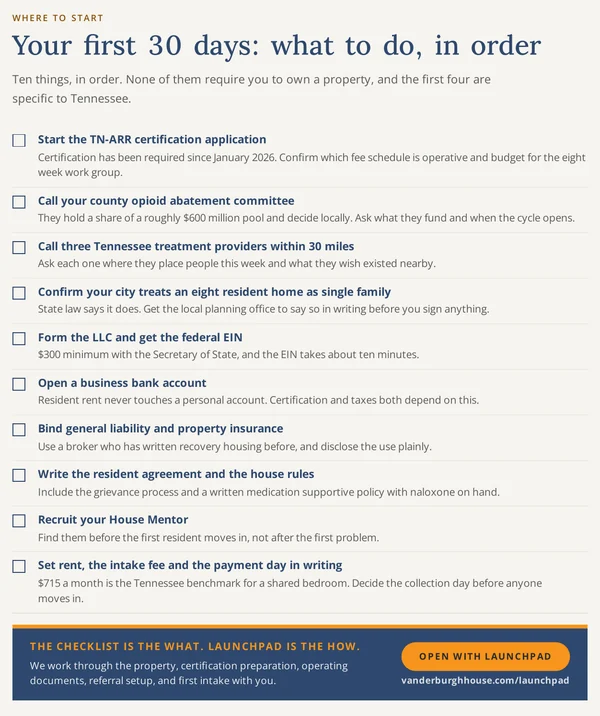
Most people ask whether they are allowed to open a recovery home. The better first question is whether the need and the money are there. This answers both, for your state.
- How many people need a bed, and how few beds exist
- Who actually pays the rent, and which programs are real
- What it costs to open on the purchase path and the lease path
How to Open a Sober House in Memphis: Step-by-Step
The statewide sequence lives in the Tennessee guide. This version is ordered for Memphis, where the classification question sits first rather than fifth, because the city has cited an operator under its family definition and the resulting case is still open. Settle how your house reads under the code before you sign anything, and the rest of the sequence runs roughly nine to fifteen months.
Ten steps, in the order a Memphis operator actually meets them.
Step 1. Settle the Classification Before You Sign
Pull the parcel in the Shelby County Zoning Atlas, which the Division of Planning and Development reaches from its maps page, and confirm the district and whether the address is inside Memphis city limits. It rarely changes the answer here, because the Unified Development Code governs both the city and unincorporated Shelby County, but it decides which body hears an appeal: the Land Use Control Board forwards special use permits to the City Council for city addresses and to the county commission for the rest.
Then read the district against the use table rather than the zoning label. A supportive living facility is permitted by right in every R and RU district; a transitional home is a social service institution, which the use table permits in no residential district at all. If a recovery home is already operating nearby, that tells you nothing about your own exposure, because A Vision For You v. City of Memphis is being litigated over exactly this, and the city has not published an interpretation.
Tennessee guideTennessee Zoning, Fair Housing, and Land Use Laws for Sober LivingWhere sober homes can operate in Tennessee and the legal protections that apply.→Step 2. Form the Entity and Register the Business
The entity signs the lease or the note, not you. A Tennessee LLC files articles of organization at $50 per member with a $300 minimum, and the annual report runs on the same floor, so a two-member single-house LLC budgets $300 to form and $300 a year to stay in good standing. Get the EIN and the business bank account open before the first resident pays anything, because commingled rent is the fastest way to make a nonprofit-versus-commercial argument harder than it needs to be.
Memphis businesses register twice. The Shelby County Clerk issues the county business license for $15, filed within 20 days of opening, and the City of Memphis adds a $15 city license through the same clerk, so $30 covers both. Under the state’s business tax tiers, gross receipts under $3,000 are exempt and $3,000 to $99,999 takes a minimal activity license, which is where a single eight-bed house lands.
Tennessee guideHow to Form a Legal Entity for a Sober Living Business in TennesseeLLC, nonprofit, or both: how Tennessee operators structure the business and the property.→Step 3. Choose a Property That Passes the Family Test
The Unified Development Code defines family as an individual or people related by blood, marriage or adoption; a group of not more than four unrelated persons; or eight or fewer people with disabilities plus up to three houseparents or guardians, in a residence licensed where required or otherwise approved by the zoning administrator. The third prong carries the clause the whole Memphis fight turns on: it does not apply where the residence is operated on a commercial basis. Choose the house and the operating structure together.
- Eight residents, not more: The third prong caps the protected household at eight people with disabilities plus three support staff, and Tenn. Code Ann. § 13-24-102 sets the same number for every zoning law in the state.
- One kitchen, one household: Keyed interior doors, several mailboxes and room-by-room rent are the evidence the code lists for a boarding house, which no residential district permits by right.
- Four or five bedrooms above grade: Eight residents in a house with two legal bedrooms is a certificate of occupancy problem before it is a zoning problem.
- A governance structure that is not plainly commercial:Nichols v. Tullahoma Open Door, Inc., 640 S.W.2d 13 (Tenn. Ct. App. 1982), held that a nonprofit home taking government subsidies and resident payments was not operated on a commercial basis.
Two anchors set the budget. HUD puts the FY2027 fair market rent for the Memphis TN-MS-AR metro at $1,717 for three bedrooms and $1,981 for four, effective October 1, 2026, and the Memphis Area Association of Realtors reported a median sale price of $238,175 in August 2026, up 5.9% year over year. Those two figures drive the cost table further down this page.
Tennessee guideSober Living Startup Costs in TennesseeEvery one-time cost to open, on the lease path and the purchase path, with the Tennessee figures behind each line.→Step 4. Clear Fire, Building and Occupancy
Memphis and Shelby County adopted the 2021 International Building Code effective December 31, 2021, along with the 2021 IRC as the Memphis and Shelby County Residential Code and the 2021 International Fire Code at Memphis Code § 9-36-1. Smoke and carbon monoxide alarms follow IRC R314 and R315, and both sections pull an existing house up to new-dwelling standards once alterations or repairs require a permit. The Memphis Fire Department Fire Prevention Bureau takes inspection requests through the Develop 901 portal and answers within 48 hours.
The trap is the certificate of occupancy. Local amendment 14 to the building code adds a posting requirement and states that a certificate of completion grants no authority to occupy before a certificate of occupancy issues, and a change of occupancy routes the building to the 2021 International Existing Building Code as locally amended. An older Memphis house with a converted garage bedroom, or one that last operated as a care facility, needs that settled with Construction Enforcement before an inspector is standing in the driveway. The requirements and their citations are set out below.
Step 5. Write the Governing Documents
TN-ARR reviews the document set at application, and Tenn. Code Ann. § 33-2-1404, added effective January 1, 2026, names fifteen minimum standards every approved certifier must impose. Write to the statute: drug and alcohol testing, resident exit plans covering relapse and relocation, a good-neighbor policy, an emergency medication and condition list, full accounting of resident money, smoke and carbon monoxide detectors and extinguishers, family notification including overdose death, weapons prohibitions, and a grievance procedure. Add the one most templates skip: a neighbor-relations plan naming who answers the phone when a neighbor calls and what that person says. In Memphis that document has a case number behind it.
Keep readingHouse Rules in Sober HousesThe rules that keep a recovery home safe, structured, and worth living in.→Step 6. Quote the Insurance for the Actual Address
Get a quote on the specific parcel before signing, because this is the line the state cost model leaves unpriced and Memphis is not an average Tennessee address for property risk. Tell the carrier plainly that the house is peer-supported recovery housing with no clinical services, ask for a dwelling policy plus a separate general liability policy, and ask whether the carrier treats the use as a rooming house. Getting sober house insurance right is a pricing question in most states and a classification question here. Bind before closing, not after.
Step 7. Recruit the Live-In House Mentor
A NARR Level II home works because someone with time in recovery lives in it and holds the structure. Memphis recruits well for this: the Memphis Area Intergroup Association lists dozens of meetings a day, and certified peer recovery specialists move through the Recovery Navigator program at CAAP. Put the arrangement in writing, move the house mentor in before the first resident, and carry the free bed as a line in the pro forma rather than a surprise in month two.
Step 8. Certify With TN-ARR
Certification is voluntary in law and close to mandatory in practice. Tenn. Code Ann. § 33-2-1402 bars licensed providers, judges and magistrates from referring anyone to an uncertified recovery residence, bars state funds from reaching one, and requires an uncertified home to post an 11 by 17 inch notice on its own wall directing residents to the Tennessee REDLINE. In a market where the courts and the county are the referral engine, an uncertified Memphis house is legal and empty. The NARR affiliate certification model behind it is the same one 30-odd states run.
- Confirm the support level. Levels I, II and III are certifiable, and Level II is what most Memphis operators should target.
- Prepare the policy set against the fifteen statutory minimum standards, then clear the work group.
- Pass the on-site assessment, after which the certification runs no more than three years with an annual physical site inspection.
Step 9. Open the Referral Doors Before You Open the House
Publicly funded referrals in Shelby County run through the courts, the Office of Reentry and the VA, and every one of them asks the same first question: are you certified. Discharge planners at Alliance Healthcare, Memphis Recovery Centers, Serenity and Grace House place with houses they have seen. Call the partners in the table below while the house is still being painted, invite three of them to tour it, and list with the Tennessee REDLINE at 1-800-889-9789. Those weeks cost nothing before the first mortgage payment and everything after it.
Step 10. Open, Then Hold Occupancy
The state model assumes 82% occupancy, an 18% vacancy allowance, and it is the number that decides whether a Memphis house clears. It is a harder number to hold here than the statewide figure suggests, because Memphis household income runs about $51,736 against $63,767 countywide, so the fee a resident can actually pay sits at the bottom of the Tennessee range and every empty week costs more relative to the rent roll. The first quarter is for proving to three referral partners that you answer the phone and take the hard placement. Admit slowly enough to keep the house stable, hold the weekly house meeting from week one, track occupancy daily, and send referral partners a short monthly note saying how many beds are open.
Keep readingHow Sober Houses Fill Beds and Stay FullProven occupancy strategies from established recovery housing operators.→Nine to fifteen months from decision to first resident is realistic in Memphis.
| Phase | Weeks (estimated) | What gets done |
|---|---|---|
| Zoning and property search | Weeks 1 to 8 | Atlas check, district and use-table read, offers written subject to a code review. |
| Entity, registration, insurance | Weeks 4 to 10 | LLC filing, EIN, bank account, county and city licenses, insurance quotes bound at closing. |
| Acquisition and permits | Weeks 8 to 24 | Closing or lease, any permit work, certificate of occupancy resolved, alarms brought to R314 and R315. |
| Documents and certification | Weeks 12 to 36 | Policy set drafted to the fifteen standards, TN-ARR training, work group, on-site assessment. |
| Referral outreach and lease-up | Weeks 20 to 52 | Partner tours, REDLINE listing, first admissions, occupancy tracked to the model. |
Timelines are estimated. What adds months in Memphis specifically is a certificate of occupancy dispute on an older converted house, and any neighborhood objection that pushes an address toward the Board of Adjustment. Both are avoidable by resolving classification before the offer rather than after.
Best Neighborhoods for a Sober Living Home in Memphis
A workable Memphis address passes four tests, and they are not the tests a residential buyer would use. Memphis is a low-density city with hourly buses outside a few corridors, so transit and house size fight each other in most of the market.
- The house reads as one household: Four or five bedrooms above grade, one kitchen, no separate entrances, in a district where the use table does not force a special use permit.
- A resident can reach work without a car: MATA rebuilt to 24 routes in 2025, and frequency outside the Poplar, Summer, Madison and Third corridors runs 60 to 120 minutes.
- Providers and courts are a reasonable trip: Discharge planners place where they can follow up, and supervision conditions assume the person can get downtown to 201 Poplar Avenue.
- The block will not organize against you: Memphis community development corporations and neighborhood associations are strong, unevenly distributed, and the difference between a quiet opening and a code complaint.
Six areas follow, with housing figures from the American Community Survey 2020 to 2024 five-year estimates at the ZIP code level, plan references from the city’s Memphis 3.0 district and small area plans, and route frequencies from the MATA system map current to September 2026.
| Area | Housing stock and transit | Siting notes for a sober living home |
|---|---|---|
| Whitehaven (38116) | Median value $138,600, with 2,731 four- and five-bedroom units and 54% of stock built 1960 to 1979. The Whitehaven small area plan designates a nurture anchor at Wesley Drive, Southwest Tennessee Community College and Methodist South Hospital. Routes 39A and 39B South Third at 60 minutes, with Route 28 Airport into the Airways Transit Center. | Large brick ranches on big lots, a city-designated anchor, a hospital, a community college and the airport job cluster. Soft appraisals make a renovation loan harder. |
| Raleigh (38128) | Median value $138,000, with 2,865 four- and five-bedroom units, the largest count of any area here. The Raleigh small area plan centers revitalization on Raleigh Springs. Route 40 Stage only, at 120 minutes. | The best large-house supply per dollar in the city and the worst transit frequency. Budget a house van or do not promise bus-based work. |
| Highland Heights and Berclair (38122, 38108) | Median value $123,000 in 38122 and $71,200 in 38108, both about two-thirds built before 1960. The Highland Heights small area plan sits inside the University District. Route 8 Chelsea and Highland at 45 minutes and Route 53 Summer at 60. | The best frequency per dollar on this list, next to the Summer Avenue jobs corridor. Pre-war frame houses carry real electrical and plumbing exposure in a city that inspects on complaint. |
| University District and Normal Station (38111) | Median value $190,100, with 2,583 four- and five-bedroom units and 63% built before 1960. See the University District plan. Routes 2 Madison, 34 Central and Walnut Grove, 50 Poplar and 57 Park. | Genuine large older houses, close to the Poplar and Union medical corridor. You are bidding against student landlords for the same five-bedroom stock. |
| Frayser (38127) | Median value $90,300, but only 1,826 four- and five-bedroom units across 17,662 homes. See the Frayser district plan. Route 11 Frayser at 60 minutes and Route 32 at 90. | The cheapest acquisition in Memphis, and the five-bedroom stock barely exists. Frayser CDC is the institution to approach first rather than around. |
| Cooper-Young and Midtown (38104) | Median value $317,200, roughly three and a half times Frayser, 65% built before 1960. See the Core City district plan. The strongest transit in the sample: Routes 2, 8, 42 Crosstown and 50 Poplar. | Beautiful stock, dense meetings, and the block where the city issued its 2024 citation. The most organized association in Memphis plus the highest prices makes it the wrong first house. |
Three house features decide the answer anywhere in Memphis, whatever the ZIP code.
- Bedrooms above grade: Four or five, permitted, with the certificate of occupancy to match. A finished basement bedroom in a 1950s ranch is where the permit history usually breaks.
- One kitchen and shared common space: The code lists keyed interior doors and multiple mailboxes as evidence of a boarding house, so the house has to read as a household on walk-through.
- Parking off the street: Nothing in the code requires it for a dwelling, and nothing generates a neighbor complaint faster than six cars on a Memphis residential block.
The suburbs inside Shelby County run their own codes: Bartlett, Germantown, Collierville, Millington, Arlington and Lakeland each zone separately, so an address there is a different research project even though Construction Enforcement still issues the permits.
- ✓Room-by-room requirements for a Level II home
- ✓Zoning and occupancy questions to ask before you tour
- ✓The red flags that should end a showing early
Who Regulates Sober Living Homes in Memphis?
No single agency regulates sober living homes in Memphis. The state decides what counts as treatment and therefore what needs a license, TDMHSAS approves the organizations that certify recovery residences, the Division of Planning and Development administers one zoning code covering both the city and unincorporated Shelby County, Construction Enforcement issues permits and certificates of occupancy, the Memphis Fire Department inspects, and the county clerk issues the business license.
A sober living home is a shared residence where adults in recovery pay their own way, follow house rules and support each other, with no treatment delivered on site. That definition is what keeps it outside state licensure: § 33-2-1401(7) describes a recovery residence as substance-free housing built on supervised, monitored or peer-led support that provides no medical or clinical services beyond verifying abstinence, while § 33-2-405 makes operating an unlicensed treatment facility a Class B misdemeanor with each day a separate offense. Add counseling or medication administration and the house changes category. The recovery housing terms in circulation blur this line constantly, and Memphis officials do not.
| Layer | Agency | What it controls for a sober living home |
|---|---|---|
| State licensure | Tennessee Department of Mental Health and Substance Abuse Services (TDMHSAS) | Licenses treatment facilities under Title 33, chapter 2, part 4, not peer-support housing. No license exists for a recovery residence. |
| State certification framework | TDMHSAS, through approved certifying organizations | Approves the organizations that certify recovery residences. TN-ARR and Recovery Is The New High hold three-year approvals that began January 1, 2026. |
| Zoning and land use | Memphis and Shelby County Division of Planning and Development | Administers the Unified Development Code for the city and unincorporated county; the Land Use Control Board hears special use permits and the Board of Adjustment hears variances and conditional uses. |
| Building and occupancy | Memphis and Shelby County Office of Construction Enforcement | Issues permits and the certificate of occupancy, through the Develop 901 portal. |
| Fire | Memphis Fire Department, Fire Prevention Bureau | Inspections, plan review and code enforcement under the 2021 International Fire Code as adopted at Memphis Code § 9-36-1. |
| Business registration | Shelby County Clerk and the City of Memphis | $15 county license plus a $15 city license, both through the clerk. |
For an operator, the whole regulatory picture reduces to four lines.
- State license: None required for a non-clinical recovery residence.
- City license: A $30 business registration, county and city combined, and nothing sober-living-specific.
- Certification: Voluntary in law, and the thing that decides whether referrals are legally permitted to reach you.
- Referrals: Controlled by the courts, the Office of Reentry, the VA and treatment discharge planners, all of whom check certification first.
Licensing is the easy part in Memphis, and certification is a known process with published fees. What actually constrains an operator here is the zoning code, and specifically one clause in a definition written for group homes in 1978.
Memphis Zoning Laws for Sober Living Homes
Memphis has no sober living ordinance, no spacing or distance separation rule between recovery homes, and no resident cap written for recovery housing. A search of the Unified Development Code, the Memphis City Council and Shelby County Commission records and the Memphis and Shelby County code of ordinances on September 16, 2026 found no ordinance, resolution or moratorium of that kind. What governs instead is the code’s definition of family, the use table, and how the city has chosen to enforce both.
How the Unified Development Code Treats a Sober Living Home
The code carries no use called sober living home, recovery residence, group home or halfway house. It carries four adjacent definitions, and which one a plan reviewer picks decides everything about the address.
- Family, Article 12 § 12.3.1: Either people related by blood, marriage or adoption; or “a group of not more than four persons who are not related”; or “eight or fewer unrelated mentally retarded, mentally handicapped or physically handicapped persons” plus up to three houseparents or guardians, in a residence licensed where required or approved by the zoning administrator. The prong ends: “This (c) definition of family does not apply to residences wherein [such] persons reside when such residences are operated on a commercial basis” (UDC Art. 12).
- Supportive living facility: The same eight-plus-three household, carrying the same commercial-basis exclusion. This is the use Memphis cited the Cooper-Young operator under.
- Transitional home: A residence for rehabilitating people from correctional facilities, mental institutions “and alcoholic and drug treatment centers,” operated by a licensed public or private agency with continuous professional guidance.
- Boarding house and rooming house: Lodging for compensation to five or more non-transients, or to four or fewer transients, with keyed interior doors, multiple mailboxes and room-for-rent signs listed as the evidence.
The use table is where those definitions bite. A supportive living facility is permitted by right in every residential district, from R-E through RU-4. A transitional home is classified as a social service institution, and that row is a special use in exactly six districts, all of them commercial, civic, employment or industrial, and blank in every residential district on the table. A boarding house is not permitted by right in any R district, and a rooming house needs a conditional use permit from the Board of Adjustment. So a Memphis house is analyzed as a household when it reads as a supportive living facility and is not operated on a commercial basis, and it is exposed the moment either half of that fails.
Memphis is rewriting the entire Unified Development Code. Public Draft 3 and an August 13, 2026 use table would replace these definitions with care home, reentry home, residential co-living and residential substance abuse treatment facility uses, each with its own district permissions. None of it is adopted as of September 16, 2026, and the current code still governs, but anyone buying in Memphis this year should read the draft documents before committing to a district.
What the Eight-or-Fewer Rule Does and Does Not Do
Operators quote the eight-or-fewer rule in Memphis as though it settles the matter. It does not, and the reason is in the sentence that follows it in both the state statute and the city code.
- Tenn. Code Ann. § 13-24-102: For any zoning law in Tennessee, “single family residence” includes a home where eight or fewer unrelated persons with disabilities reside, plus up to three support staff or guardians (the statute).
- Tenn. Code Ann. § 13-24-104: The same part “does not apply to such family residences wherein persons with disabilities reside when such residences are operated on a commercial basis” (the exclusion). Memphis copied both halves into its own definition.
- What “commercial” means:Nichols v. Tullahoma Open Door, Inc., 640 S.W.2d 13 (Tenn. Ct. App. 1982), read the word in its ordinary sense and held that a nonprofit home receiving government subsidies, mortgage reimbursements and per-resident payments was not operated on a commercial basis. No published Tennessee decision extends that to a for-profit recovery residence.
Where the state classification runs out, federal law starts. People in recovery from substance use disorder are protected under the Fair Housing Act and the Americans with Disabilities Act, and the HUD and DOJ joint statement on state and local land use of November 10, 2016 sets out how those protections reach zoning decisions. That is the framework behind sober living zoning everywhere, and the practical tool inside it is requesting reasonable accommodation in writing, before enforcement rather than after.
Keep readingThe Federal Fair Housing Act and Sober Living: Everything You Need to KnowThe federal protections every operator, neighbor, and local official should understand.→A Vision For You v. City of Memphis, and What It Has Not Decided
In October 2024 Memphis code enforcement cited the operator of a recovery home at 1925 Nelson Avenue in Cooper-Young for operating a supportive living facility on a commercial basis in a single-family district, with a court date set for November (FOX13 Memphis, October 25, 2024). The operators sued. A Vision For You, LLC v. City of Memphis, No. 2:24-cv-03007-JPM-atc (W.D. Tenn.), was filed December 18, 2024, and on June 17, 2025 the court denied the motion to dismiss, holding the plaintiffs had standing on their Fair Housing Act and ADA claims because the city’s conduct interfered with the ability to provide housing to people in recovery. The docket shows a motion for judgment on the pleadings denied on August 28, 2026 and activity through September 4, 2026.
- Two written reasonable-accommodation requests, in August and October 2024, asking the city to treat the residents as a family under the code and to waive the nonprofit requirement.
- A further request to be excused from a wet sprinkler system requirement.
- Both denied, followed by the citation and the federal complaint.
What has not changed is as important as what has. No ordinance was passed, no definition was amended, and nothing in the Unified Development Code binds a Memphis operator differently today than it did in 2023. The case is pending, so it decides nothing yet. What it does is tell you exactly which argument the city makes, and the Sixth Circuit authority it will be made against.
- Larkin v. Michigan Dep’t of Social Services, 89 F.3d 285 (6th Cir. 1996): Spacing requirements and neighbor-notice provisions aimed at group homes facially discriminate against people with disabilities and are preempted by the Fair Housing Amendments Act (opinion). It is part of why Memphis has no spacing rule to enforce.
- Smith & Lee Associates v. City of Taylor, 102 F.3d 781 (6th Cir. 1996): The Act required the city to accommodate a home for elderly disabled residents by allowing up to nine residents in a single-family zone (opinion). This is the template for an over-eight accommodation request.
- Anderson v. City of Blue Ash, 798 F.3d 338 (6th Cir. 2015): The current published Sixth Circuit statement of the reasonable-accommodation elements against a city enforcing its own ordinance (opinion).
For an operator buying in Memphis this year, the file means three concrete things.
- Put every accommodation request in writing, dated, to a named person at the Division of Planning and Development, and keep the reply.
- Decide the ownership structure before the offer, because nonprofit or for-profit is the first fact the city reaches for.
- Do not treat a nearby operating home as proof that yours is safe, and do not treat the pending case as a rule in your favor.
How your home gets classified, where Fair Housing applies, and what to do if the city says no.
Memphis Fire and Building Code Rules for Sober Living Homes
A single-family Memphis house with eight residents and no on-site care is a Group R-3 occupancy under the 2021 International Building Code as locally adopted, which covers congregate living facilities of 16 or fewer non-transient occupants. Three points decide what the building and fire departments actually ask for.
- The custodial care line: IBC § 310.6 puts a facility into Group R-4 when more than five but not more than 16 people “receive custodial care,” and the list of R-4 uses names alcohol and drug centers, group homes and halfway houses. A peer-support house provides no custodial care, which is the argument, and Memphis has published no written interpretation either way.
- The certificate of occupancy: Local amendment 14 states that a certificate of completion grants no authority to occupy before a certificate of occupancy issues, and a change of occupancy routes the building to the 2021 International Existing Building Code as locally amended. The fee is $125.
- What the fire department covers:The Fire Prevention Bureau inspects hospitals, hotels, schools and certain other structures annually, reviews plans, and takes inspection requests through the Develop 901 portal with a 48-hour response. A single-family dwelling is not on the annual list, so nothing prompts an inspection until someone asks for one.
Alarms are where first-time Memphis operators fall short of both the code and the TN-ARR assessment, and the requirements below apply to every dwelling in the city regardless of who lives in it.
| Requirement | What the rule says | Authority |
|---|---|---|
| Smoke alarms | In each sleeping room, outside each sleeping area, and on every story including basements, interconnected and hard-wired with battery backup. | IRC R314.3, R314.4, R314.6, 2021 IRC as locally adopted |
| Retrofit trigger | Alterations, repairs or additions that require a permit bring the whole dwelling up to new-dwelling alarm standards. | IRC R314.2.2 |
| Carbon monoxide alarms | Outside each separate sleeping area, and inside a bedroom containing a fuel-burning appliance. Same permit-based retrofit trigger, with exceptions for exterior-surface work. | IRC R315.2.2, R315.3 |
| Fire sprinklers | Not required in an existing one- or two-family dwelling. Memphis and Shelby County deleted IRC R313.1 and R313.2 outright, and the state rule makes R313 non-mandatory. | Local IRC amendments 15 and 16; Tenn. Code Ann. § 68-120-101(a)(8) |
| When sprinklers do apply | Once a house is reclassified out of Group R-3 into R-4 or I-1, the building code requires sprinklers throughout the Group R fire area. | IBC § 903.2.8 |
| Adopted codes | 2021 IBC, 2021 IRC as the Memphis and Shelby County Residential Code, 2021 IEBC and 2021 IFC locally; the state fire marshal adopts the 2018 IRC and 2021 NFPA 101 statewide. | Joint ordinance, effective December 31, 2021; Tennessee State Fire Marshal |
Nobody makes a Memphis single-family house comply. No annual inspection reaches it, and the alarm retrofit rules trigger on a permit the operator pulls voluntarily, so the burden sits entirely with the operator until a complaint, an insurance claim or a certification assessment arrives. Settle the bedroom count against the certificate of occupancy before the TN-ARR site visit rather than after, and work the occupancy math on paper first.
Alarms, egress, extinguishers, and the documentation an inspector expects on file.
Get the checklist freeNo cost, no obligation. Unsubscribe in one click.How Much Does It Cost to Open a Sober House in Memphis?
Tennessee sober living startup costs run from about $24,872 on a lean eight-bed lease to $133,881 on a purchase, with the purchase path starting near $105,387 and an operating reserve of $8,109 built in. The single largest line statewide is the down payment, modeled at $74,400 on an adjusted acquisition price of $372,000, which is Tennessee’s median sale price of $344,667 as of June 30, 2026 plus a disclosed 8% recovery-housing premium. Memphis changes two inputs and leaves the rest alone: the lease anchor and the purchase anchor. Furnishing, certification, insurance and the reserve hold at the state figures.
| Line item | Memphis figure | Source |
|---|---|---|
| Four-bedroom lease anchor | $1,981 a month, effective October 1, 2026 | HUD FY2027 fair market rents, Memphis TN-MS-AR metro (Federal Register notice) |
| Three-bedroom lease anchor | $1,717 a month, same schedule | HUD FY2027 fair market rent schedule |
| Purchase anchor | $238,175 median sale price, August 2026, up 5.9% year over year | Memphis Area Association of Realtors, August 2026 market report |
| Adjusted acquisition, estimated | About $257,000, applying the state model’s disclosed 8% recovery-housing premium to the local median | Estimated from the MAAR median using the state model’s own premium |
| Down payment at 20%, estimated | About $51,400, against $74,400 in the state model | Estimated from the adjusted acquisition price above |
| Annual property tax, estimated | About $3,397, or $283 a month, at the combined city and county rate of $5.283192 per $100 assessed and a 25% residential ratio | City of Memphis 2026 rate, Shelby County 2026 rate, Trustee calculation method |
| Entity and registration | $300 LLC formation floor, $300 annual report, $30 combined city and county business license | Tennessee Secretary of State, Shelby County Clerk |
| Certification, year one at eight beds | $1,406, being a $990 one-time training fee plus $416 in annual service fees | TN-ARR fee schedule |
Two adjustments turn the statewide model into a Memphis budget, and only one of them moves much.
- Purchase path: Swapping the state’s $74,400 down payment for about $51,400 on the adjusted Memphis acquisition price takes roughly $23,000 out of the purchase subtotal, bringing it to around $82,000 at the lean end, estimated. That still excludes closing costs, renovation, and any certificate of occupancy work an older converted house needs.
- Lease path: It barely moves. A four-bedroom at the FY2027 fair market rent of $1,981 is close to the state model’s assumption, so test a landlord’s quote against that figure and treat anything far above it as a recovery-housing premium you are being asked to pay twice.
Memphis has no grant, voucher or subsidy that pays a sober living operator to open. Money reaches recovery housing here indirectly, and three routes are worth knowing before you plan around any of them.
- TDMHSAS Creating Homes Initiative: Seed grants to nonprofits creating recovery and reentry beds. The April 2025 round put $5.2 million into 12 agencies for 101 beds across nine counties including Shelby. Applications run through the CHI program and its West Tennessee housing facilitator.
- Opioid abatement funds: Shelby County received a first direct subdivision payment of $3,579,148 and is the largest county recipient in the state. Recovery housing is an eligible abatement activity, and the council’s community grant cycles are open to applicants.
- Purchased placements: The Office of Reentry buys housing placements from partner providers under a $999,101 federal Smart Reentry award rather than paying a per-diem to operators directly.
None of these is startup capital, and none of them is a rent subsidy. They are competitive grants that reach nonprofits and agencies, mostly after a home is already running, and the Creating Homes Initiative money goes to creating beds rather than carrying them. Build the budget as though no public dollar arrives, because for a new for-profit operator in Shelby County, none will.
Tennessee guideTennessee Recovery Housing Funding: Why It Rarely Works the Way Operators ExpectBlock grants, opioid settlement dollars, Medicaid, and county contracts: what reaches a sober living home and what does not.→Is a Sober Living Home Profitable in Memphis?
Yes, if the house is certified and stays near full, and the Memphis version of that answer is better than the state’s on carry and worse on nothing. The Tennessee reference model runs a 14-bed owner-operated home at $7,303 a month in revenue against $3,720 in operating costs, leaving $3,583 in net operating income before the owner’s labor, a 49% margin, on an adjusted purchase price of $372,000 financed at 80% loan to value over 30 years at 6.65%. Memphis changes two lines in that stack: the mortgage and the property tax.
The score is a statewide reading, and Memphis pulls it in two directions at once: the lowest acquisition cost in Tennessee against the lowest resident ability to pay. The table below restates the state model and scales only the property lines.
| Line | Tennessee reference model ([N] beds) | Memphis adjustment (estimated) |
|---|---|---|
| Monthly revenue, 14 beds at 82% occupancy | $7,303 | Unchanged |
| Mortgage principal and interest | $1,910 on a $297,600 loan | About $1,321 estimated, on a loan of roughly $205,800 at the same 6.65% and 80% loan to value, from the Memphis median sale price |
| Real estate taxes | $136 | About $283 estimated, at Memphis’s and Shelby County’s combined 2026 rate of $5.283192 per $100 assessed |
| Property insurance | $224 | Unchanged. Quote the address; the state model prices off the NAIC state average with an uplift |
| All other operating costs | $1,450 | Unchanged |
| Total monthly operating costs | $3,720 | About $3,278 estimated |
Everything except the mortgage and the property tax is held at the state figures, and both adjusted lines are estimates rather than quotes. Together they run about $442 a month below the state model, so the same revenue carries a modeled net operating income of roughly $4,025 a month, estimated, instead of $3,583. Shrink the house to the eight residents the family definition protects and that margin nearly disappears, which is the real Memphis trade: the eight-bed house is the safe one, and the 14-bed house is the profitable one.
- Occupancy, not the mortgage: The mortgage is the cheapest line in Memphis and vacancy is the most expensive. One empty bed for a quarter costs more than the entire property tax difference.
- Certification status: An uncertified house is cut off from court, reentry and VA referrals by statute, which is an occupancy problem expressed as a compliance problem.
- The fee a Memphis submarket can carry: The statewide anchor is about $165 a week for a shared bed. Memphis household incomes run below the state, so the fee that fills a house here is set by what a person earns in a first job back, not by the mortgage.
Your property will not match the model, and finding out how far off takes a few minutes with real numbers.
Will your property pencil out?
Get a custom projection for your Tennessee property, then compare it with typical returns.
Get my projectionFree calculator with your property’s numbers.See Tennessee profitabilityRealistic revenue, operating costs, and margins in Tennessee.How to Get Residents for a Sober Living Home in Memphis
Publicly funded referrals in Shelby County run through the courts, the Office of Reentry and the VA, and private referrals come from treatment discharge planners. Three doors matter most, and all three check certification before they send anyone.
- The Tennessee REDLINE, 1-800-889-9789: The 24-hour statewide treatment referral line, and the number the statutory disclosure sign itself directs residents to (TDMHSAS). It is the listing every Memphis house should hold.
- The Returning Neighbors Program:The Shelby County Office of Reentry buys housing placements from partner providers under a federal Smart Reentry award rather than paying operators a per-diem, so eligibility runs through the release plan and the partner list, not an application you file.
- Certification:Tenn. Code Ann. § 33-2-1402 bars licensed providers, judges and magistrates from referring anyone to an uncertified recovery residence and bars state funds from reaching one, which makes TN-ARR certification a referral requirement in everything but name.
Twenty organizations carry most of the placement traffic in Shelby County. Public agencies and the courts lead the list because they control the referrals that come with a funding source attached.
| Organization | Type | How residents reach you |
|---|---|---|
| Shelby County Recovery Court | Court | A judicially supervised 12 to 18 month docket, four phases, ordering treatment and drug screens. Stable housing is a phase condition. |
| Shelby County Veterans Treatment Court | Court | Tennessee’s first veterans court; makes community resource referrals for housing alongside treatment. |
| Shelby County Mental Health Court | Court | Co-occurring participants routed to supportive housing as a supervision condition. |
| Shelby County Office of Reentry | County agency | The Returning Neighbors Program buys placements at release; a certified residence is a qualifying placement. |
| Shelby County Probation | County agency | Misdemeanor probation and diversion officers impose residence and treatment conditions. |
| VA Memphis, Lt. Col. Luke Weathers Jr. VA Medical Center | Federal | HUD-VASH case managers place veterans directly; the Grant and Per Diem program funds transitional beds. |
| Shelby County Health Department | County agency | Overdose outreach and naloxone distribution at five clinics feed people into treatment and then into housing. |
| Tennessee Recovery Navigators, delivered locally by CAAP | Peer program | Certified peers meet overdose patients in emergency departments and route them to treatment and housing. |
| Alliance Healthcare Services | Nonprofit provider | The largest behavioral health provider in Memphis; crisis stabilization discharge planning refers to recovery residences. |
| Memphis Recovery Centers | Nonprofit provider | Residential and intensive outpatient treatment with step-down discharge planning to sober living. |
| Serenity Recovery Centers | Nonprofit provider | Gender-specific residential care in Midtown; clients without a safe home go to recovery housing at discharge. |
| Grace House of Memphis | Nonprofit provider | Women’s residential and extended care since 1976; extended care is itself a bridge to independent sober living. |
| Harbor House | Nonprofit provider | Long-standing residential treatment discharging to transitional and recovery housing. |
| The Salvation Army Purdue Center of Hope | Nonprofit provider | Residential recovery for women and children; graduates move on to independent sober housing. |
| Hospitality Hub of Memphis | Nonprofit | The continuum of care’s single entry point, running jail-release referrals and treatment connections. |
| Community Alliance for the Homeless | Continuum of care lead | Coordinated entry and HMIS for Memphis and Shelby County; routes households with substance use histories toward recovery-supportive housing. |
| Catholic Charities of West Tennessee | Nonprofit | Street outreach and veteran housing case management place people into housing including recovery residences. |
| Regional One Health | Hospital | The public safety-net hospital; emergency department discharge planning for overdose and withdrawal patients. |
| Methodist Le Bonheur Healthcare | Hospital | The largest system in Shelby County; behavioral health discharge referrals into community treatment and housing. |
| HopeWorks | Nonprofit | Reentry and workforce participants needing sober, stable housing are referred out to recovery residences. |
The fellowships refer more residents than any agency does, informally. The Memphis Area Intergroup Association of Alcoholics Anonymous answers a 24-hour line at (901) 454-1414 and lists meetings across the county every day of the week, and the West Tennessee Area of Narcotics Anonymous runs a helpline at (901) 276-5483. Neither organization refers formally or endorses any home. Meeting secretaries and sponsors are still how a large share of Memphis residents find a bed, which is a reason to be present in the rooms long before you need them.
If you are reading this looking for a bed rather than a business plan, the REDLINE at 1-800-889-9789 answers 24 hours a day, and the link below goes straight to available homes.
Take the next step
Apply, browse homes, or search the national directory.
Apply onlineGet a call back within 24 hours.View VSL homesSee Chartered recovery homes and find the right fit.Search the national directoryCertified sober houses anywhere in the US.Or call (844) 762-3747, weekdays 8a to 5p.
Common Mistakes When Opening a Sober House in Memphis
The errors that sink a Memphis house in year one happen early, usually before the closing, and every one of them is a local version of a national mistake.
- Buying before reading the use table: A district label tells you nothing here. A supportive living facility is permitted by right in every R district and a transitional home is permitted in none of them, and the difference is the description you give the city, not the house you bought.
- Treating the eight-or-fewer rule as the end of the analysis: Memphis copied both halves of the state statute, and the second half excludes homes operated on a commercial basis. That clause is what the city cited in Cooper-Young, and it is what the federal case is about.
- Using statewide cost figures on a Memphis pro forma: Memphis property is cheaper than the Tennessee median and the combined city and county tax rate is high, so both the mortgage line and the tax line move, in opposite directions. A budget built on the state median overstates one and understates the other.
- Opening uncertified and waiting for referrals: Certification is voluntary, and without it no judge, magistrate or licensed provider may refer to the house and no state dollar may reach it. The beds do not fill and nobody explains why.
- Assuming the bus goes there: Outside a few corridors Memphis runs 60 to 120 minute headways, so a cheap five-bedroom house in Raleigh puts residents an hour from work in each direction unless the house has a van.
- Meeting the neighbors after the complaint: Memphis community development corporations and neighborhood associations are organized and, in Cooper-Young, mobilized. The good-neighbor policy the state now requires by statute works only if somebody has already had the conversation.
The Tennessee book and the state blueprint carry the checklists, the policy templates and the fee schedules behind every step above.

The book gives you the map to open a home. When you’re ready to launch, certify, and sustain, the Blueprint is the full playbook covering funding, legal, insurance, and operations.
Frequently Asked Questions About Opening a Sober House in Memphis
Do you need a license to open a sober living home in Memphis?
No. Tennessee requires no operating license for a non-clinical recovery residence, because Tenn. Code Ann. § 33-2-1401(7) defines a recovery residence as peer-supported housing with no on-site treatment, and TDMHSAS licenses only treatment facilities. Memphis adds no sober-living license of its own. What Memphis does require is a $15 city and $15 county business registration, and what the state effectively requires for referrals is TN-ARR certification.
How many unrelated people can live in a sober living home in Memphis?
The Unified Development Code defines family as up to four unrelated people, or eight or fewer people with disabilities plus up to three support staff, mirroring Tenn. Code Ann. § 13-24-102. The eight-plus-three prong carries an exclusion for residences operated on a commercial basis, and Memphis has enforced that exclusion. Eight residents is the defensible number; more than eight is a reasonable-accommodation request, not a right.
Is there a Memphis ordinance regulating sober living homes?
No. A search of the Unified Development Code, Memphis City Council and Shelby County Commission records, and the municipal code on September 16, 2026 found no ordinance, resolution or moratorium specific to sober living or recovery housing. The city regulates through its family definition and case-by-case code enforcement instead. A full replacement of the Unified Development Code is in public draft and would create new use categories, but it is not adopted.
Does Memphis require sprinklers in a sober living home?
Not in an existing one- or two-family dwelling. Memphis and Shelby County deleted IRC sections R313.1 and R313.2 outright when they adopted the 2021 residential code, and Tenn. Code Ann. § 68-120-101(a)(8) bars a statewide sprinkler mandate for one- and two-family dwellings. Sprinklers become a requirement only if the house is reclassified out of Group R-3 into R-4 or I-1, which is the position a Memphis operator has been litigating since 2024.
What does it cost to open a sober living home in Memphis?
Tennessee startup costs run from about $24,872 on a lean eight-bed lease to $133,881 on a purchase. Memphis changes two inputs: the four-bedroom fair market rent is $1,981 a month from October 1, 2026, and the August 2026 median sale price was $238,175, which puts an estimated 20% down payment near $51,400 rather than the state model’s $74,400. Furnishing, insurance, certification and the operating reserve hold at the state figures.
Which Memphis neighborhoods work best for a sober living home?
Whitehaven offers the best combination of large houses, a city-designated anchor at Methodist South Hospital and Southwest Tennessee Community College, and hourly bus service on South Third. Raleigh has the most four- and five-bedroom stock and the worst transit. Highland Heights and Berclair give the best frequency per dollar. Cooper-Young has the best transit and the highest prices, and it is where the city issued its 2024 citation.
Your Memphis Sober House Startup Checklist
Every item below is covered somewhere above, and each one names the Memphis specific rather than a generic action. None of them is optional here.
Four guides cover the operating ground this page only touches.
How VSL Helps You Open a Sober House in Memphis
Vanderburgh Sober Living charters independently operated recovery homes into a cooperative network, so the operator keeps ownership of the business and gains the brand, the operating standards and the startup support of the Chartered Operator community. The questions this page kept returning to are the ones that support is built around: how a house reads under a local code, what a certifier will ask for at assessment, how to price a bed that a person can pay out of a first job back, and how to build referral relationships before the mortgage starts.
Two routes run from here. The self-paced course covers the sequence end to end on your own schedule, and the Mastery Program puts a team alongside you through zoning, certification and the first admissions. If you are weighing a specific Memphis address, or deciding between leasing in Whitehaven and buying in Raleigh, that is exactly the conversation to have before the offer rather than after.
Start your sober house
Pick the path that fits where you are in the process.
Download the free guidePath to Purposeful Recovery Housing, by Dr. Hunter T. Foote.Explore the Mastery ProgramHands-on startup, certification, and operating support.See how starting with VSL worksThe opportunity, the community, and what a Charter includes.Prefer to talk now? Call (844) 762-3747, weekdays 8a to 5p.
Educational only; not legal, financial, or medical advice. Fees, rents, and rules change, and the Memphis adjustments above are estimates built on the Tennessee reference model. Confirm current requirements with Memphis, Shelby County, and qualified professionals before you sign or spend.
Research & Sources
- Foote, H. T. (2026). Vanderburgh Sober Living Operating Climate Index, 2026 Edition. Vanderburgh Sober Living. https://www.vanderburghhouse.com/research/operating-climate-index-2026/
- Memphis and Shelby County. (2024). Unified Development Code (ZTA 24-2). Shelby County, Tennessee. https://shelbycountytn.gov/DocumentCenter/View/40803/Unified-Development-Code-ZTA-24-2
- Memphis and Shelby County Division of Planning and Development. (2026). Unified Development Code Update: Public Draft Documents. https://www.901udcupdate.com/documents
- Memphis and Shelby County Division of Planning and Development. (2026). Maps and Atlases. https://www.develop901.com/maps-atlas
- Memphis and Shelby County Division of Planning and Development. (2026). Land Use Control Board. https://www.develop901.com/land-use-control-board
- Memphis and Shelby County Division of Planning and Development. (2026). Board of Adjustment. https://www.develop901.com/board-of-adjustment
- Memphis and Shelby County Division of Planning and Development. (2026). Construction Enforcement. https://www.develop901.com/construction-enforcement
- Memphis and Shelby County. (2021). 2021 International Building Code With Local Amendments. https://www.shelbycountytn.gov/DocumentCenter/View/39392/2021-International-Building-Code-with-Local-Amendments
- Memphis and Shelby County. (2021). Local Amendments to the 2021 ICC International Residential Code. https://agenda.shelbycountytn.gov/OnBaseAgendaOnline/Documents/DownloadFileBytes/EXHIBIT%20A%20LOCAL%20AMENDMENTS%20TO%202021%20ICC%20INTERNATIONAL%20RESIDENTIAL%20CODE.PDF.pdf?documentType=1&meetingId=3479&itemId=83216&publishId=232480&isSection=False&isAttachment=True
- City of Memphis. (2021). Ordinance Adopting the 2021 International Fire Code. https://shelbycountytn.gov/DocumentCenter/View/39440/City-Council-Ordinance-IFC-2021_Amendment-Insert
- Shelby County Government. (2022). Building Fee Schedule. https://www.shelbycountytn.gov/DocumentCenter/View/39428/2022-BUILDING-FEE-SCHEDULE
- Develop 901. (2026). Citizen Access Permit Portal. Shelby County, Tennessee. https://aca-prod.accela.com/SHELBYCO/Default.aspx
- City of Memphis Division of Fire Services. (2026). Fire Prevention Bureau. https://www.memphistn.gov/fire-prevention/
- Tennessee State Fire Marshal’s Office. (2025). Adopted Codes and Code History. Tennessee Department of Commerce and Insurance. https://www.tn.gov/commerce/fire/codes-enforcement/history.html
- Tennessee Code Annotated. (2026). § 13-24-102, Single family residence classification. https://law.justia.com/codes/tennessee/title-13/chapter-24/part-1/section-13-24-102/
- Tennessee Code Annotated. (2026). § 13-24-104, Inapplicability to commercial residences for persons with disabilities. https://law.justia.com/codes/tennessee/title-13/chapter-24/part-1/section-13-24-104/
- Tennessee Code Annotated. (2026). § 33-2-1401, Definitions. https://law.justia.com/codes/tennessee/title-33/chapter-2/part-14/section-33-2-1401/
- Tennessee Code Annotated. (2026). § 33-2-1402, Recovery residences; referrals, funding and notice. https://law.justia.com/codes/tennessee/title-33/chapter-2/part-14/section-33-2-1402/
- Tennessee Code Annotated. (2026). § 33-2-405, Unlawful operation without a license. https://law.justia.com/codes/tennessee/title-33/chapter-2/part-4/section-33-2-405/
- Tennessee Code Annotated. (2026). § 68-120-101, Statewide building construction safety standards. https://law.justia.com/codes/tennessee/title-68/safety/chapter-120/part-1/section-68-120-101/
- Tennessee General Assembly. (2025). Public Chapter 406. Tennessee Secretary of State. https://publications.tnsosfiles.com/acts/114/pub/pc0406.pdf
- Tennessee General Assembly. (2021). Public Chapter 309. Tennessee Secretary of State. https://publications.tnsosfiles.com/acts/112/pub/pc0309.pdf
- Tennessee Department of Mental Health and Substance Abuse Services. (2026). Recovery Residences. https://www.tn.gov/behavioral-health/substance-abuse-services/treatment/recovery-residences.html
- Tennessee Department of Mental Health and Substance Abuse Services. (2026). Creating Homes Initiative. https://www.tn.gov/behavioral-health/chi.html
- Tennessee Department of Mental Health and Substance Abuse Services. (2025). TDMHSAS Awards $5,200,000 to Create Affordable Housing. https://www.tn.gov/behavioral-health/news/2025/4/14/tdmhsas-awards–5-200-000-to-create-affordable-housing.html
- Tennessee Department of Mental Health and Substance Abuse Services. (2026). Tennessee Recovery Navigators. https://www.tn.gov/behavioral-health/substance-abuse-services/treatment/peers/tennessee-recovery-navigators.html
- Tennessee Opioid Abatement Council. (2026). Community Grants and Subdivision Payments. https://www.tn.gov/oac/community.html
- Tennessee Department of Health. (2026). Overdose Surveillance and Fatal Overdose Data, 2013 to 2024. https://www.tn.gov/health/odsurveillance.html
- Shelby County Health Department. (2026). Provisional Opioid-Related Data Reports. https://www.shelbytnhealth.com/399/Provisional-Opioid-Related-Data-Reports
- Shelby County Health Department. (2026). Opioid Overdose Prevention. https://www.shelbytnhealth.com/377/Opioid-Overdose-Prevention
- U.S. Department of Housing and Urban Development. (2025). Continuum of Care Homeless Populations and Subpopulations Report, TN-501 Memphis and Shelby County. https://files.hudexchange.info/reports/published/CoC_PopSub_CoC_TN-501-2025_TN_2025.pdf
- U.S. Department of Housing and Urban Development. (2026). FY2027 Schedule of Metropolitan and Non-Metropolitan Fair Market Rents. https://www.huduser.gov/portal/datasets/fmr/fmr2027/FY2027_FMR_Schedule.pdf
- U.S. Department of Housing and Urban Development. (2026). Fair Market Rents for the Housing Choice Voucher Program, Fiscal Year 2027. Federal Register. https://www.federalregister.gov/documents/2026/09/01/2026-17891/fair-market-rents-for-the-housing-choice-voucher-program-moderate-rehabilitation-single-room
- U.S. Department of Justice and U.S. Department of Housing and Urban Development. (2016). Joint Statement on State and Local Land Use Laws and Practices and the Application of the Fair Housing Act. https://www.justice.gov/opa/file/912366/dl
- U.S. Census Bureau. (2025). QuickFacts: Memphis City, Tennessee. https://www.census.gov/quickfacts/fact/table/memphiscitytennessee/PST045225
- U.S. Census Bureau. (2025). QuickFacts: Shelby County, Tennessee. https://www.census.gov/quickfacts/fact/table/shelbycountytennessee/PST045225
- Memphis Area Association of Realtors. (2026). August 2026 Market Report. https://www.maar.org/clientuploads/news/market_statistics/2026/August_2026_Market_Report.pdf
- Shelby County Trustee. (2026). Memphis Tax Rates. https://www.shelbycountytrustee.com/245/Memphis-Tax-Rates
- Shelby County Trustee. (2026). Shelby County Tax Rates. https://www.shelbycountytrustee.com/246/Shelby-County-Tax-Rates
- Shelby County Trustee. (2026). Calculate Taxes. https://www.shelbycountytrustee.com/208/Calculate-Taxes
- Tennessee Secretary of State. (2026). Articles of Organization, Limited Liability Company (SS-4270). https://sos-tn-gov-files.tnsosfiles.com/forms/ss-4270.pdf
- Tennessee Secretary of State. (2026). Business Services Frequently Asked Questions. https://sos.tn.gov/businesses/faqs
- Shelby County Clerk. (2026). Business Tax Division. https://www.shelbycountytn.gov/559/Business-Tax-Division
- City of Memphis. (2026). Licenses and Permits. https://memphistn.gov/licenses-and-permits/
- Tennessee Department of Revenue. (2026). Business Tax Registration and Licensing. https://www.tn.gov/revenue/taxes/business-tax/registration-and-licensing.html
- Tennessee Alliance of Recovery Residences. (2026). Certification and Fee Schedule. https://www.tnarr.org/
- A Vision For You, LLC v. City of Memphis, No. 2:24-cv-03007-JPM-atc (W.D. Tenn.). Docket. CourtListener. https://www.courtlistener.com/docket/69478520/a-vision-for-you-llc-v-the-city-of-memphis/
- A Vision For You, LLC v. City of Memphis, No. 2:24-cv-03007-JPM-atc (W.D. Tenn. June 17, 2025). Order denying motion to dismiss. CourtListener. https://www.courtlistener.com/opinion/10609214/a-vision-for-you-llc-v-the-city-of-memphis/
- Larkin v. Michigan Department of Social Services, 89 F.3d 285 (6th Cir. 1996). CourtListener. https://www.courtlistener.com/opinion/721510/larkin-v-state-of-michigan-department-of-social-services/
- Smith & Lee Associates, Inc. v. City of Taylor, 102 F.3d 781 (6th Cir. 1996). CourtListener. https://www.courtlistener.com/opinion/731244/smith-lee-associates-inc-united-states-of-america-v-city-of-taylor/
- Anderson v. City of Blue Ash, 798 F.3d 338 (6th Cir. 2015). FindLaw. https://caselaw.findlaw.com/court/us-6th-circuit/1710548.html
- Nichols v. Tullahoma Open Door, Inc., 640 S.W.2d 13 (Tenn. Ct. App. 1982). Justia. https://law.justia.com/cases/tennessee/court-of-appeals/1982/640-s-w-2d-13-1.html
- FOX13 Memphis. (2024, October 25). Cooper-Young Community Divided Over Sober Living Home. https://www.fox13memphis.com/news/cooper-young-community-divided-over-sober-living-home/article_0fcbd81c-9315-11ef-a3e8-1b635e42d40b.html
- Memphis Area Transit Authority. (2026). System Map, September 2026. https://www.matatransit.com/assets/2/6/MATA-SysMap-Sept2026-prf2.pdf
- City of Memphis. (2026). Memphis 3.0 Document Dashboard. https://www.memphis3point0.com/document-dashboard
- City of Memphis. (2026). Whitehaven District Small Area Plan. Memphis 3.0. https://www.memphis3point0.com/_files/ugd/100a0d_9d594a3b745f4fc6b07934bdedd6da2b.pdf
- City of Memphis. (2026). Raleigh Small Area Plan. Memphis 3.0. https://100a0d59-51a0-4e58-a4fe-68ac607f7fbc.usrfiles.com/ugd/100a0d_ec2ac28cbe884974871ec5334e39147a.pdf
- City of Memphis. (2026). Highland Heights Small Area Plan. Memphis 3.0. https://100a0d59-51a0-4e58-a4fe-68ac607f7fbc.usrfiles.com/ugd/100a0d_1abda3ada0164021b7a9e29bc06ef9ee.pdf
- City of Memphis. (2026). Frayser District Plan. Memphis 3.0. https://www.memphis3point0.com/district-home/frayser-district
- City of Memphis. (2026). University District Plan. Memphis 3.0. https://www.memphis3point0.com/district-home/university-district
- City of Memphis. (2026). Core City District Plan. Memphis 3.0. https://www.memphis3point0.com/district-home/core-city-district
- Census Reporter. (2026). ZIP Code Tabulation Area 38116, Memphis, Tennessee. American Community Survey 2020-2024 5-Year Estimates. https://censusreporter.org/profiles/86000US38116-38116/
- Census Reporter. (2026). ZIP Code Tabulation Area 38128, Memphis, Tennessee. American Community Survey 2020-2024 5-Year Estimates. https://censusreporter.org/profiles/86000US38128-38128/
- Census Reporter. (2026). ZIP Code Tabulation Area 38122, Memphis, Tennessee. American Community Survey 2020-2024 5-Year Estimates. https://censusreporter.org/profiles/86000US38122-38122/
- Census Reporter. (2026). ZIP Code Tabulation Area 38111, Memphis, Tennessee. American Community Survey 2020-2024 5-Year Estimates. https://censusreporter.org/profiles/86000US38111-38111/
- Census Reporter. (2026). ZIP Code Tabulation Area 38127, Memphis, Tennessee. American Community Survey 2020-2024 5-Year Estimates. https://censusreporter.org/profiles/86000US38127-38127/
- Census Reporter. (2026). ZIP Code Tabulation Area 38104, Memphis, Tennessee. American Community Survey 2020-2024 5-Year Estimates. https://censusreporter.org/profiles/86000US38104-38104/
- Shelby County Government. (2026). Recovery Court. https://drugcourt.shelbycountytn.gov/
- Shelby County Government. (2026). Veterans Treatment Court. https://veteranscourt.shelbycountytn.gov/about-us
- Shelby County Government. (2026). Probation Services. https://www.shelbycountytn.gov/259/Probation
- Shelby County Government. (2026). Office of Re-Entry. https://www.shelbycountytn.gov/4027/Office-of-Re-Entry
- Bureau of Justice Assistance. (2024). Smart Reentry: Housing Demonstration Award, Shelby County. U.S. Department of Justice. https://bja.ojp.gov/funding/awards/15pbja-24-gg-03883-scax
- City of Memphis. (2026). Strategic Community Investment Fund FY26 Awards. https://memphistn.gov/scif-awards-fy26-press-release
- U.S. Department of Veterans Affairs. (2026). Memphis VA Medical Center Health Services. https://www.va.gov/memphis-health-care/health-services/
- Community Alliance for the Homeless. (2026). Continuum of Care, Memphis and Shelby County. https://www.cafth.org/
- Hospitality Hub of Memphis. (2026). Programs and Services. https://www.hospitalityhub.org/
- Alliance Healthcare Services. (2026). Behavioral Health Services. https://www.alliance-hs.org/
- Memphis Recovery Centers. (2026). Treatment Programs. https://memphisrecovery.com/
- Serenity Recovery Centers. (2026). Programs and Locations. https://serenityrecovery.org/
- Grace House of Memphis. (2026). Residential and Extended Care. https://gracehouseofmemphis.org/
- Harbor House. (2026). Residential Treatment. https://harborhousetreatmentcenter.org/
- The Salvation Army of Memphis. (2026). Shelters and Services. https://salvationarmymemphis.org/shelters-and-services/
- Catholic Charities of West Tennessee. (2026). Housing and Homeless Services. https://ccwtn.org/
- Regional One Health. (2026). Services. https://www.regionalonehealth.org/
- Methodist Le Bonheur Healthcare. (2026). Behavioral Health. https://www.methodisthealth.org/
- HopeWorks. (2026). Reentry Program. https://www.whyhopeworks.org/reentry/
- Memphis Area Intergroup Association of Alcoholics Anonymous. (2026). Meetings and Helpline. https://www.memphis-aa.org/
- Narcotics Anonymous, West Tennessee Area. (2026). Helpline and Meeting Finder. https://na-wt.org/
- Oxford House. (2026). Tennessee Vacancies. https://www.oxfordvacancies.com/?state=TN
- Zillow. (2026). Tennessee Home Values. https://www.zillow.com/home-values/53/TN/
- Freddie Mac. (2026). Primary Mortgage Market Survey. https://www.freddiemac.com/pmms
- National Association of Insurance Commissioners. (2025). Homeowners Insurance Report. https://content.naic.org/sites/default/files/publication-hmr-zu-homeowners-report.pdf