
Opening a sober living home in Louisville means working inside three sets of rules at once, and only one of them is a state rule. Kentucky requires no operating license for a recovery residence, but KRS 222.502 has, since July 1, 2024, made certification by an approved certifying organization mandatory before a home may operate, advertise, or take a referral. Louisville Metro adds two layers the rest of the Commonwealth does not have: the LDC § 4.3.14 reads a recovery residence as Transitional Housing and caps it at three residents per dwelling unit in every single-family district, and LMCO Chapter 115 requires a separate annual Metro license for the same home. The need is not in doubt. Jefferson County recorded 237 overdose deaths in 2025, the highest county count in Kentucky, and the January 2025 point-in-time count found 1,831 people experiencing homelessness across Louisville, of whom 502 adults reported chronic substance abuse.
This page covers what is specific to Louisville and Jefferson County: how the Land Development Code classifies a recovery residence and what that costs an operator in beds, the Metro license nobody outside this county files, the four ordinances that built the current framework, the local cost anchors, the departments an application actually passes through, and the agencies that keep beds full here. Kentucky’s statewide certification mandate, the KYARR application itself, and the full startup and operating cost model live in the Kentucky guide below. Where this page carries a figure from that model, it restates it and adjusts only the lines Louisville actually changes rather than rebuilding the model from scratch.
Before you read onHow to Open a Sober Living Home in KentuckyThis post covers one piece of the process. The complete Kentucky guide walks through every step, from planning to your first resident.→Is Louisville a Good Place to Open a Sober Living Home?
Yes, with one condition that decides everything else: the bed count you can lawfully run at the address you choose. Louisville has the deepest demand, the most developed public referral machinery, and the cheapest large housing stock in Kentucky, and Kentucky itself rates well for operators. What Louisville does not give you is the freedom to size the home to the pro forma. In a single-family district, three residents is the by-right ceiling, and everything above it runs through the Board of Zoning Adjustment with a 1,000-foot separation attached.
Recovery Housing Demand in Jefferson County
Demand in Louisville is not speculative and it does not come from one place. Four pipelines produce people who need a bed on a specific day, and each one behaves differently.
- Overdose survivors reached after the event: Louisville Metro’s Quick Response Team has worked 9,829 overdose referrals since July 2021, reached 2,411 people, and linked 455 of them to substance use treatment. Those are people in contact with the system at the moment housing matters most.
- The justice system: Four Jefferson County drug court programs were certified in 2024 under the Supreme Court’s administrative order, and Metro Corrections runs a 90-day in-custody program whose discharge planners explicitly place graduates into sober transitional living homes.
- The homelessness response: The Coordinated Shelter Access line alone reserves shelter beds and refers onward, and the January 2025 count put 633 people unsheltered on a single night.
- Treatment discharge: Louisville carries the largest concentration of residential treatment capacity in the Commonwealth, from The Healing Place to the Volunteers of America Freedom House, and every one of those programs discharges people who need somewhere structured to go next.
These are the figures a lender or a referral partner asks about before anything else.
| Indicator | Louisville figure | Why it matters to an operator |
|---|---|---|
| Overdose deaths, Jefferson County | 237 in 2025, down from 351 in 2024 | Deaths fell 32 percent year over year, the fourth straight statewide decline. Falling mortality does not mean falling demand: more people surviving means more people leaving detox and emergency care needing a bed. |
| Homeless point-in-time count | 1,831 people (January 2025), 633 unsheltered | 502 adults reported chronic substance abuse, about 27 percent of the count, and 352 of those were unsheltered. This is the population most local funding is aimed at. |
| Certified recovery housing supply, statewide | 96 operators, 323 residences, 4,538 beds across 39 counties and 48 cities | Kentucky markets are competitive rather than empty. Plan against a real vacancy allowance rather than assuming a waiting list. |
| Opioid settlement dollars, Jefferson County | More than $57 million over 18 years, with more than $27 million allocated as of July 2026 | Metro is actively contracting with housing and recovery organizations. None of it is an operator subsidy, but it funds the partners who place residents. |
| Public transit | 6.0 million TARC trips in FY2026; 91 percent of weekday routes frequent after the August 2026 redesign | Residents without cars need to reach work, meetings and probation appointments. A frequent-service corridor is an occupancy advantage, not a nicety. |
| Median gross rent, Jefferson County | $1,149 per month | The gap between a whole-house lease and per-bed recovery housing rent is what makes the model work here, and it is wider in Louisville than in most Kentucky markets. |
Kentucky scores 8 out of 10 on the Operating Climate Score in VSL’s Operating Climate Index and is classified as moderately regulated, with a market strength score of 10 out of 10 and a certification value score of 9 out of 10 (Foote, 2026). Market strength is the sub-index Louisville does the most to carry: it is the Commonwealth’s largest metro, its largest treatment market, and the seat of KYARR itself. The certification value score is the other half of the same story, because in Kentucky certification is what opens the publicly funded door rather than merely signalling quality.
The three-resident by-right cap in Louisville’s single-family districts is the single fact that decides whether the Kentucky reference model is reachable at a given address. The statewide 14-bed model is not a single-family by-right home in this county, and an operator who budgets from the state model without reading the zoning district first has built a plan around beds they cannot fill.
Most people ask whether they are allowed to open a recovery home. The better first question is whether the need and the money are there. This answers both, for your state.
- How many people need a bed, and how few beds exist
- Who actually pays the rent, and which programs are real
- What it costs to open on the purchase path and the lease path
How to Open a Sober House in Louisville: Step-by-Step
The order below is not the statewide sequence. In Louisville the zoning district and the resident cap come before everything, including the entity, because the code decides the bed count and the bed count decides whether the deal works at all. The statewide order in the Kentucky guide starts with the entity; here that would mean paying filing fees to find out the address caps at three residents. A first home in Louisville typically takes six to nine months from first parcel search to first resident, and longer where a conditional use permit is needed.
Twelve steps, in the order a Louisville operator actually meets them.
Step 1. Confirm the Zoning District and the Resident Cap Before You Make an Offer
Louisville Metro has no sober living use category. The Louisville Metro Land Development Code routes a recovery residence into Transitional Housing, defined at LDC § 1.2.2 as “a temporary residential living arrangement for persons participating in a program that provides supportive services.” That classification carries a hard number. In the R-R, R-E, R-1, R-2, R-3, R-4, R-5, R-5A and R-5B districts, LDC § 4.3.14 permits Transitional Housing by right with special standards at three residents per dwelling unit.
Look the parcel up on LOJIC, Louisville and Jefferson County’s shared mapping system, before earnest money moves. The zoning district is the whole business case here: a six-bed home in an R-4 block is not a permitted use, and a fourteen-bed home is not a permitted use anywhere in a single-family district in this county.
Ordinance No. 099-2025, approved July 10, 2025 under Case No. 24-LDC-0012, modified the density and occupancy requirements for Transitional Housing permitted by right in R-5A and R-5B only, and is recorded in the LDC ordinance adoption table. It left the three-resident standard in R-R through R-5 untouched.
Kentucky guideKentucky Zoning, Fair Housing, and Land Use Laws for Sober LivingWhere sober homes can operate in Kentucky and the legal protections that apply.→Step 2. Decide Between the By-Right Route and the Conditional Use Permit
Above three residents in a single-family district, the only lawful path is a conditional use permit from the Board of Zoning Adjustment under LDC § 4.2.55. The two routes are mutually exclusive by the section’s own terms: it does not apply to Transitional Housing permitted with special standards under § 4.3.14.
The permit route carries a separation requirement the by-right route does not. Under § 4.2.55(D), the Board must find that the use “will not result in harm to the health, safety, or general welfare of the surrounding neighborhood,” and the property may not sit closer than 1,000 feet, property line to property line, to another commercial boarding house, rehabilitation home, or Transitional Housing use approved by conditional use permit.
Two further provisions decide how long a permit lasts. Subsection (K) lets the Board revoke it after two substantiated civil or criminal complaints in twelve months, and subsection (L) voids it if the Chapter 115 license lapses for six months. Determinations follow the general conditional use procedure at LDC § 11.5A.1(A), which runs notice through KRS 100.237.
Step 3. Form the Entity and Open the Occupational License Account
The entity signs the lease or takes title, not the operator personally. Kentucky charges $40 to file Articles of Organization and $15 for the annual report (Kentucky Secretary of State fee schedule), and every LLC and corporation owes a $175 minimum Limited Liability Entity Tax each taxable year whether or not the home earns a profit. That is $230 in year one. Get the EIN and the business bank account open before the first resident pays rent.
Louisville Metro then requires a separate registration. The Louisville Metro Revenue Commission issues a tax account number under LMCO § 110.07 through its Registration Application, and no registration fee is stated on the Commission’s own pages. The tax is on net profits, at a combined 2.2 percent made up of 1.25 percent Metro, 0.20 percent TARC and 0.75 percent school boards, per the Form OL-3 instructions.
Kentucky guideHow to Form a Legal Entity for a Sober Living Business in KentuckyLLC, nonprofit, or both: how Kentucky operators structure the business and the property.→Step 4. Match the House to the Household Test and the Budget Anchors
Louisville’s definition of family at LDC § 1.2.2 is functional and carries no numeric cap: “One (1) or more persons occupying premises and living as one (1) housekeeping unit.” A dwelling unit is a single unit intended for occupancy of no less than thirty consecutive days by one family, with independent provisions for living, sleeping, eating, cooking and sanitation. A house that reads as one household on those terms is the strongest position an operator can occupy in this county.
What the house has to deliver follows from that:
- One kitchen the whole house shares, and shared common space the residents actually use together, because the housekeeping-unit test turns on a shared household rather than separate rented rooms.
- Bedrooms that are permitted bedrooms on the property record, not finished basement or attic rooms added by a prior owner without a permit.
- Thirty-day-minimum written occupancy terms, since the dwelling unit definition is built on that threshold.
- A bathroom-to-resident ratio and sleeping-room capacity that will survive the certification site visit as well as the building official.
Two anchors set the budget. The HUD FY2027 fair market rent for the Louisville KY-IN HUD Metro FMR Area, effective October 1, 2026, is $1,629 for a three-bedroom and $1,874 for a four-bedroom. The Greater Louisville Association of Realtors reported put the August 2026 median sale price at $300,000 across the Greater Louisville MLS service area. Those two figures drive the cost table below.
Kentucky guideSober Living Startup Costs in KentuckyEvery one-time cost to open, on the lease path and the purchase path, with the Kentucky figures behind each line.→Step 5. Clear the Change of Occupancy, Building and Fire Review
Kentucky’s residential code, the Kentucky Residential Code, 3rd Edition incorporating the 2015 IRC at 815 KAR 7:125, does not require permits or inspections for a single-family dwelling unless a local ordinance requires them. Louisville has such an ordinance, so the exemption does not help here: the Louisville Metro Office of Construction Review issues building permits through Accela and inspects the work.
The trap is the change of occupancy and use permit. Louisville requires one when a building’s purpose changes even without physical alteration, and the application needs zoning confirmation from Louisville Metro Planning, floor plans and a life-safety plan. A final inspection including fire is required before anyone may occupy, and a certificate of occupancy is issued at the end of it. A house previously used as a care facility, or with bedrooms a prior owner finished without a permit, has to be resolved here rather than after residents move in.
Step 6. Apply for the Louisville Metro License Under Chapter 115
This step exists nowhere else in Kentucky. Louisville Metro Code of Ordinances § 115.001 requires an annual Metro license for boarding houses, homeless shelters, rehabilitation homes and transitional housing facilities. The license year runs from issuance to the following September 1, the fee is $100 ($150 for a campus), background checks are part of the application, and renewal is filed ninety days before expiry.
Order matters. The Metro requirements page sets out the sequence Construction Review expects: zoning first, then the conditional use permit where one is needed, then the building permit and inspection, then the license application and its own inspection, then annual renewal. A lapse of six months voids any conditional use permit the home holds.
Step 7. Write the Governing Documents KYARR Reviews
Certification in Kentucky is a documentation exercise before it is an inspection. KYARR reviews 32 individual policies against the four domains of the NARR Standard, and 908 KAR 1:410 separately requires a written medication usage and storage policy, an emergency preparedness plan, a written criminal record check policy for staff with direct resident contact, and written occupancy terms covering fees, deposits, refunds and discharge. Writing these after opening means writing them under pressure, against a home that is already running a different way.
Add the document most templates omit: a neighbor-relations plan naming who answers a neighbor’s phone call and what that person says. In a county where a neighborhood association’s objection helped defeat a recovery residence permit, that page is not a courtesy.
Keep readingHouse Rules in Sober HousesThe rules that keep a recovery home safe, structured, and worth living in.→Step 8. Bind Insurance on the Specific Address
Insurance is priced on the building, the bed count and the use, so a quote for the actual address is the only number worth budgeting against. Kentucky’s average annual HO-3 homeowners premium was $1,525 for data year 2023 in the National Association of Insurance Commissioners Homeowners Report, and group residential use is underwritten differently from an owner-occupied house. Ask the carrier directly whether the policy covers a residence with unrelated adult tenants under written occupancy terms, whether it covers liability arising from house rules enforcement, and what it requires for alarms and egress.
Two Louisville questions belong in the same conversation. Ask for the flood determination before the quote rather than after, because the adopted Portland Neighborhood Plan records that the 1937 and 1945 floods emptied the neighborhood and the 1957 floodwall displaced more than 140 homes, and the river-adjacent west end carries parcels a carrier will price differently from the same house in Beechmont. Ask also what the carrier requires once the home is licensed, since the Chapter 115 Metro license carries its own inspection and a Board of Zoning Adjustment permit can be revoked under § 4.2.55(K) after two substantiated complaints in twelve months.
Bind before the certification file closes. 908 KAR 1:410 makes proof of fire, liability and hazard coverage part of the application, so an unbound policy stalls the whole submission, and the Metro license application asks for the same evidence a few weeks later.
Step 9. Recruit the Live-In House Mentor
A NARR Level II home is defined by a live-in house mentor, and that role is what makes the social model work: someone in recovery who lives in the house, runs the weekly house meeting, holds the rules, and is present when something goes wrong at two in the morning. Recruit from the Louisville recovery community rather than from a job board. Graduates of long-term residential programs at The Healing Place, Volunteers of America Mid-States, and the Wayside Christian Mission Sober Living Program are where operators here find people who already understand the model.
Put the arrangement in writing, move the mentor in before the first resident, and carry the unpaid bed in the budget from day one. It reappears as a real deduction in the pro forma below.
Step 10. Certify With KYARR and File Proof With the Cabinet
Certification is not voluntary in Kentucky and it is not optional in Louisville. KRS 222.502 has, since July 1, 2024, prohibited establishing, operating, maintaining or advertising a recovery residence without certification by an approved certifying organization and proof of that certification filed with the Cabinet for Health and Family Services. 908 KAR 1:410 sets no application, certification or renewal fee. The process runs in three phases:
- Phase One is verification: the application and attestations, the signed code of ethics, the grievance policy, entity documents, proof of insurance, and notarized owner permission where the home is leased.
- Phase Two is the 32-policy review against the NARR Standard’s four domains, which is where most first-time applicants stall.
- Phase Three is the site visit and the staff and resident interviews, after which a compliant residence is certified for twelve months and one with non-urgent deficiencies may receive a six-month provisional approval.
- Proof of certification then goes to the Cabinet, which publishes the residence and notifies Louisville Metro within thirty days under KRS 222.504. From July 1, 2026 that filing runs through the Kentucky Recovery Housing Network portal.
Step 11. Build the Referral Pipeline Before You Open
Publicly funded referrals in Louisville are controlled by a small number of desks, and every one of them is closed to an uncertified home. KRS 222.508 bars state agencies, state-contracted vendors, political subdivisions and licensed treatment providers from referring to uncertified recovery housing after June 30, 2024, gives certified residences first consideration in court placements, and gates public funding on certification.
Start calling while the house is still being set up. Discharge planners place people they have met, into homes they have seen. Invite three partners to tour, list the home with the Kentucky addiction help line at 1-833-859-4357 and on the state bed locator, and introduce yourself to the Metro Corrections reentry team and the Jefferson County drug court coordinators. Those weeks cost nothing before the mortgage starts and they are the difference between filling in two months and filling in six.
Step 12. Open and Hold Occupancy
The Kentucky reference model turns cash-positive at 45 percent occupancy, which is the seventh paying bed in a fourteen-bed home. The first quarter is for getting there, not for hitting the base case. Admit at a pace the house can absorb rather than filling every bed in three weeks and losing four of them by month two.
Hold the weekly house meeting from the first week, track occupancy daily, and send a short monthly note to every referral partner saying how many beds are open. A certified home with live referral relationships in Louisville can reach break-even within two to three months and the 82 percent base case by month five or six.
Keep readingHow Sober Houses Fill Beds and Stay FullProven occupancy strategies from established recovery housing operators.→The phases below follow that step order.
| Phase | Weeks (estimated) | What gets done |
|---|---|---|
| Zoning and property search (Steps 1–2, 4) | Weeks 1–8 | Parcel and district research on LOJIC, the by-right versus conditional use decision, offers and lease negotiation. Add 12 to 20 weeks where a conditional use permit is filed. |
| Entity, registration and insurance (Steps 3, 8) | Weeks 3–6 | Articles of Organization, EIN, bank account, Metro Revenue Commission registration, insurance quotes and binder. |
| Permits and Metro license (Steps 5–6) | Weeks 6–16 | Change of occupancy application, building permit and inspections, then the Chapter 115 license application and its inspection. |
| Documents and certification (Steps 7, 10) | Weeks 8–24 | The 32 policies, the medication and emergency plans, the KYARR application, the 32-policy review and the site visit. |
| House mentor and referral outreach (Steps 9, 11) | Weeks 12–24 | Recruit and move in the mentor, tour three referral partners, list with the state bed locator and the addiction help line. |
| Opening and fill (Step 12) | Weeks 20–40 | First admissions, weekly house meetings, break-even around the seventh paying bed, base-case occupancy by month five or six. |
Timelines are estimated. Timelines are estimated. Two things add months in Louisville specifically: a conditional use permit, which puts the home on the Board of Zoning Adjustment’s calendar and exposes it to organized neighborhood opposition, and a change of occupancy on a house with unpermitted bedrooms or a prior care-facility use, which has to be resolved before a certificate of occupancy is issued.
Best Neighborhoods for a Sober Living Home in Louisville
A workable Louisville address has to clear four tests at once, and the first one has no appeal.
- The zoning district and its cap: Louisville Metro’s districts, not the neighborhood’s character, decide how many residents the home may house by right. R-R through R-5B caps Transitional Housing at three residents per dwelling unit under LDC § 4.3.14.
- The 1,000-foot separation, if a permit is needed: Only on the conditional use route. LDC § 4.2.55(D) bars a permitted Transitional Housing use within 1,000 feet of another permitted boarding house, rehabilitation home or transitional housing use, measured property line to property line.
- Preservation district review: Louisville has eight local preservation districts, including Old Louisville, Limerick, Butchertown, Clifton, Parkland and Chickasaw. Exterior work in one needs a certificate of appropriateness from an architectural review committee, which adds time and cost to any egress or accessibility change.
- Frequent transit: After the New TARC Network launched in August 2026, frequent 15-minute service runs on Route 1 Broadway–Bardstown, Route 3 Market–Preston, Route 4 4th Street–New Cut and Route 10 Dixie Highway. Residents without cars need one of those corridors.
Six areas follow. The housing detail comes from Louisville Metro’s adopted neighborhood plans and the Shelby Park historic district nomination, the transit detail from TARC’s route list and the New TARC Network materials, and the values and rents from Census American Community Survey five-year estimates by ZIP code tabulation area.
| Area | Housing stock and transit | Siting notes for a sober living home |
|---|---|---|
| Beechmont and South Louisville | The South Central Neighborhoods Plan, adopted November 19, 2025, describes an aging stock across Southside, Wilder Park, Preston Park, Southland Park and Beechmont, with renter shares from 40 percent in Beechmont to 66 percent in Southside. ACS five-year estimates put median home value at $184,600 in ZIP 40214. TARC Route 4 (15 minutes, weekdays) serves Beechmont, Iroquois and Southside. | The best overall combination in the metro: 15-minute transit, mid-range prices, no preservation district and therefore no architectural review, and an adopted plan that proposes densification rather than resisting it. Mary & Elizabeth Hospital is a transit-connected clinical anchor. The plan itself names the airport and industrial uses in the area, so check parcel-level adjacency before touring. |
| Shelby Park and Smoketown | The Shelby Park historic district nomination, listed April 26, 2024, records 1,162 resources of which roughly 65 percent are shotgun houses built between the 1880s and 1920, on narrow lots with shallow setbacks. TARC Route 3 (15 minutes) runs the Preston corridor at the eastern edge; Route 5 (30 minutes) serves the neighborhood directly. | National Register listing without local preservation-district designation, so federal and state rehabilitation tax credits are available and no certificate of appropriateness is required. Against that, this is the densest concentration of shelters and transitional housing in the metro, with the Volunteers of America family shelter inside the neighborhood and the Brook and Jackson Street shelter row immediately west. If a conditional use permit is needed, the 1,000-foot separation is hardest to clear here. |
| Portland | The adopted Portland Neighborhood Plan describes frame and brick shotguns and modest bungalows built between 1850 and 1930, mostly detached single-family, with 75 percent of the units in one sub-area built before 1949. ACS five-year estimates put median home value at $87,600 in ZIP 40212, the lowest acquisition basis of any candidate. Route 3 (15 minutes) runs West Market; Routes 5 and 20 (30 minutes) originate here. | The cheapest way into a large house in Louisville, and the adopted plan expressly cautioned against creating a local preservation district, so no architectural review applies. The Healing Place men’s campus on West Market is at the eastern edge, which is a referral asset. Flooding is the real constraint: the 1937 and 1945 floods emptied the neighborhood and the 1957 floodwall displaced more than 140 homes, so verify the parcel-level flood plain before making an offer. |
| Old Louisville and Limerick | The adopted Old Louisville and Limerick Neighborhood Plan describes late-Victorian mansions alongside one- and two-story brick and frame homes originally built as single-family or duplex structures, many already converted. ACS five-year estimates put median home value at $197,300 in ZIP 40203. TARC Route 4 (15 minutes weekdays) runs 4th Street through the neighborhood; Route 1 serves the Broadway edge. | The largest supply of large houses in the city, which matters if a conditional use permit for more than three residents is the plan. Two headwinds: both Old Louisville and Limerick are local preservation districts requiring certificate-of-appropriateness review for exterior work, and the adopted plan seeks to reduce multifamily unit counts back toward the single-family pattern, which is the language an opponent will quote at a hearing. The SoBro shelter cluster is immediately north. |
| Crescent Hill and Clifton | The adopted Clifton and Crescent Hill Area Plan governs both. Crescent Hill is late-19th and early-20th-century frame with brick, stone and stucco, zoned R-5 single-family with accessory apartment, R-5A multifamily and limited R-6 and R-7, with form districts running roughly 40 percent Traditional Neighborhood and 18 percent Neighborhood. ACS five-year estimates put median home value at $273,900 in ZIP 40206, the highest of the six. TARC Route 8 (30 minutes) is the only service. | The most stable housing market and the most receptive professional referral network on this list, near the Masonic Home and reservoir institutional corridor. Clifton is a local preservation district and Crescent Hill is not, which is the difference between needing architectural review and not. No 15-minute route, the highest acquisition cost of the six, and an adopted plan that requires infill to be compatible in scale, density and design. |
| Shawnee | The adopted Shawnee Neighborhood Plan covers the area. ACS five-year estimates put median home value at $100,400 in ZIP 40211. Transit is the strongest in the metro: all three branches of TARC Route 1 (15 minutes weekdays) originate at Shawnee Park, and Route 3 (15 minutes) also serves Shawnee, Park DuValle and Parkland. | The best frequency-and-affordability combination in Louisville, and the most documented opposition risk. The Board of Zoning Adjustment denied a conditional use permit for a women’s recovery residence here by 4 to 1 after the Shawnee Neighborhood Association objected, its president citing six homes in three blocks, and testimony framed west Louisville as absorbing more than its share. A Metro Public Health coordinator testified to roughly 90 transitional living houses concentrated in west Louisville. Expect organized opposition and plan the neighbor-relations work before filing anything. |
Three house-level features decide a Louisville address regardless of which neighborhood it sits in.
- Permitted bedrooms on the record: Louisville’s shotgun and Victorian stock is full of bedrooms added without permits. A change of occupancy application surfaces every one of them, and resolving it after closing is the single most common budget overrun here.
- One shared kitchen and real common space: The LDC § 1.2.2 definition of family turns on living as one housekeeping unit. A house that has been chopped into separate rented rooms with separate cooking arrangements has given away the strongest legal position available in this county.
- Off-street parking: Neighborhood objections in Louisville rarely arrive as objections to recovery housing. They arrive as objections to parking and traffic, and a house with a drive and a rear pad removes the complaint most likely to reach a councilperson.
Jefferson County also contains several separately incorporated cities, among them Jeffersontown, Middletown, Anchorage, Shively, St. Matthews and Prospect. Confirm on LOJIC which jurisdiction a parcel sits in before assuming Metro’s districts and Metro’s license are the whole picture.
- ✓Room-by-room requirements for a Level II home
- ✓Zoning and occupancy questions to ask before you tour
- ✓The red flags that should end a showing early
Who Regulates Sober Living Homes in Louisville?
No single agency regulates a sober living home in Louisville. Kentucky sets a certification mandate but issues no operating license, a private certifying organization does the reviewing, Louisville Metro Planning and Design Services decides where the home may sit and how many people may live in it, the Office of Construction Review permits the building and issues the Metro license, Louisville Fire inspects, and the Metro Revenue Commission taxes the business. Six desks, none of which will tell you what the others require.
A sober living home is a shared residence where adults in recovery live under written house rules, pay their own rent, and receive no medical or clinical services on site. That last clause is what keeps the home outside licensure: KRS 222.506 bars a certified recovery residence from directly providing medical or clinical services, and a home that crosses that line becomes an alcohol and other drug treatment entity that must be licensed under 908 KAR 1:370 at a $500 licensure fee and a $500 annual renewal. Louisville’s own code draws the same line from the other side, defining a Rehabilitation Home as a building providing residence for people receiving supervised medical or professional care, and Transitional Housing as a supportive but non-clinical living arrangement.
| Layer | Agency | What it controls for a sober living home |
|---|---|---|
| State licensing | Kentucky Cabinet for Health and Family Services (CHFS), Department for Behavioral Health, Developmental and Intellectual Disabilities | No operating license for a recovery residence. KRS 222.502 requires certification plus proof filed with the Cabinet before a home may operate, maintain, or advertise. Providing clinical services on site converts the home into a treatment entity licensed under 908 KAR 1:370 at $500 plus $500 annual renewal. |
| State certification | Kentucky Alliance of Recovery Residences (KYARR), the Kentucky NARR affiliate, headquartered in Louisville | Reviews against the NARR Standard across four domains, runs the three-phase application, and issues the certificate. 908 KAR 1:410 sets no application, certification or renewal fee, requires a site visit, and provides for a 12-month initial term and a six-month provisional term. Oxford House, Inc. is a separately named statutory certifying organization. |
| Local zoning and land use | Louisville Metro Planning and Design Services; Board of Zoning Adjustment | Classifies the home as Transitional Housing and caps it at three residents per dwelling unit by right in R-R through R-5B under LDC § 4.3.14. Anything larger requires a conditional use permit under LDC § 4.2.55, with the 1,000-foot separation and the revocation provisions that come with it. |
| Local building and occupancy | Louisville Metro Office of Construction Review | Issues building permits and the change of occupancy and use permit required when a building’s purpose changes, and issues the certificate of occupancy after a final inspection that includes fire. |
| Local operating license | Louisville Metro Office of Construction Review, under LMCO Chapter 115 | Requires an annual Metro license for transitional housing facilities and rehabilitation homes. The fee is $100, the license year ends September 1, background checks apply, and renewal is filed 90 days before expiry. |
| Fire | Louisville Fire | Runs the inspection program and conducts the fire portion of the occupancy inspection. Its request-an-inspection program covers residential property excluding single-family homes and duplexes, and commercial property. |
| Local business tax | Louisville Metro Revenue Commission | Requires registration for an occupational license tax account under LMCO § 110.07 and collects a combined 2.2 percent on net profits made up of 1.25 percent Metro, 0.20 percent TARC and 0.75 percent school boards. |
The short version for an operator:
- State license: Not required, and there is no application to file.
- City license: Required. The Metro license under LMCO Chapter 115 costs $100 a year and is the step operators moving here from another state never see coming.
- Certification: Mandatory under state law, not voluntary, and it gates referrals, court placements and public funding.
- Referrals: Controlled by county and state desks that may only place people in certified homes.
Licensing is the easy part in Louisville, because there is nothing to apply for at the state level and the Metro license is a hundred dollars and an inspection. Zoning is what actually constrains an operator here, and it constrains the one variable the whole business plan rests on.
Louisville Zoning Laws for Sober Living Homes
Louisville Metro has no sober living ordinance, no sober-living-specific spacing rule, and no resident cap written for recovery housing as such. What it has instead is a land use category that captures recovery residences anyway, and a hard number attached to it. Recovery homes in Louisville are regulated as Transitional Housing or, where supervised clinical care is provided, as Rehabilitation Homes, under the Land Development Code and LMCO Chapter 115.
How the Louisville Metro Land Development Code Treats a Sober Living Home
The code carries no group-home or sober-living use category. Three definitions at LDC § 1.2.2 decide the classification instead, and the third is the one that binds.
- Family: “One (1) or more persons occupying premises and living as one (1) housekeeping unit.” The definition is functional and carries no numeric cap on unrelated persons, which is the most operator-friendly family definition in any large Kentucky jurisdiction (LDC § 1.2.2).
- Transitional Housing: “A temporary residential living arrangement for persons participating in a program that provides supportive services (such as counseling, education, training, etc.) to help them achieve personal independence. Staff is available as needed.” The definition expressly distinguishes it from a boarding house, family care home, homeless shelter, rehabilitation home and residential care facility, and states that these facilities are not subject to the Uniform Residential Landlord and Tenant Act under KRS Chapter 383 (LDC § 1.2.2).
- Community Residence: Limited to state-licensed homes serving developmentally disabled individuals, with no more than eight unrelated residents. It does not reach substance use recovery housing, so an operator who finds this definition and assumes an eight-person allowance has read the wrong entry.
- The residential districts:LDC § 4.3.14 permits Transitional Housing with special standards in every district where residential use is allowed, from R-R through R-8A and across the office and commercial districts. In R-R, R-E, R-1, R-2, R-3, R-4, R-5, R-5A and R-5B the standard is three residents per dwelling unit. Mid-density districts multiply the district’s dwelling unit allowance by 2.97, the 2023 census average family size. OR-3, OTF, C-2, C-3, C-M and EZ-1 allow up to 400 residents or beds per acre.
That produces a genuine tension an operator has to understand before signing anything. A house of adults living as one housekeeping unit, sharing a kitchen and paying rent to a single landlord, fits Louisville’s own definition of a family, and a family in a single-family district is not capped at three. A house marketed and operated as a supportive program with a house mentor and a set of house rules fits the definition of Transitional Housing, and that use is capped at three by right. Louisville Metro’s own Office of Construction Review guidance resolves the ambiguity in practice by listing transitional housing facilities and rehabilitation homes as licensed uses with a permit sequence attached, which is the clearest statement of the city’s position available.
The 1,000-foot separation applies only on the conditional use permit route. A home operating by right under the special standards at § 4.3.14 is not subject to it, and neither route imposes a spacing rule on homes that are not permitted by conditional use permit. Do not let a neighbor, or a planner working from the shelter provisions, tell you otherwise without reading § 4.2.55(D) alongside § 4.3.14.
What Kentucky’s Certification Mandate Does and Does Not Do for Zoning
The rule operators quote wrongly in Kentucky is the compliance presumption. Certification is frequently described as something that settles the local land use question. It does not. The statutes do different and narrower work.
- KRS 222.502: Requires certification by an approved certifying organization and proof filed with the Cabinet before a residence may be established, operated, maintained or advertised. It is an operating mandate, not a zoning entitlement (KRS 222.502).
- KRS 222.504: Requires the Cabinet to publish a quarterly list of certified residences and to notify a local government within 30 days of receiving a residence’s proof of certification, and provides that a residence showing a local government current proof of certification is presumed by that local government to be in compliance with the chapter (KRS 222.504).
- KRS 222.510: Expressly preserves local land use authority under KRS Chapter 100. The presumption in KRS 222.504 runs to compliance with the recovery housing chapter, not to compliance with the Land Development Code (KRS 222.510).
- What this means for an unlicensed, certified home: Certification will not raise the three-resident cap, will not excuse a conditional use permit, and will not substitute for the Chapter 115 license. It is necessary and it is not sufficient.
The protection that does reach a Louisville zoning decision comes from disability status under the federal Fair Housing Act. People in recovery from substance use disorder are protected, local governments owe a duty of reasonable accommodation, and the Justice Department and HUD have set out how that applies to group homes in land use. Interestingly, Louisville’s own code already gestures at the standard the federal framework rewards: § 4.2.55(C) states that transitional housing serving as recovery housing “should follow best practice industry standards and operational rules such as the National Alliance for Recovery Residences (NARR) standards.” An operator who certifies and documents is building the record a reasonable accommodation request rests on.
Keep readingThe Federal Fair Housing Act and Sober Living: Everything You Need to KnowThe federal protections every operator, neighbor, and local official should understand.→The Four Ordinances That Built the Current Framework, and What Is Pending
Louisville Metro Council has acted on group and transitional housing four times, and the framework an operator works inside today is the product of all four. The first is the one that created it: Ordinance No. 102-2021, file O-174-21, “AN ORDINANCE AMENDING SEVERAL SECTIONS OF THE LOUISVILLE METRO LAND DEVELOPMENT CODE REGARDING BOARDING AND GROUP HOUSING REGULATIONS (CASE NO. 21-LDC-0001) (AS AMENDED),” introduced April 16, 2021, passed July 29, 2021 and approved August 5, 2021.
- Ordinance No. 102-2021 (Case 21-LDC-0001) built the modern boarding house, transitional housing, rehabilitation home and homeless shelter framework in the Land Development Code.
- Ordinance No. 170-2021, file O-467-21, passed November 11, 2021 and approved November 22, 2021, amended LMCO Chapter 115 on the licensing side.
- Ordinance No. 099-2025, approved July 10, 2025 under Case No. 24-LDC-0012, modified the density and occupancy requirements for Transitional Housing permitted by right with special standards in the R-5A and R-5B districts only.
- Ordinance No. 163-2025, approved September 15, 2025 under Case No. 24-LDC-0001 and directed by Metro Council Resolution No. 019, Series 2024, added Day Shelter, Accessory Overnight Shelter and Extreme Weather Shelter as regulated uses and revised the Homeless Shelter conditional use standards at § 4.2.56.
What did not change matters more than what did. None of the four created a recovery residence category, exempted certified homes, or altered the three-resident standard in R-R through R-5. Ordinance No. 099-2025 reached only R-5A and R-5B; Ordinance No. 163-2025 reworked shelter uses and left § 4.3.14 alone. The governing case law is also not local: the Sixth Circuit’s decisions set the frame Kentucky federal courts apply.
- Larkin v. Michigan Department of Social Services, 89 F.3d 285 (6th Cir. 1996): Held that state spacing and notice requirements applied to adult foster care homes violated the Fair Housing Act as amended, because they singled out housing for people with disabilities (89 F.3d 285).
- Smith & Lee Associates, Inc. v. City of Taylor, 102 F.3d 781 (6th Cir. 1996): Held that a municipality’s refusal to allow a larger number of residents in an adult foster care home failed the reasonable accommodation duty where the larger number was necessary to make the home financially viable (102 F.3d 781).
- Joint Statement of the Department of Justice and the Department of Housing and Urban Development on group homes, local land use and the Fair Housing Act: Warns that spacing requirements, conditional use processes applied only to housing for people with disabilities, and refusals to grant reasonable accommodations can violate the Act (DOJ and HUD joint statement).
As of September 16, 2026, none of the six text amendments on Louisville Metro’s proposed Land Development Code amendments page addresses shelters, group housing, boarding houses, transitional housing, rehabilitation homes or recovery residences: the live cases are the Urban Center Neighborhood Form District, Housing and Mixed-Use Corridors, Neighborhood Housing (Case 26-LDC-0001), Data Centers (25-LDC-0014), Package Liquor Stores (26-LDC-0003) and Shively Inclusionary Zoning (26-LDC-0005). No moratorium is in effect; the only one ever filed, O-341-14, covering transitional housing and halfway shelters in Shawnee and Chickasaw, was tabled in 2014 and never enacted. Three moves follow for an operator today.
- Pull the zoning district on LOJIC and size the home to the by-right standard unless the deal clearly supports a conditional use permit application and its timeline.
- Where a permit is needed, measure the 1,000 feet yourself against known permitted transitional housing, rehabilitation homes and commercial boarding houses before spending anything on the application.
- Document the reasonable accommodation record from the start: the certification file, the house rules, the neighbor-relations plan, and every written communication with Planning and Design Services.
How your home gets classified, where Fair Housing applies, and what to do if the city says no.
Louisville Fire and Building Code Rules for Sober Living Homes
A single-family sober living home in Louisville normally carries an R-3 occupancy classification, the same as any other dwelling, under the Kentucky Residential Code, 3rd Edition incorporating the 2015 International Residential Code at 815 KAR 7:125. Three things decide what Construction Review and Louisville Fire actually ask for.
- Whether care is provided: R-3 holds for a dwelling. Once a building provides supervised medical or professional care it is a Rehabilitation Home in Louisville’s own terms and moves under the 815 KAR 7:120, the 2018 Kentucky Building Code incorporating the 2015 IBC, where residential care classifications and their sprinkler requirements apply. A recovery residence that provides no clinical services stays on the residential side of that line.
- The certificate of occupancy: Louisville requires a change of occupancy and use permit whenever a building’s purpose changes, even with no physical alteration, and a final inspection including fire is required before occupancy. This is where a converted house with unpermitted bedrooms or a prior care-facility use gets caught, and it has to be resolved before the inspection rather than after residents move in.
- The fire department’s scope:Louisville Fire offers inspections for residential property excluding single-family homes and duplexes, and for commercial property. A single-family recovery residence therefore sits outside the routine inspection program, which does not mean it sits outside the requirements.
Alarms are where first-time operators fall short of both the code and the KYARR site visit, and the requirements below apply to every dwelling in Louisville regardless of who lives in it.
| Requirement | What the rule says | Authority |
|---|---|---|
| Smoke alarms | Interconnected smoke alarms in each sleeping room, outside each separate sleeping area in the immediate vicinity of bedrooms, and on every storey including basements. | 815 KAR 7:125 (2015 IRC Section R314) |
| Carbon monoxide alarms | Required outside each separate sleeping area in the immediate vicinity of the bedrooms in dwellings with fuel-fired appliances or an attached garage. | 815 KAR 7:125 (2015 IRC Section R315) |
| Emergency escape and rescue openings | Every basement and every sleeping room below the fourth storey needs an emergency escape and rescue opening meeting minimum size and sill height. This is the requirement that catches finished basement bedrooms. | 815 KAR 7:125 (2015 IRC Section R310) |
| Certificate of occupancy after a change of use | No occupancy until the change of occupancy permit is issued and the final inspection, including fire, is passed. | Louisville Metro Office of Construction Review |
| Kentucky Standards of Safety | NFPA 1 (2018) and NFPA 101 Life Safety Code (2018) are adopted statewide but expressly exclude single- and two-family dwellings, so they bite only where the home is classified as something other than a dwelling. | 815 KAR 10:060 |
| Fire extinguishers, posted evacuation maps and emergency information | Not a code mandate for an R-3 dwelling. These are part of the standard KYARR inspects against at the Phase Three site visit, alongside working detectors, clear egress and posted emergency information. | 908 KAR 1:410 |
| Metro license inspection | The Chapter 115 license application carries its own inspection, separate from the building permit and separate from certification. | LMCO Chapter 115 |
The burden sits with the operator, and that is the point most easily missed in Louisville. Kentucky’s residential code does not require permits or inspections for single-family dwellings absent a local ordinance, and Louisville Fire does not routinely inspect single-family homes. Nobody will prompt you. The change of occupancy permit and the Chapter 115 license inspection are what eventually force the issue, and by then the renovation money is spent. Work the occupancy math for a recovery home before the inspection rather than after: bedroom count, egress and bathroom ratio are the numbers the whole pro forma rests on.
Alarms, egress, extinguishers, and the documentation an inspector expects on file.
Get the checklist freeNo cost, no obligation. Unsubscribe in one click.How Much Does It Cost to Open a Sober House in Louisville?
The Kentucky reference model prices a lean leased start at about $18,670 and a well-provisioned one at roughly $50,000, with a typical leased six-bed home landing near $29,990 all-in, and the purchase path at about $95,889 in first-dollar cash. Louisville does not change most of that. Entity fees, the Limited Liability Entity Tax, certification, furnishings and the operating reserve are the same here as anywhere in the Commonwealth. What Louisville changes is the property line, both anchors of it, and it adds one line that exists nowhere else in Kentucky.
| Line item | Louisville figure | Source |
|---|---|---|
| Entity formation and state filing | $230 in year one: $40 Articles of Organization plus $15 annual report, plus the $175 minimum Limited Liability Entity Tax. | Kentucky Secretary of State fee schedule; Schedule LLET, Kentucky Department of Revenue |
| Louisville Metro occupational license registration | No stated registration fee. The ongoing cost is the 2.2 percent combined tax on net profits. | Louisville Metro Revenue Commission; Form OL-3 instructions |
| Louisville Metro Chapter 115 license | $100 a year for a transitional housing facility or rehabilitation home, $150 for a campus, on a license year ending September 1. | LMCO §§ 115.002–115.003; Metro requirements page |
| State operating license | $0. No license exists. For contrast, a licensed alcohol and other drug treatment entity pays $500 at licensure and $500 annually. | KRS 222.502; 908 KAR 1:370 |
| Certification | $0 in fees. The regulation sets no application, certification or renewal fee. The real cost is 32 policies, roughly 40 to 80 hours of operator time, or $1,500 to $4,000 where the drafting is outsourced. | 908 KAR 1:410; KYARR presentation |
| Lease anchor, two months at market | $3,258 on a three-bedroom or $3,748 on a four-bedroom, at the FY2027 fair market rent of $1,629 and $1,874 effective October 1, 2026. | HUD FY2027 Fair Market Rent Schedule, Louisville KY-IN HUD Metro FMR Area |
| Purchase anchor, 20 percent down | $64,800 on a $324,000 basis, being the August 2026 median sale price of $300,000 plus the reference model’s disclosed 8 percent recovery-housing premium. Estimated. | Greater Louisville Association of Realtors, August 2026; statewide median basis in the reference model |
| Conditional use permit, where one is needed | Not priced here. Application, survey, and the professional time to prepare and present the case are address-specific, and the Board of Zoning Adjustment calendar adds months rather than dollars. | LDC § 4.2.55 |
| Everything else | Furnishings, renovation and safety upgrades, insurance and the operating reserve carry the statewide figures unchanged. | Restated from the Kentucky reference model; see the startup costs guide below |
Two adjustments turn the statewide model into a Louisville budget.
- Purchase path: Swap the model’s $57,420 down payment for $64,800 at the Louisville anchor, which moves first-dollar cash from about $95,889 to roughly $103,300 once closing costs scale with it. Estimated, and it still excludes any conditional use permit work, any unpermitted-bedroom remediation surfaced by the change of occupancy application, and the $100 Metro license.
- Lease path: Barely moves. Two months at the FY2027 four-bedroom fair market rent is $3,748 against the model’s $3,240 to $6,810 range, so the statewide leased total of roughly $29,990 holds in Louisville. Use $1,874 a month as the figure to test a landlord’s quote against, and treat anything far above it as a premium you are being asked to pay for a use the landlord has not yet agreed to.
Local money exists, and none of it is a startup subsidy for an operator. It reaches organizations that place residents, which is a different thing and matters for a different reason.
- Kentucky Opioid Abatement Advisory Commission awards: Recovery Now received $233,800 to expand recovery housing and Oxford House, Inc. received $500,000 for peer-led recovery housing in Jefferson County, alongside awards to The Healing Place, Goodwill Industries of Kentucky, ChooseWell Communities and St. John Center (2025 award announcement; Kentucky Opioid Abatement Advisory Commission).
- Louisville Metro opioid settlement allocations: More than $57 million to Jefferson County over 18 years, with more than $27 million allocated as of July 2026 across Metro agencies and grantees including Beacon House Aftercare, ChooseWell Communities and CARE Inc. (Louisville Metro opioid settlement page).
These are competitive grants awarded to named organizations on their own applications, not money a new operator can budget against. They do not arrive before opening, they are not available on demand, and none of them pays a mortgage. Their value to a new home is indirect: they fund the partners who refer residents, which is why the referral work in Step 11 earns more than the grant research does.
Kentucky guideKentucky Recovery Housing Funding: Why It Rarely Works the Way Operators ExpectBlock grants, opioid settlement dollars, Medicaid, and county contracts: what reaches a sober living home and what does not.→Is a Sober Living Home Profitable in Louisville?
Yes, on the condition that the address supports enough beds. The Kentucky reference model runs a 14-bed home at $630 per bed per month, reaching $6,422 in total monthly revenue against $3,156 in operating costs, for a net operating income of $3,266 before the owner’s labor, a 51 percent net margin, and break-even at 45 percent occupancy, which is the seventh paying bed. Louisville changes exactly two inputs in that model: the mortgage principal and interest, and the property tax. It also changes something the model cannot express, which is whether 14 beds is lawful at the address at all.
The score is a statewide reading, and Louisville sharpens both sides of it. Property is more expensive here than in the Commonwealth at large, which pushes the capital in; demand, transit and the referral machinery are all deeper here than anywhere else in Kentucky, which pulls the return up. The table restates the Kentucky reference model with only the two property lines scaled to Louisville anchors.
| Line | Kentucky reference model ([N] beds) | Louisville adjustment (estimated) |
|---|---|---|
| Bed count | 14 beds | Unchanged as a model assumption. Lawful only above the by-right standard, so in a single-family district this configuration requires a conditional use permit under LDC § 4.2.55. |
| Rent per bed | $630 per month | Unchanged. |
| Potential rent at full occupancy | $8,820 | Unchanged. |
| Less: house mentor bed | ($630) | Unchanged. |
| Less: network membership or scholarship bed | ($630) | Unchanged. |
| Less: vacancy allowance at 18 percent | ($1,588) | Unchanged. |
| Total rent income | $5,972 | Unchanged. |
| Plus: intake and laundry income | $450 | Unchanged. |
| Total revenue | $6,422 | Unchanged. |
| Mortgage principal and interest | $1,474 on a $229,680 loan at 6.65 percent, 30-year fixed | $1,664 estimated, applying the same method to the August 2026 Louisville median sale price of $300,000 plus the model’s 8 percent recovery-housing premium, 20 percent down, at the Freddie Mac 30-year rate. |
| Real estate taxes | $145 per month | $200 per month, estimated, applying the model’s 8 percent premium to the $2,223 median annual real estate tax for owner-occupied units in Jefferson County. Rates vary by district: the Urban Services District adds 32.76 cents per $100 on top of the Metro rate, per the Jefferson County Sheriff’s published rates. |
| All other operating expenses | $1,537 per month | Unchanged. Insurance, utilities, supplies, repairs, drug screens, internet, marketing and administrative filings carry the statewide figures. |
| Total monthly operating costs | $3,156 | $3,401 estimated. |
| Net operating income, before owner’s labor | $3,266 | $3,021 estimated, a 47 percent net margin. |
| Break-even occupancy | 45 percent, the seventh paying bed | Unchanged at the seventh paying bed, with a thinner cushion. The seventh bed clears by roughly $199 a month in Louisville against $444 in the statewide model. |
The adjustment holds every revenue line and every non-property expense constant and scales only the mortgage and the tax. It is an estimate built on published anchors, not a quote, and no lender, assessor or insurer has priced this house. On those terms a Louisville home runs a 47 percent net margin against the statewide model’s 51 percent. Three local factors move that margin more than the mortgage does.
- The bed count the zoning district allows: A 14-bed home and a three-bed home are not the same business. Fixed costs barely move between them while revenue moves by a factor of four, so the conditional use permit decision in Step 2 is worth more to the margin than any financing term an operator will negotiate.
- Certification and the referral gate:KRS 222.508 closes every publicly funded placement to an uncertified home. In a market with this many public referral desks, certification is not a compliance cost, it is the demand channel.
- Which tax district the parcel sits in: The Urban Services District carries an additional 32.76 cents per $100 of assessed value on top of the Metro rate, and suburban fire districts add 10 to 20 cents. Two houses at the same price in different districts do not carry the same monthly tax line.
No real property matches the model. Finding out how far off yours is takes a few minutes and changes what you are willing to pay for it.
Will your property pencil out?
Get a custom projection for your Kentucky property, then compare it with typical returns.
Get my projectionFree calculator with your property’s numbers.See Kentucky profitabilityRealistic revenue, operating costs, and margins in Kentucky.How to Get Residents for a Sober Living Home in Louisville
Publicly funded referrals in Louisville run through county and state desks, and since June 30, 2024 those desks may only place people in certified recovery housing. Private pay, hospital discharge and the recovery fellowships fill the rest. Three public doors matter most.
- The Kentucky addiction help line, 1-833-859-4357: Screens callers and refers to treatment and recovery services statewide, alongside the FindHelpNowKY bed locator that Louisville Metro points residents to (Louisville Metro addiction help page).
- Coordinated Shelter Access, 502-637-2337: Louisville Metro’s single point of entry, open 10am to 1pm daily at the Ollie Green II Building. It reserves shelter beds and refers callers onward to other providers, which is the route many people take before they reach recovery housing (Louisville Metro Homeless Services Division).
- Certification as the gate:KRS 222.508 bars state agencies, state-contracted vendors, political subdivisions and licensed treatment providers from referring to uncertified recovery housing, gives certified residences first consideration in court placements, and gates public funding on certification. Every desk on this list is bound by it, which makes certification a referral requirement in practice as well as in law.
Sixteen organizations follow. Public agencies lead the list because they control the funded placements and the court-ordered ones, and the nonprofit providers follow because they control discharge.
| Organization | Type | How residents reach you |
|---|---|---|
| Louisville Metro Quick Response Team | Metro public health | Reaches people within 72 hours of an overdose off EMS, fire and police referral lists and links them to treatment, housing and social services. Call 502-551-8590 and ask to be added to the housing options the team works from. |
| Louisville Metro Homeless Services Division | Metro agency | Coordinated Shelter Access at 502-637-2337 reserves beds and refers onward. List the home and keep the open-bed count current. |
| Louisville Metro Department of Corrections, Enough is Enough | Metro corrections | A 90-day in-custody program whose discharge planners place graduates into residential treatment, MAT programs and sober transitional living homes at release. |
| Louisville Metro MORE Program | Metro public health | Medication-oriented recovery for people in residential treatment and for justice-involved and pregnant or postpartum residents, with transportation and housing linkage at step-down. 502-574-6414. |
| Louisville Metro Harm Reduction Outreach Services | Metro public health | Six neighborhood outreach sites plus the Gray Street location connect participants to treatment programs, which is often the first contact before housing. 502-574-8800. |
| Jefferson County Drug Court, 30th Judicial Circuit | Court | Four programs certified in 2024 place diversion and probation participants into supervised treatment and structured living. Reach the coordinators through the Administrative Office of the Courts specialty courts office at 502-573-2350. |
| Kentucky Division of Probation and Parole | State corrections | An officer refers a client to a Social Service Clinician who sets the level of care; clients land in Louisville programs and then need housing. The DOC community program catalog lists the approved Louisville providers. |
| Robley Rex VA Medical Center | Federal | Homeless-services care coordinators arrange transitional and permanent housing alongside addiction treatment for veterans. |
| UofL Health, Peace Hospital | Hospital | No-charge assessment line at 502-451-3333 routes detox and medication-assisted treatment patients to community housing at discharge. |
| Norton Healthcare Behavioral Medicine | Hospital | Emergency department and inpatient behavioral medicine referrals into community substance use care and, from there, housing. |
| Metro United Way 2-1-1 | Information and referral | Free 24-hour information and referral covering Metro Louisville and surrounding counties. Getting the home listed accurately here is low effort and steady volume. |
| The Healing Place | Nonprofit provider | Free detox and long-term residential on men’s and women’s campuses, 502-585-4848. Graduates step into recovery residences as a matter of course. |
| Volunteers of America Mid-States | Nonprofit provider | Freedom House for women and mothers, a recovery community center and a family recovery court program, with a public referral form. Louisville office 502-635-4530. |
| Wayside Christian Mission Sober Living Program | Nonprofit provider | A six-month free program taking referrals from courts, jails, clinicians and other treatment facilities, and transferring people out to longer-term housing. Intake 502-345-9030. |
| Centerstone Louisville, the Living Room | Nonprofit provider | A 24-hour crisis walk-in and diversion center at 708 Magazine Street run with Metro public health, police and corrections, referring stabilized guests into treatment and housing. 877-467-3123. |
| Seven Counties Services | Community mental health center | The regional center for Jefferson and six surrounding counties and the Department of Corrections designated community outpatient provider. 502-589-1100, crisis 502-589-4313. |
| St. John Center for Homeless Men | Nonprofit provider | Day shelter and street outreach connecting men to shelter, healthcare and recovery services. 502-568-6758. |
| Goodwill Industries of Kentucky, Another Way | Nonprofit provider | A daily van picks up people from shelters and the street; the program has placed more than 125 people into temporary and permanent housing. |
| ChooseWell Communities | Nonprofit provider | Works with pregnant and postpartum mothers in recovery, based at the Volunteers of America Freedom House, moving families from residential treatment into supported living. |
| Dismas Charities | Reentry provider | Headquartered in Louisville, running reentry residential centers including the Department of Corrections approved Diersen center for women. Residents step down to community housing. |
Do not skip the fellowships. Neither refers formally and neither will send a resident on paper, but meeting secretaries and sponsors are how a large share of people actually find a house. The Louisville AA Intergroup runs a phone line monitored 24 hours at 502-582-1849 from its office on Eastern Parkway, and the Louisville Area of Narcotics Anonymous publishes the area meeting finder. Get the home known at the meetings closest to the address, and register it on the state bed locator at Find Help Now Kentucky so a clinician searching for an open bed at four on a Friday afternoon can find it.
If you have arrived here looking for a bed rather than a business plan, the next step is different and simpler.
Take the next step
Apply, browse homes, or search the national directory.
Apply onlineGet a call back within 24 hours.View VSL homesSee Chartered recovery homes and find the right fit.Search the national directoryCertified sober houses anywhere in the US.Or call (844) 762-3747, weekdays 8a to 5p.
Common Mistakes When Opening a Sober House in Louisville
These are the errors that show up in Louisville homes that struggle in year one, and every one of them happens before the first resident moves in.
- Signing on a property before pulling the zoning district: The three-resident by-right standard at LDC § 4.3.14 is the whole business case in a single-family district. An operator who buys a six-bedroom house in an R-4 block and then reads the code has bought a house that cannot lawfully hold six residents without a Board of Zoning Adjustment hearing.
- Budgeting from the statewide model without the Metro license and the change of occupancy: Louisville adds a $100 annual Chapter 115 license, its own inspection, and a change of occupancy permit that surfaces every unpermitted bedroom in the house. None of those lines appear in a statewide startup budget, and the remediation is the one that costs real money.
- Assuming certification settles the zoning question:KRS 222.510 preserves local land use authority, and the compliance presumption in KRS 222.504 runs to the recovery housing chapter rather than to the Land Development Code. A certified home in the wrong district is a certified home with a zoning problem.
- Filing for a conditional use permit in a saturated block: The 1,000-foot separation at LDC § 4.2.55(D) applies on the permit route, and the Board weighs neighborhood harm. In Shelby Park, Phoenix Hill and parts of west Louisville the separation and the saturation argument are both live, and a 4-to-1 denial in Shawnee shows how that plays out in a hearing room.
- Treating the opioid settlement money as available capital: Jefferson County’s settlement allocations and the state opioid abatement awards go to named organizations on competitive applications. They fund referral partners, not new operators, and no part of that money arrives before opening.
- Opening before the referral relationships exist: Every publicly funded desk in Louisville is closed to an uncertified home under KRS 222.508, and even a certified one gets placements from discharge planners who have met the operator and seen the house. The weeks spent touring partners before opening cost nothing; the same weeks after the mortgage starts cost about $630 per empty bed per month.
The Kentucky book and the Blueprint carry the templates, checklists and worked budgets behind every step above.

The book gives you the map to open a home. When you’re ready to launch, certify, and sustain, the Blueprint is the full playbook covering funding, legal, insurance, and operations.
Frequently Asked Questions About Opening a Sober House in Louisville
Do You Need a License to Open a Sober Living Home in Louisville?
Two answers, and both matter. Kentucky requires no state operating license, but KRS 222.502 has required certification by an approved certifying organization since July 1, 2024. Louisville Metro separately requires an annual license under LMCO Chapter 115 for a transitional housing facility or rehabilitation home, at $100 a year on a license year ending September 1.
How Many Residents Can a Sober Living Home Have in Louisville?
Three per dwelling unit by right in the single-family districts, R-R through R-5B, under LDC § 4.3.14. Mid-density districts multiply the district dwelling unit allowance by 2.97, and the high-density office and commercial districts allow up to 400 residents per acre. Above the by-right standard, a conditional use permit from the Board of Zoning Adjustment is the only lawful route.
Can a Sober Living Home Open in a Single-Family Neighborhood in Louisville?
Yes. LDC § 4.3.14 permits Transitional Housing with special standards in every district where residential use is allowed, including R-1 through R-5. The constraint is size rather than location: three residents per dwelling unit by right, with anything larger requiring a conditional use permit under LDC § 4.2.55.
Is There a Spacing Requirement Between Sober Living Homes in Louisville?
Only on the conditional use permit route. LDC § 4.2.55(D) bars a permitted Transitional Housing use within 1,000 feet, property line to property line, of another commercial boarding house, rehabilitation home or transitional housing use approved by conditional use permit. A home operating by right under the special standards is not subject to any separation requirement.
What Does It Cost to Open a Sober House in Louisville?
The Kentucky model prices a typical leased start near $29,990 all-in and the purchase path at about $95,889. Louisville moves the purchase path to roughly $103,300 estimated, on a $324,000 basis at the August 2026 median sale price plus the model’s 8 percent premium, and adds the $100 Metro license. The lease path barely moves: two months at the FY2027 four-bedroom fair market rent of $1,874 is $3,748.
Is Certification Required to Open a Recovery Residence in Louisville?
Yes. Certification is mandatory statewide under KRS 222.502, and KRS 222.508 bars state agencies, state-contracted vendors, political subdivisions and licensed treatment providers from referring anyone to an uncertified home. KYARR, the Kentucky NARR affiliate, is headquartered in Louisville. 908 KAR 1:410 sets no application, certification or renewal fee.
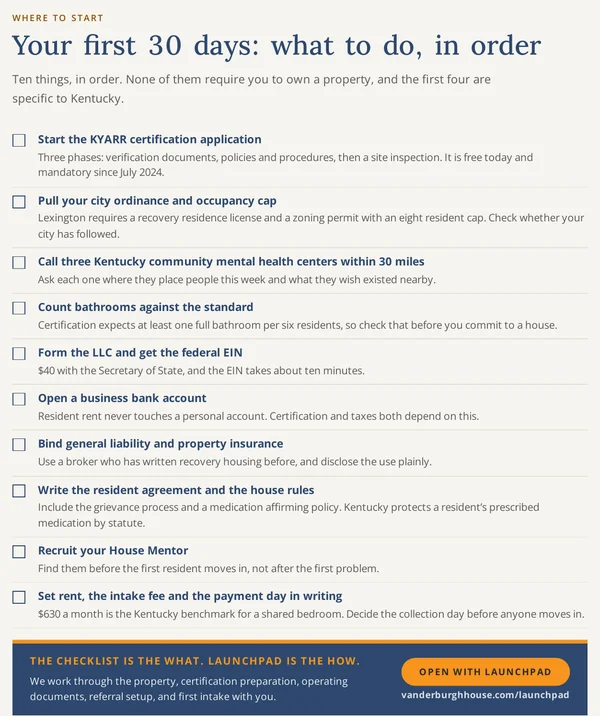
Your Louisville Sober House Startup Checklist
Every item below is covered somewhere on this page, and in Louisville none of them is optional.
Four evergreen guides sit behind the items above and apply in every state.
How VSL Helps You Open a Sober House in Louisville
Vanderburgh Sober Living charters independently operated recovery homes into a cooperative network across more than a dozen states, and most Chartered Operators opened their first home with no prior experience in recovery housing. The help is aimed at exactly the places this page kept returning to: reading a zoning district before an offer goes in, deciding between the by-right standard and a conditional use permit, writing the 32 policies KYARR reviews, getting the Chapter 115 license and the change of occupancy sequenced in the right order, and building the referral relationships that make a certified Louisville home fill in three months instead of six.
There are two routes in. The Launchpad program is guided pre-launch work: one-on-one strategy, Academy training, weekly coaching and the document templates. The Mastery program is hands-on startup, certification and operating support inside the Chartered Operator community, for operators who want someone alongside them through the permit, the license and the first year. If you have a specific Louisville address in hand, or you are deciding between leasing and buying in this market, that is a conversation worth having before the offer rather than after: get in touch with the VSL team.
Start your sober house
Pick the path that fits where you are in the process.
Download the free guidePath to Purposeful Recovery Housing, by Dr. Hunter T. Foote.Explore the Mastery ProgramHands-on startup, certification, and operating support.See how starting with VSL worksThe opportunity, the community, and what a Charter includes.Prefer to talk now? Call (844) 762-3747, weekdays 8a to 5p.
Educational only; not legal, financial, or medical advice. Fees, rents, and rules change, and the Louisville adjustments above are estimates built on the Kentucky reference model. Confirm current requirements with Louisville, Jefferson County, and qualified professionals before you sign or spend.
Research & Sources
- Foote, H. T. (2026). Vanderburgh Sober Living Operating Climate Index, 2026 Edition. Vanderburgh Sober Living. https://www.vanderburghhouse.com/research/operating-climate-index-2026/
- Louisville Metro Government. (2026). Land Development Code § 1.2.2: Definitions. American Legal Publishing. https://codelibrary.amlegal.com/codes/louisvillemetro/latest/loukyldc/0-0-0-69
- Louisville Metro Government. (2026). Land Development Code § 4.3.14: Transitional Housing. American Legal Publishing. https://codelibrary.amlegal.com/codes/louisvillemetro/latest/loukyldc/0-0-0-4044
- Louisville Metro Government. (2026). Land Development Code § 4.2.55: Transitional Housing Conditional Use Permit. American Legal Publishing. https://codelibrary.amlegal.com/codes/louisvillemetro/latest/loukyldc/0-0-0-3692
- Louisville Metro Government. (2026). Land Development Code § 11.5A: Conditional Use Permit Procedures. American Legal Publishing. https://codelibrary.amlegal.com/codes/louisvillemetro/latest/loukyldc/0-0-0-9600
- Louisville Metro Government. (2026). Code of Ordinances § 115.001: Boarding and Group Housing Definitions. American Legal Publishing. https://codelibrary.amlegal.com/codes/louisvillemetro/latest/loukymetro/0-0-0-54083
- Louisville Metro Government. (2026). Code of Ordinances §§ 115.002–115.003: License Required; Application and Fees. American Legal Publishing. https://codelibrary.amlegal.com/codes/louisvillemetro/latest/loukymetro/0-0-0-54065
- Louisville Metro Government. (2026). Code of Ordinances, Table XIV: Land Development Code Ordinance Adoption Table. American Legal Publishing. https://codelibrary.amlegal.com/codes/louisvillemetro/latest/loukymetro/0-0-0-58222
- Louisville Metro Government. (2025). Ordinance No. 163, Series 2025: Homeless and Crisis Shelters (Case No. 24-LDC-0001). https://louisvilleky.gov/sites/default/files/2025-10/ORD%20163%202025.pdf
- Louisville Metro Office of Planning. (2026). Proposed Land Development Code Amendments. https://louisvilleky.gov/government/office-planning/proposed-land-development-code-amendments
- Louisville Metro Office of Planning. (2026). Local Preservation Districts and Individual Landmarks. https://louisvilleky.gov/government/office-planning/local-preservation-districts-individual-landmarks
- Louisville Metro Office of Planning. (2026). Completed and Adopted Neighborhood Plans and Studies. https://louisvilleky.gov/government/office-planning/completedadopted-neighborhood-plans-and-studies
- Louisville Metro Office of Planning. (2019). Plan 2040: Louisville Metro Comprehensive Plan. https://louisvilleky.gov/government/office-planning/comprehensive-plan
- Louisville Metro Office of Planning. (2021). Portland Neighborhood Plan. https://louisvilleky.gov/sites/default/files/2021-12/portland-neighborhood-plan-adopted-ord.pdf
- Louisville Metro Office of Planning. (2025). Old Louisville and Limerick Neighborhood Plan. https://louisvilleky.gov/sites/default/files/2025-01/oldlouisvillelimerickpdf.pdf
- Louisville Metro Office of Planning. (2021). Shawnee Neighborhood Plan. https://louisvilleky.gov/sites/default/files/2021-12/shawnee-neighborhood-plan-adopted-ord.pdf
- Louisville Metro Office of Planning. (2023). Clifton and Crescent Hill Area Plan. https://louisvilleky.gov/sites/default/files/2024-01/clifton-crescent-hill-area-plan_ord_lr.pdf
- Louisville Metro Office of Planning. (2025). South Central Neighborhoods Plan. https://louisvilleky.gov/sites/default/files/2025-12/South%20Central%20Neighborhoods%20Plan%20FINAL%2011.19.2025%20ORD.pdf
- Kentucky Heritage Council. (2024). Shelby Park Historic District, National Register of Historic Places Nomination. https://louisvilleky.gov/sites/default/files/2024-09/ky_jefferoncounty_shelbyparkhistoricdistrict.pdf-s.pdf
- Louisville Metro Office of Construction Review. (2026). Homeless Shelter, Transitional or Rehabilitation Home Requirements. https://louisvilleky.gov/government/construction-review/homeless-shelter-transitional-or-rehabilitation-home-requirements
- Louisville Metro Office of Construction Review. (2026). Building Permit. https://louisvilleky.gov/government/construction-review/building-permit
- Louisville Metro Office of Construction Review. (2026). Change of Occupancy and Use Permits. https://louisvilleky.gov/government/construction-review/change-occupancy-use-permits
- Louisville Fire. (2026). Request a Fire Inspection. Louisville Metro Government. https://louisvilleky.gov/government/fire/services/request-fire-inspection
- Louisville Metro Homeless Services Division. (2026). Emergency Shelter Options and Coordinated Shelter Access. https://louisvilleky.gov/government/homeless-services-division/emergency-shelter-options
- Louisville Metro Department of Public Health and Wellness. (2026). Addiction Help. https://louisvilleky.gov/government/health-wellness/addiction-help
- Louisville Metro Department of Public Health and Wellness. (2026). Quick Response Team. https://louisvilleky.gov/government/health-wellness/quick-response-team-qrt
- Louisville Metro Department of Public Health and Wellness. (2026). Harm Reduction Outreach Services. https://louisvilleky.gov/government/health-wellness/harm-reduction-outreach-services-formerly-syringe-services
- Louisville Metro Department of Public Health and Wellness. (2026). Medication Oriented Recovery and Enhancement (MORE) Program. https://louisvilleky.gov/government/health-wellness/medication-oriented-recovery-and-enhancement-more-program
- Louisville Metro Department of Corrections. (2026). Enough is Enough. https://louisvilleky.gov/government/corrections/enough-enough
- Louisville Metro Government. (2026). Louisville Opioid Settlement. https://louisvilleky.gov/government/health-wellness/louisville-opioid-settlement
- Louisville Metro Revenue Commission. (2026). Forms and Publications. https://louisvilleky.gov/government/revenue-commission/forms-and-publications
- Louisville Metro Revenue Commission. (2024). Form OL-3 Occupational License Tax Return Instructions. https://louisvilleky.gov/sites/default/files/2024-12/ol-3_instructions_2024.pdf
- Jefferson County Sheriff’s Office. (2026). Property Tax Rates. https://www.jcsoky.org/property-tax/rates
- Kentucky Legislative Research Commission. (2024). KRS 222.502: Certification of recovery residences required. https://apps.legislature.ky.gov/law/statutes/statute.aspx?id=55089
- Kentucky Legislative Research Commission. (2024). KRS 222.504: Cabinet and local government authority; list of certified residences. https://apps.legislature.ky.gov/law/statutes/statute.aspx?id=55090
- Kentucky Legislative Research Commission. (2024). KRS 222.506: Recovery residence requirements. https://apps.legislature.ky.gov/law/statutes/statute.aspx?id=55091
- Kentucky Legislative Research Commission. (2023). KRS 222.508: Entities required to refer individuals to certified residences. https://apps.legislature.ky.gov/law/statutes/statute.aspx?id=53895
- Kentucky Legislative Research Commission. (2023). KRS 222.510: Local land use authority preserved. https://apps.legislature.ky.gov/law/statutes/statute.aspx?id=53896
- Kentucky Legislative Research Commission. (2024). 908 KAR 1:410: Recovery housing. https://apps.legislature.ky.gov/law/kar/titles/908/001/410/
- Kentucky Legislative Research Commission. (n.d.). 908 KAR 1:370: Licensing procedures, fees, and general requirements for nonhospital-based alcohol and other drug treatment entities. https://apps.legislature.ky.gov/law/kar/titles/908/001/370/
- Kentucky Legislative Research Commission. (2024). 815 KAR 7:125: Kentucky Residential Code. https://apps.legislature.ky.gov/law/kar/titles/815/007/125/15055/
- Kentucky Legislative Research Commission. (2024). 815 KAR 7:120: Kentucky Building Code. https://apps.legislature.ky.gov/law/kar/titles/815/007/120/
- Kentucky Legislative Research Commission. (n.d.). 815 KAR 10:060: Kentucky Standards of Safety. https://apps.legislature.ky.gov/law/kar/titles/815/010/060/11255/
- Kentucky Secretary of State. (2026). Business Filing Fees. https://www.sos.ky.gov/bus/business-filings/Pages/Fees.aspx
- Kentucky Department of Revenue. (2026). Schedule LLET: Limited Liability Entity Tax. https://revenue.ky.gov/Business/Corporation-Income-and-Limited-Liability-Entity-Tax/Pages/default.aspx
- Kentucky Cabinet for Health and Family Services. (2026). Kentucky Recovery Housing Network. https://www.chfs.ky.gov/agencies/dbhdid/Pages/krhn.aspx
- Kentucky Alliance of Recovery Residences. (2025). KYARR presentation to the Governor’s Local Issues Conference. Kentucky Department for Local Government. https://dlg.ky.gov/DLG%20Documents/GLIC%202025%20KYARR%20Presentation.pdf
- National Alliance for Recovery Residences. (2026). Kentucky Alliance of Recovery Residences affiliate profile. https://narronline.org/affiliate/kentucky-alliance-of-recovery-residences/
- Kentucky Office of Drug Control Policy. (2026). 2025 Overdose Fatality Report. https://odcp.ky.gov/Documents/2025%20Overdose%20Fatality%20Report.pdf
- U.S. Department of Housing and Urban Development. (2025). 2025 Continuum of Care Homeless Assistance Programs Homeless Populations and Subpopulations Report, KY-501 Louisville/Jefferson County. https://files.hudexchange.info/reports/published/CoC_PopSub_CoC_KY-501-2025_KY_2025.pdf
- U.S. Department of Housing and Urban Development. (2026). FY2027 Fair Market Rent Schedule. Office of Policy Development and Research. https://www.huduser.gov/portal/datasets/fmr/fmr2027/FY2027_FMR_Schedule.pdf
- U.S. Census Bureau. (2026). QuickFacts: Louisville/Jefferson County metro government (balance) and Jefferson County, Kentucky. https://www.census.gov/quickfacts/fact/table/louisvillejeffersoncountymetrogovernmentbalancekentucky,jeffersoncountykentucky/PST045224
- U.S. Census Bureau. (2026). QuickFacts: Jefferson County, Kentucky. https://www.census.gov/quickfacts/fact/table/jeffersoncountykentucky/PST045224
- U.S. Census Bureau. (2025). Table B25103: Mortgage status by median real estate taxes paid, Jefferson County, Kentucky. American Community Survey. https://api.censusreporter.org/1.0/data/show/latest?table_ids=B25103&geo_ids=05000US21111
- Greater Louisville Association of Realtors. (2026). August 2026 Housing Market Stats Report. https://louisvillerealtors.com/articles/august-2026-housing-market-stats-report
- Zillow. (2026). Kentucky Home Values. https://www.zillow.com/home-values/24/ky/
- Freddie Mac. (2026). Primary Mortgage Market Survey. https://www.freddiemac.com/pmms
- National Association of Insurance Commissioners. (2026). Homeowners Insurance Report. https://content.naic.org/sites/default/files/publication-hmr-zu-homeowners-report.pdf
- Transit Authority of River City. (2026). The New TARC Network. https://www.ridetarc.org/newtarcnetwork/
- Transit Authority of River City. (2026). Routes and Schedules. https://www.ridetarc.org/routes/
- Transit Authority of River City. (2026). TARC Annual Report 2026. https://www.ridetarc.org/wp-content/uploads/2026/07/TARC-Annual-Report_2026.pdf
- Kentucky Court of Justice. (2024). Specialty court programs certified under Administrative Order 2022-50. https://www.kycourts.gov/Pages/Article.aspx?n=KentuckyCourtofJustice&prId=396
- Kentucky Department of Corrections. (2026). Division of Probation and Parole. https://corrections.ky.gov/Probation-and-Parole/Pages/default.aspx
- Kentucky Department of Corrections. (2026). Community Programs Catalog. https://corrections.ky.gov/Divisions/programs/Documents/2026/07%20-%20July/COMM%20ASK.pdf
- Office of the Attorney General of Kentucky. (2025). Kentucky Opioid Abatement Advisory Commission awards announcement. https://www.kentucky.gov/Pages/Activity-stream.aspx?n=AttorneyGeneral&prId=1737
- Kentucky Opioid Abatement Advisory Commission. (2026). Kentucky Opioid Abatement Advisory Commission. https://kyoaac.ky.gov/
- Kentucky Cabinet for Health and Family Services. (2026). Find Help Now Kentucky recovery housing bed locator. https://findhelpnow.org/ky/recoveryhousing
- U.S. Court of Appeals for the Sixth Circuit. (1996). Larkin v. Michigan Department of Social Services, 89 F.3d 285. https://www.courtlistener.com/opinion/721510/larkin-v-state-of-michigan-department-of-social-services/
- U.S. Court of Appeals for the Sixth Circuit. (1996). Smith & Lee Associates, Inc. v. City of Taylor, 102 F.3d 781. https://www.courtlistener.com/opinion/731244/smith-lee-associates-inc-united-states-of-america-v-city-of-taylor/
- U.S. Department of Justice & U.S. Department of Housing and Urban Development. (n.d.). Joint Statement on group homes, local land use, and the Fair Housing Act. https://www.justice.gov/crt/joint-statement-department-justice-and-department-housing-and-urban-development
- Louisville Future. (2025). One permit denied, but the fight against transitional housing isn’t over. https://louisvillefuture.com/archived-news/one-permit-denied-but-the-fight-against-transitional-housing-isnt-over/
- Metro United Way. (2026). 2-1-1 Get Help Now. https://metrounitedway.org/get-help-now/
- Louisville AA Intergroup. (2026). Louisville AA Intergroup of Alcoholics Anonymous. https://loukyaa.org/
- Louisville Area of Narcotics Anonymous. (2026). Louisville Area of Narcotics Anonymous. https://www.nalouisville.net/
- The Healing Place. (2026). How It Works. https://thehealingplace.org/how-it-works/
- Volunteers of America Mid-States. (2026). Substance Use Recovery Services. https://www.voamid.org/services/substance-use-recovery/
- Wayside Christian Mission. (2026). Sober Living Program. https://www.waysidechristianmission.org/slp1
- St. John Center for Homeless Men. (2026). Programs. https://www.stjohncenter.org/programs/
- Centerstone. (2026). Centerstone Louisville Adult Downtown. https://centerstone.org/venue/centerstone-louisville-adult-downtown/
- Seven Counties Services. (2026). Seven Counties Services. https://sevencounties.org/
- Goodwill Industries of Kentucky. (2026). Another Way Program. https://goodwillky.org/goodwill-industries-of-kentucky-receives-150000-from-louisville-tourism-to-support-another-way-program/
- ChooseWell Communities. (2026). What We Do. https://www.choose-well.org/what-we-do
- Dismas Charities. (2026). Dismas Charities. https://www.dismas.com/
- U.S. Department of Veterans Affairs. (2026). Homeless Veteran Care, Robley Rex VA Medical Center. https://www.va.gov/louisville-health-care/health-services/homeless-veteran-care/
- UofL Health. (2026). Substance Use and Mental Health Services. https://uoflhealth.org/substance-use-and-mental-health-services/
- Norton Healthcare. (2026). Behavioral Health Services. https://nortonhealthcare.com/services-and-conditions/behavioral-health/services/