Opening a sober living home in Boston means working inside three sets of rules at once, and none of them is a sober living license. Massachusetts does not license recovery residences, so certification through the Massachusetts Alliance for Sober Housing is voluntary in law, though Chapter 17, Section 18A closes every public referral door to a home that skips it. The City of Boston has never enacted a sober home ordinance, so a house is classified by head count against the ordinary definitions in the Boston Zoning Code: a state lodging house license attaches at four lodgers, the zoning definition of Lodging House at five, and full sprinklering at six. Demand is not the open question here, because Suffolk County recorded 212 opioid-involved overdose deaths in 2024, more than any other Massachusetts county, with 171 of them in Boston.
What follows is specific to Boston: how the zoning code classifies the house, the three head-count thresholds that decide which license and which fire system apply, the city departments that sign off, the local cost anchors, and the agencies that keep beds full. The statewide rules, the MASH process and the full cost and profitability models live in the Massachusetts guide below. Shared state figures are restated here with the local property lines swapped in, not recalculated.
Before you read onHow to Open a Sober Living Home in MassachusettsThis post covers one piece of the process. The complete Massachusetts guide walks through every step, from planning to your first resident.→Watch: How to Start a Sober Living Home in Massachusetts
The video walks through the statewide sequence: the line between housing and treatment that keeps a recovery residence outside state licensure, what MASH certification asks for, how a Massachusetts city reviews the use, and what the startup budget looks like. The rest of this page applies those steps to Boston, where the head-count thresholds and the price of the housing stock change several of the answers.
The Massachusetts book covers the same ground in print, with the checklists and templates an operator needs on day one.
Is Boston a Good Place to Open a Sober Living Home?
Yes, on the lease path, and with real care on the purchase path. Boston has the densest referral network in New England and a state law that steers every publicly funded placement toward certified homes, which is as favorable a demand picture as an operator will find. The offsetting facts are the most expensive housing stock in the state and a sprinkler mandate that attaches at six residents.
Recovery Housing Demand in Suffolk County
Demand in Boston comes from four pipelines that all end at the same shortage of beds. None of them is speculative, and each already discharges people who need somewhere structured to go.
- Treatment discharges: The Boston Public Health Commission runs Transitions and Entre Familia alongside the city detox and stabilization capacity at Bay Cove and the Dimock Center, and every one of those stays ends in a discharge plan that needs an address.
- The courts and probation: The Suffolk County District Attorney diverted 321 people through Services Over Sentences in 2025, up 89 percent on the year before, and the program names housing assistance among what it provides.
- Recovery court sessions: Four Boston Municipal Court recovery sessions sit in Charlestown, Dorchester, East Boston and South Boston, and their probation officers place participants into housing under the certified-list rule.
- The homelessness response: Boston counted 3,674 people experiencing homelessness in 2026, with only 3 percent unsheltered, which means most referrals arrive through a program rather than off the street.
Four figures come up in almost every conversation with a lender, a landlord or a discharge planner in this city.
| Indicator | Boston figure | Why it matters to an operator |
|---|---|---|
| Opioid-involved overdose deaths, Suffolk County (2024) | 212, the highest count of any Massachusetts county, of which Boston accounted for 171 | Referral volume is local and documented, which is the evidence a certifying inspector and a lender both recognize. |
| Statewide overdose trend (2025, preliminary) | 978 deaths, down 27 percent on 2024 and the first year under 1,000 since 2013 | Fewer deaths does not mean fewer beds needed. More people surviving means more people leaving treatment and needing housing. |
| Homeless census, City of Boston (2026) | 3,674 people, with 3 percent unsheltered | Most residents will be referred by a program, so relationships with those programs matter more than any marketing spend. |
| Certified recovery residences, Massachusetts | More than 180 MASH-certified homes statewide | A short list for a state this size, and the only list state agencies and probation officers may refer to. |
| Population, Boston and Suffolk County | 672,973 in Boston and 791,891 in Suffolk County as of July 2025 | The catchment is dense enough that one house draws from a few neighborhoods rather than the whole metro. |
| Rapid transit coverage | Red, Orange, Blue and Green lines plus the Mattapan trolley, with the Fairmount commuter line through Dorchester and Mattapan | Residents without a car can hold a job and get to meetings, which is what actually keeps a bed filled. |
Massachusetts ranks fourth on VSL’s Operating Climate Index, with a composite Operating Climate Score of 8 out of 10 and a Moderately Regulated classification (Foote, 2026). It rates 10 for Legal Climate, 10 for Certification Value and 10 for Market Strength, against 3 for Fire and Building Feasibility. Boston is where both ends of that spread are sharpest: the referral infrastructure behind the Market Strength score is concentrated here, and so are the code costs behind the Fire and Building score.
Boston decides nothing about a recovery home through a special use category, because it has none. Almost everything turns on head count. Four unrelated lodgers triggers the state lodging house license, five meets the zoning definition of Lodging House, and six triggers full sprinklering. Choose the number before you choose the house.
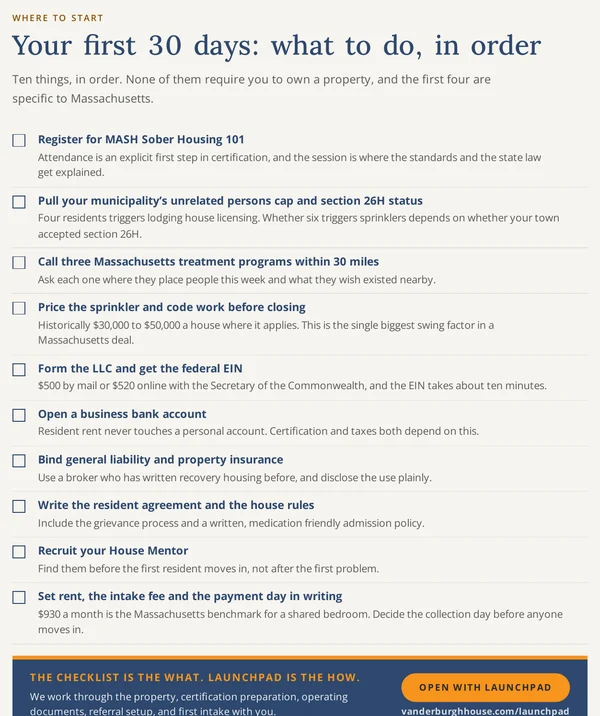
Most people ask whether they are allowed to open a recovery home. The better first question is whether the need and the money are there. This answers both, for your state.
- How many people need a bed, and how few beds exist
- Who actually pays the rent, and which programs are real
- What it costs to open on the purchase path and the lease path
How to Open a Sober House in Boston: Step-by-Step
The statewide sequence lives in the Massachusetts guide. This version is ordered for Boston, where the head count is the first decision rather than a detail settled late, because it determines the license, the fire system and the size of building you need to look for. Plan on six to twelve months from first showing to first resident.
Ten steps, in the order a Boston operator actually meets them.
Step 1. Set the Head Count, Then Run the Zoning Check
Decide how many residents the house will hold before you tour anything, because three Boston thresholds sit within two people of each other. Chapter 140, Section 22 requires a lodging house license at four or more lodgers not within the second degree of kindred to the operator. Article 2, Section 2-1 of the Boston Zoning Code sets its Lodging House definition at five, and Chapter 148, Section 26H requires full sprinklering at six.
With the number settled, search the address in the BPDA Zoning Viewer, read the zoning subdistrict off the information panel, and find that subdistrict in the neighborhood article’s use table. The Inspectional Services Department publishes the procedure, including how to read the A, C and F codes for allowed, conditional and forbidden. Confirm the address is inside Boston: Chelsea, Revere and Winthrop share Suffolk County but run their own codes, and Massachusetts has no unincorporated land, so there is no county fallback anywhere in the state.
Massachusetts guideMassachusetts Zoning, Fair Housing, and Land Use Laws for Sober LivingWhere sober homes can operate in Massachusetts and the legal protections that apply.→Step 2. Form the Entity and File the Boston Registrations
The entity signs the lease or takes title, never the operator personally. A Massachusetts limited liability company costs $500 for the Certificate of Organization and $500 for every annual report after it, so year one is $1,000 before anything else. Get the EIN and open the bank account before the first resident pays rent.
Boston requires a business certificate from the Office of the City Clerk for any business trading under a name other than the owner’s: $65, valid four years, with $35 more for a non-resident of Massachusetts. Where the house is not lodging-house licensed, ISD rental registration also applies at $25 for the first registration and $15 to renew, and Boston Municipal Code 9-1.3 exempts dwellings that hold a current lodging house license. Budget the lodging house license itself now if the head count is four or more.
Massachusetts guideHow to Form a Legal Entity for a Sober Living Business in MassachusettsLLC, nonprofit, or both: how Massachusetts operators structure the business and the property.→Step 3. Pick the Property Against the Two Boston Anchors
A Boston house is read as a household only while it satisfies the zoning definition of Family, which covers one person or people related by blood, marriage, adoption or an analogous family union living as a single non-profit housekeeping unit. A group of unrelated adults paying separate rent does not meet it, so the head count and the use table decide more than the floor plan does. Four things still have to be true of the building itself.
- Sleeping rooms that clear the Sanitary Code: 105 CMR 410.420 requires 70 square feet for a single-occupancy sleeping room and 50 square feet per occupant where a room is shared, which caps the bed count independently of zoning.
- One shared kitchen and common living space: The household has to function as one dwelling rather than a set of locked units, which is also what the certification standard looks for.
- A second means of egress from every sleeping floor: Converted triple-deckers often fail this, and it is the first thing a Boston fire inspector checks.
- Off-street parking: It removes the objection neighbors raise first and the one a Zoning Board of Appeal hears most often.
Two Boston numbers drive the cost table below. HUD’s FY2026 fair market rent for the Boston-Cambridge-Quincy metro area is $3,526 for a three-bedroom and $3,894 for a four-bedroom, effective October 1, 2025. The Greater Boston Association of Realtors put the median single-family sale price at $1,002,500 in August 2026.
Massachusetts guideSober Living Startup Costs in MassachusettsEvery one-time cost to open, on the lease path and the purchase path, with the Massachusetts figures behind each line.→Step 4. Settle Sprinklers, Alarms and the Certificate of Occupancy
Sprinklers are the largest code cost in Boston and the one most operators find late. Boston accepted Chapter 148, Section 26H on December 5, 2012, as the Automatic Sprinkler Appeals Board recorded, so the five-year compliance window closed in 2017 and a house letting to six or more must be fully sprinklered. The Department of Fire Services advisory states that sober homes are not licensed by the Commonwealth and so do not fall inside the licensed-group-residence exclusion.
Occupancy is barred until the building commissioner issues a Certificate of Occupancy, and the Boston Fire Department signs off electronically before ISD issues it. The trap is an older house with finished basement bedrooms or a prior care-facility use on record, because that history has to be cleared with ISD before the certificate issues rather than after the beds arrive. The citations sit in the fire and building section further down.
Step 5. Write the Governing Documents Before You Open
MASH reviews the documents at application, not afterward, and writing them once residents are already in the house means writing them under pressure. Put the house rules, resident agreement, grievance procedure, medication policy, relapse and discharge policy and fee schedule in writing first. Add the one most templates skip: a neighbor relations plan naming who answers a neighbor’s call, what they say, and how fast they call back.
Keep readingHouse Rules in Sober HousesThe rules that keep a recovery home safe, structured, and worth living in.→Step 6. Bind Insurance on the Specific Address
Get a quote on the actual Boston address before signing, because insurance is one of the lines the state cost model leaves unpriced and Boston’s building stock moves it. Ask the carrier which occupancy classification they will write the policy under, whether they underwrite recovery housing at all, and what they need disclosed about the resident agreement. Bind before the first resident moves in rather than at the closing.
Step 7. Recruit the Live-In House Mentor
The house mentor is a resident who takes on peer leadership in exchange for rent, and the arrangement is what makes a NARR Level II home work rather than a rooming house with rules. Recruit through the Boston recovery community: alumni of homes already operating here, meeting secretaries, and the peer staff at the programs listed further down this page. Put the arrangement in writing, move the mentor in before the first resident, and remember the bed comes off revenue in every model on this page.
Step 8. Apply for MASH Certification
Certification is voluntary in Massachusetts law and close to mandatory in practice in Boston. Chapter 17, Section 18A bars state agencies, their statewide-contract vendors, and officers setting release, parole or discharge conditions from referring anyone to housing that is not certified, and the certified list goes out to agencies, probation officers and judges on a bimonthly cycle. The fee is $425 a year: $375 for certification plus a $50 inspection, effective July 1, 2024.
- Start with Sober Housing 101 for Potential Operators, the orientation MASH requires before an application opens.
- Submit the application with the governing documents, the property information and the fee.
- Pass the on-site inspection against the NARR Level II standard, then recertify each year before the next inspection falls due.
Step 9. Work the Referral List Before You Open
Publicly funded referrals in Boston run through the certified list and through people, not through advertising. Call the partners in the table further down while the house is still being set up, invite three of them to walk through it, and register with PAATHS at 1-855-494-4057 and the Massachusetts Substance Use Helpline at 800-327-5050. Those weeks cost nothing while the lease or the note has not started, and the same calls made after opening cost a month of empty beds each.
Step 10. Open and Hold Occupancy
The Massachusetts reference model turns cash positive at about 54 percent occupancy, roughly eight of 14 beds paying, and Boston’s property lines push that higher. Fill slowly enough to protect the house culture and fast enough to clear the note, which for most operators means 60 to 120 days from opening to stabilized occupancy. Hold a weekly house meeting, track occupancy daily, and send referral partners a short monthly note saying how many beds are open.
Keep readingHow Sober Houses Fill Beds and Stay FullProven occupancy strategies from established recovery housing operators.→The phases below assume a lease rather than a purchase, and no Zoning Board of Appeal hearing.
| Phase | Weeks (estimated) | What gets done |
|---|---|---|
| Head count, zoning check and property search | 4 to 10 | Confirm the subdistrict and its use table, fix the bed count, tour houses against the Sanitary Code minimums. |
| Entity, business certificate and lease | 2 to 4 | File with the Secretary of the Commonwealth, file the business certificate, sign with the entity as tenant. |
| Code work, alarms and inspections | 6 to 20 | Alarm and sprinkler work where the head count requires it, fire department sign-off, then the certificate of occupancy. |
| Lodging house license | 6 to 12 | Application, neighborhood process, inspection certificate, and the Licensing Board hearing. |
| Governing documents and MASH application | 4 to 8 | Sober Housing 101, the documents, the application, and the on-site inspection. |
| Referral outreach and opening | 4 to 8 | Partner visits, helpline listings, and the first admissions. |
Timelines are estimated. The two things that add months in Boston are a sprinkler retrofit in an older or occupied building, and a Zoning Board of Appeal hearing where the subdistrict reads the use as conditional or forbidden.
Best Neighborhoods for a Sober Living Home in Boston
A workable Boston address passes four tests, and price is only one of them.
- Stock: Four or more real bedrooms that clear the Sanitary Code minimums, which in Boston usually means a triple-decker, a large Victorian, or a detached single-family in the outer neighborhoods.
- Transit: Residents without a car have to reach work and meetings, so a rapid transit station or a Fairmount Line stop within walking distance does more for occupancy than square footage does.
- Concentration: Roxbury, Dorchester and Mattapan already carry most of the city’s recovery housing, and residents have said so publicly, which raises the political cost of adding another house there.
- Tenure: High owner-occupancy predicts organized opposition at a Zoning Board hearing more reliably than any other neighborhood statistic.
Six areas follow. Housing and tenure figures come from the Boston Planning Department’s 2025 neighborhood profiles, transit from the MBTA, and the zoning article numbers from the Boston Zoning Code.
| Area | Housing stock and transit | Siting notes for a sober living home |
|---|---|---|
| Dorchester (Article 65) | 49,565 housing units, half of them with three or more bedrooms, 61.6 percent renter, median two-bedroom asking rent $2,800 against $3,200 citywide. Red Line at JFK/UMass, Savin Hill, Fields Corner, Shawmut and Ashmont; Fairmount Line at Uphams Corner, Four Corners and Talbot Avenue. | The largest supply of big houses in the city at below-citywide rent, on two transit spines. It is also the most saturated recovery housing market in Boston, and residents have raised concentration publicly, so the neighborhood work has to be done early and in person. |
| Mattapan (Article 60) | 9,863 units, 50.1 percent with three or more bedrooms, median two-bedroom $2,775, the lowest of the six. Mattapan trolley from Ashmont to Mattapan, plus Fairmount Line stops at Blue Hill Avenue and Morton Street. | The cheapest entry point with large stock and two transit modes. Owner-occupancy is higher than the citywide average and Mattapan is named alongside Dorchester and Roxbury in the concentration argument, so expect organized abutters. |
| Hyde Park (Article 69) | Historic buildings and mid-century single-family homes, with 59 percent of households owning against 36 percent citywide. Commuter rail at Hyde Park, Fairmount and Readville. | The best physical fit in the city for a detached single-family configuration, and the lowest existing recovery housing density. The same 59 percent owner-occupancy is the strongest predictor of a contested hearing, and Hyde Park sits inside the July 2026 residential rezoning draft. |
| Roslindale (Article 67) | 12,573 units, 50.3 percent with three or more bedrooms, 59.3 percent owner-occupied, median two-bedroom $2,945. Needham Line at Roslindale Village, Bellevue and Highland, with Orange Line Forest Hills at the northern edge. | Large-bedroom stock, a walkable square and Orange Line access at one end, with little existing recovery housing. Most of the neighborhood is commuter-rail only, the price sits above Mattapan and Dorchester, and it is inside the same rezoning draft. |
| East Boston (Article 53) | 19,747 units, 73.2 percent renter, median two-bedroom $3,000, but only 32.8 percent of units have three or more bedrooms. Blue Line at Maverick, Airport, Wood Island, Orient Heights and Suffolk Downs. | The densest rapid transit coverage of the six and no documented recovery housing saturation, which keeps the siting conversation simpler. The shortage of large units is structural, so finding four or more real bedrooms takes longer here than anywhere else on this list. |
| Roxbury (Article 50) | 22,502 units, 75.5 percent renter, only 38.1 percent with three or more bedrooms, median two-bedroom $3,300, above the citywide figure. Orange Line at Ruggles, Roxbury Crossing and Jackson Square, with Silver Line service at Nubian. | The closest proximity to the treatment and hospital referral network, which shortens the path to a full house. It is also the most saturated and most contested market in the city, and rent now runs above the citywide median, so it works best for an operator who already has Roxbury relationships. |
Three features decide a Boston house once the neighborhood is settled.
- Bedroom count over square footage: A 2,400 square foot house with three bedrooms is worth less to this business than a 1,900 square foot house with five.
- A second egress from every sleeping floor: Converted triple-deckers frequently fail on this, and the fix is structural rather than cosmetic.
- Off-street parking: It removes the objection that reaches a Zoning Board hearing most often, and it costs nothing to check before touring.
Chelsea, Revere and Winthrop sit inside Suffolk County but outside Boston, each with its own zoning code, its own inspectional department and its own licensing authority. Nothing on this page applies at those addresses, and Massachusetts has no unincorporated land, so every Suffolk County address is governed by one of those four municipalities.
- ✓Room-by-room requirements for a Level II home
- ✓Zoning and occupancy questions to ask before you tour
- ✓The red flags that should end a showing early
Who Regulates Sober Living Homes in Boston?
No single agency regulates recovery residences in Boston. The Commonwealth does not license them, MASH certifies them voluntarily, the Inspectional Services Department and the Licensing Board decide whether the building may be occupied and licensed, the Boston Fire Department decides what life-safety systems it carries, and the Boston Public Health Commission and the courts decide who is referred into it.
A sober living home is a shared residence where adults in recovery pay their own rent, agree to house rules, and receive no treatment on the premises. That last clause is what keeps it outside state licensure, because delivering clinical services on site turns the house into a licensed treatment program under a different body of law. The Boston Zoning Code never names sober living at all, which is why classification falls to Family, Lodging House and Group care residence, general.
| Layer | Agency | What it controls for a sober living home |
|---|---|---|
| State licensing | Bureau of Substance Addiction Services (BSAS) | Licenses treatment programs, not recovery residences. Chapter 17, Section 18A addresses certification and referral rather than licensure, and a house that begins delivering clinical services on site moves into licensed treatment. |
| State certification (voluntary) | Massachusetts Alliance for Sober Housing (MASH) | Certifies against the NARR standard for $425 a year. Certification is not required to operate and is required for every publicly funded referral. |
| State lodging house law | Licensing Board for the City of Boston | Issues the lodging house license required by Chapter 140, Section 22 where lodgings are let to four or more persons not within the second degree of kindred, from $75 a year. |
| City zoning | Boston Planning Department and the Zoning Board of Appeal | Classifies the use through each neighborhood article’s use table, applying the Article 2 definitions of Family, Lodging House and Group care residence, general. |
| City building | Boston Inspectional Services Department (ISD) | Issues the Certificate of Occupancy without which a building may not be occupied, runs rental registration, and publishes the zoning designation check. |
| City fire | Boston Fire Department (BFD) | Enforces 527 CMR 1.00, signs off before ISD issues the certificate of occupancy, and runs the smoke and carbon monoxide compliance inspections. |
| City business registration | Office of the City Clerk | Issues the business certificate required of any business trading under a name other than the owner’s, $65 for four years. |
| Referrals and public funding | Boston Public Health Commission (BPHC) and the Boston Municipal Court | Control who arrives, through PAATHS and through recovery court and probation placements limited to the certified list. |
The short version for an operator sizing this up.
- State license: Not required. Massachusetts does not license recovery residences, and no state agency inspects them as a condition of operating.
- City license: Required at four or more lodgers, from the Licensing Board for the City of Boston, starting at $75 a year, with an ISD inspection certificate first.
- Certification: Voluntary in law. In practice it is the condition of every publicly funded referral in the city, and it costs $425 a year.
- Referrals: Controlled by the certified list under Chapter 17, Section 18A and by the city’s own referral desks, not by advertising.
Licensing is the easy part in Boston, because there is no recovery residence license to get and the lodging house license is a form and a fee. Zoning is where the work sits, because the city has never written a rule about recovery housing and ordinary definitions have to do work they were not drafted for.
Boston Zoning Laws for Sober Living Homes
Boston has no sober home ordinance, no spacing rule and no resident cap written for recovery housing. What governs instead is the Boston Zoning Code’s ordinary definitions, applied through each neighborhood article’s use table, together with the state lodging house statute, the building and fire codes, and federal and state fair housing law.
How the Boston Zoning Code Classifies a Sober Living Home
The code never uses the words sober living or recovery residence. Four definitions in Article 2, Section 2-1 decide the classification instead, and which one applies turns almost entirely on the number of residents and the relationship between them.
- Family, clause 19: Defined as one person, or two or more persons related by blood, marriage, adoption or other analogous family union, occupying a dwelling unit and living as a single non-profit housekeeping unit. A group of unrelated adults paying separate rent does not satisfy it.
- Lodging House, clause 25: Any dwelling in which living space, with or without common kitchen facilities, is let to five or more persons. Text Amendment No. 346, adopted March 12, 2008, added the single non-profit housekeeping unit test to this definition and to Boarding House.
- Group care residence, general, clause 22A: The one category in the code that expressly names residents recovering from alcohol and drug use, which makes it the use ISD is most likely to apply where a house is not read as a family.
- Group Residence, Limited, clause 22B: Reserved for premises licensed, regulated or operated by the Commonwealth, or operated by a Commonwealth vendor under contract. A MASH-certified home is none of those, so this category does not shelter it.
- The subdistrict use tables: Each neighborhood article carries its own use table marking a use allowed, conditional or forbidden. Expect conditional or forbidden for both Lodging House and Group care residence across most residential subdistricts.
A Boston house is analyzed as a household only while it reads as one: a shared kitchen, shared living space, one set of house rules governing the whole dwelling, and a head count below five. Above that the use table governs and the route is a Zoning Board of Appeal hearing. The city publishes the check itself, including how to read the A, C and F codes, which is the closest thing Boston offers to a written position on the question.
Run the use table before you sign anything. A purchase and sale agreement with no zoning contingency, on a house whose subdistrict reads Lodging House as conditional, leaves an operator holding a building they cannot open and a hearing they may lose.
What the Four-or-More Lodger Rule Does and Does Not Do
Operators quote the rule as though four residents automatically makes a house a lodging house in every sense. It does not. Two provisions carry two different thresholds, and neither of them is a protection.
- M.G.L. c. 140, § 22: Sets the state lodging house license trigger at four or more persons not within the second degree of kindred to the operator, and expressly excludes group residences licensed or regulated by agencies of the Commonwealth, which a recovery residence is not.
- Boston Zoning Code, Art. 2, § 2-1, cl. 25: Sets the zoning definition of Lodging House at five or more persons. A four-person Boston house can therefore need a state lodging house license while not being a zoning Lodging House at all.
- M.G.L. c. 40A, § 3: Does not require a Massachusetts city to treat recovery residence residents as a family. In BAK Realty, LLC v. City of Fitchburg, SJC-13639 (2025), the Supreme Judicial Court held that residents with disabilities are entitled to treatment equal to families or to similar-sized groups of unrelated people without disabilities, not to whichever is more favorable, and upheld classifying a sober house as a boarding house.
The protection that actually reaches a Boston recovery home comes from disability status rather than from the zoning code. Residents in recovery are protected under the federal Fair Housing Act, and the practical lever at a Zoning Board hearing is requesting reasonable accommodation. The analysis behind it is the one that governs sober living zoning generally, and it is worth reading before a hearing rather than after one.
Keep readingThe Federal Fair Housing Act and Sober Living: Everything You Need to KnowThe federal protections every operator, neighbor, and local official should understand.→Docket 2019-1442 and Why Boston Still Has No Sober Home Ordinance
The only ordinance Boston has ever filed on this subject is Docket 2019-1442, “Ordinance regulating sober homes in the City of Boston,” filed by Councilor Garrison on October 9, 2019. It was never enacted. Three earlier hearing orders asked the Council to examine the question and produced no legislation: Docket 2012-0559 in April 2012, Docket 2018-0851 in June 2018, and Docket 2019-0183 in January 2019.
- A search of the Boston City Council legislative record on September 12, 2026, for sober homes, sober housing, recovery residences and lodging houses returned those four matters and nothing later.
- None of the four carries an enactment date, and no corresponding provision appears in the City of Boston Code.
- Nothing sober-living-specific has been filed with the Council since October 9, 2019.
Nothing changed in Boston law on that date or since. No spacing rule, no registration scheme and no cap on residents in a recovery home binds an operator here today, and the zoning definitions above are the whole of the local test. What fills the space instead is case law, and it does not run in operators’ favor.
- Safe Haven Sober Houses, LLC v. City of Boston, 517 F. Supp. 2d 557 (D. Mass. 2007): The only reported Boston recovery housing case. ISD cited a Roxbury home for unpermitted conversions and for operating an unlicensed rooming house, and the federal court declined to enjoin the city’s Housing Court proceedings.
- BAK Realty, LLC v. City of Fitchburg, SJC-13639 (2025): The Supreme Judicial Court upheld a city’s classification of a sober house as a boarding house and held that Chapter 40A, Section 3 does not require treating residents as a family.
- Summers v. City of Fitchburg, No. 18-1725 (1st Cir. 2019): The First Circuit held that exemption from the state sprinkler law is not a reasonable accommodation under the Fair Housing Act or the ADA, which is why the Section 26H threshold cannot be negotiated away.
- Department of Fire Services advisory, January 25, 2024: States that sober homes are not licensed by the Commonwealth and therefore do not fall within the licensed-group-residence exclusion from the sprinkler requirement.
For an operator today, the absence of an ordinance is neither protection nor permission. Three moves follow from it.
- Check the Council record before you sign, because the finding above is dated September 12, 2026 and a newly filed docket would change the calculation immediately.
- Track the residential zoning text amendment released on July 17, 2026, which would rezone residential Roslindale, West Roxbury and Hyde Park and keeps lodging houses as a conditional use. It is a draft, not an adopted rule.
- Treat the head count rather than the ordinance as the thing that decides your exposure, and document the household arrangement from the first day.
How your home gets classified, where Fair Housing applies, and what to do if the city says no.
Boston Fire and Building Code Rules for Sober Living Homes
A Boston recovery residence with sixteen or fewer occupants sits in Use Group R-3 under the Massachusetts State Building Code, 780 CMR Tenth Edition, the same group as a single-family house. Three points decide what the building and fire departments actually ask for.
- The occupant-count line: The Massachusetts amendment to Section 310.4 places nontransient boarding houses with sixteen or fewer occupants in R-3; above sixteen the building becomes R-2 and picks up multifamily requirements.
- The certificate of occupancy: 780 CMR Chapter 51, Section R111.1 bars occupancy, and any change in occupancy classification, until the building commissioner issues a Certificate of Occupancy and Use. A converted house with unpermitted bedrooms cannot clear it until that work is resolved.
- The fire department’s scope: BFD signs off electronically before ISD issues the certificate, and runs the smoke and carbon monoxide compliance inspections on ten business days’ notice with the fee paid before scheduling.
Alarms and sprinklers are where first-time Boston operators fall short of both the code and the MASH inspection, and every requirement below applies to any dwelling at that head count regardless of who lives in it.
| Requirement | What the rule says | Authority |
|---|---|---|
| Automatic sprinklers | Required throughout any lodging or boarding house letting to six or more persons not within the second degree of kindred to the operator. Boston accepted the section on December 5, 2012, so the five-year compliance window closed in 2017. | M.G.L. c. 148, § 26H; ASAB 17-01 |
| The sprinkler exclusion | Licensed group residences are excluded. The state advisory states that sober homes are not licensed by the Commonwealth and so are not excluded, and the First Circuit has held that exemption is not a reasonable accommodation. | DFS advisory; Summers v. City of Fitchburg |
| Lodging house classification | Massachusetts appellate authority has treated Oxford House-model recovery housing as a lodging house for the purposes of the sprinkler statute. | Mass. Sober Housing Corp. v. Automatic Sprinkler Appeals Bd., 52 Mass. App. Ct. 702 |
| Smoke detectors | Required on sale or transfer. Boston applies the section to pre-1975 buildings containing one to five dwelling units. | M.G.L. c. 148, § 26F |
| Carbon monoxide alarms | Required on sale or transfer in every residential dwelling unit, regardless of the building’s age or unit count. | M.G.L. c. 148, § 26F½ |
| General fire code compliance | Egress, extinguishers, housekeeping and storage are governed by the Massachusetts Comprehensive Fire Safety Code, 2021 edition, effective May 12, 2023. | 527 CMR 1.00 |
| Periodic certificate of inspection | Required on a schedule set by use group, with the fee set by the municipality rather than the state. | 780 CMR § 110.7 |
| Sleeping room size | Seventy square feet for a single-occupancy sleeping room, 50 square feet per occupant where a room is shared, and 150 square feet of habitable floor space for the first occupant plus 100 for each additional occupant. | 105 CMR 410.420 |
Nobody prompts a single-family house in Boston to comply. No inspector arrives unless a permit, a sale, a license application or a neighbor’s complaint brings one, so the operator carries the whole burden of getting egress, alarms and the sprinkler question right before anyone asks. Work the bed count first, because determining maximum occupancy against the Sanitary Code minimums belongs before the inspection rather than after it, and the sprinkler and alarm questions are cheaper to answer during a renovation than during a license application.
Alarms, egress, extinguishers, and the documentation an inspector expects on file.
Get the checklist freeNo cost, no obligation. Unsubscribe in one click.How Much Does It Cost to Open a Sober House in Boston?
The Massachusetts reference model prices an opening at $41,482 to $206,057 all in with the operating reserve included, built on a modeled lease of $2,819 a month and a $676,764 purchase price. Boston changes exactly two of those inputs, the lease anchor and the purchase anchor, and leaves the rest where the state model puts them: furnishings at $11,848, supplies at $1,777, utility deposits at $889, marketing at $740, first-year insurance at $3,250 to $6,618, and a reserve of $13,045 to $17,337. The table below prices only the lines Boston actually moves.
| Line item | Boston figure | Source |
|---|---|---|
| Entity formation, year one | $1,000, being the $500 Certificate of Organization plus the $500 annual report | Secretary of the Commonwealth, Corporations Division |
| Boston business certificate | $65 for four years, plus $35 for a non-resident of Massachusetts | Office of the City Clerk |
| State recovery residence license | $0. Massachusetts does not license recovery residences. | M.G.L. c. 17, § 18A |
| Boston lodging house license | From $75 a year for nine rooms or fewer, required at four or more lodgers | Licensing Board for the City of Boston |
| ISD change of occupancy and use of premises | $20 for three-family and under or $50 for four-family and up, plus $50 for use of premises | Boston ISD Building Division fee schedule |
| MASH certification | $425 a year, being $375 for certification plus a $50 inspection, effective July 1, 2024 | MASH application |
| Lease anchor, four-bedroom | $3,894 a month, so three months at signing is $11,682 | HUD FY2026 Fair Market Rents, effective October 1, 2025 |
| Purchase anchor | $1,002,500 median single-family sale price, so 20 percent down is $200,500 | Greater Boston Association of Realtors, August 2026 |
Two adjustments turn the statewide model into a Boston budget, and they pull in opposite directions.
- Purchase path: Boston’s $1,002,500 metro median replaces the model’s $676,764, so 20 percent down becomes $200,500 rather than $135,353. That is an estimated $65,147 more cash at closing, and it excludes renovation, a sprinkler retrofit and closing costs.
- Lease path: The lease anchor moves far less. A four-bedroom at HUD’s FY2026 fair market rent of $3,894 runs $1,075 a month above the model’s $2,819, which is the figure to test a Boston landlord’s quote against before arguing about it.
There is no Boston grant an opening operator can apply for, and the one state capital program that touches recovery housing is closed to most of them.
- MassHousing’s Center for Community Recovery Innovations: Awards one-time gap funding for capital projects that create or preserve affordable sober housing, in an annual competitive round. It is open to 501(c)(3) organizations only and requires a match, which rules out a for-profit startup.
- Boston’s federal recovery housing allocations: Already committed rather than open, including $19 million for permanent supportive housing and $18 million for the low-threshold sites. There is no application window for a new recovery residence.
Neither of these is startup capital. Both are project funding that arrives after a nonprofit sponsor and a match are already in place, and neither pays a lease deposit, a sprinkler retrofit or a first month of vacancy. Budget Boston on the assumption that the opening is funded privately.
Massachusetts guideMassachusetts Recovery Housing Funding: Why It Rarely Works the Way Operators ExpectBlock grants, opioid settlement dollars, Medicaid, and county contracts: what reaches a sober living home and what does not.→Is a Sober Living Home Profitable in Boston?
Yes on the lease path, and only with patience on the purchase path, and the mortgage is the reason. The Massachusetts reference model runs 14 beds at $930 each, grossing $9,466 a month against $5,779 in operating costs for a net operating income of $3,687 before the owner’s labor, a margin near 39 percent, and it turns cash positive at about 54 percent occupancy, roughly eight of 14 beds. Boston changes two lines in that model and leaves every other line alone: principal and interest, and real estate tax.
The score is a statewide reading, and Boston sharpens both ends of it. The table below restates the Massachusetts reference model and scales only the property lines, so every other line is held exactly where the state model has it.
| Line | Massachusetts reference model (14 beds) | Boston adjustment (estimated) |
|---|---|---|
| Potential rent, 14 beds at $930 | $13,020 | Unchanged |
| Less: house mentor bed | ($930) | Unchanged |
| Less: network membership allowance | ($930) | Unchanged |
| Less: vacancy factor, 18 percent | ($2,344) | Unchanged |
| Plus: intake and laundry income | $650 | Unchanged |
| Total revenue | $9,466 | Unchanged |
| Mortgage principal and interest | $3,422 | $5,069 estimated, on 80 percent of the $1,002,500 Greater Boston median sale price at the model’s terms |
| Real estate tax | $547 | $1,036 estimated, at Boston’s FY2026 residential rate of $12.40 per $1,000 of assessed value |
| All other operating expenses | $1,810 | Unchanged |
| Total operating costs | $5,779 | $7,915 estimated |
| Net operating income, before owner’s labor | $3,687 | $1,551 estimated |
| Breakeven occupancy | About 54 percent, roughly 8 of 14 beds | About 10 of 14 beds, estimated |
The Boston column holds revenue, per-bed rent, the vacancy factor and every non-property expense exactly where the state model puts them, and scales only principal, interest and real estate tax. It is an estimate built on a metro median, not a quote on a building. On those terms the margin falls from roughly 39 percent to about 16 percent, and the extra $2,136 a month is a little over two beds of rent at the model’s $930.
- Occupancy, not the mortgage: Every point of vacancy below the modeled 18 percent is worth about $130 a month, so a house that fills to 95 percent in a Boston referral market recovers more than any plausible rate change would give back.
- Certification: Section 18A makes MASH certification the gate on every public referral, which makes a $425 annual fee the highest-return line in the budget.
- The lease path: Removing principal, interest and real estate tax and substituting a $3,894 four-bedroom lease leaves the model far closer to the state figures than the purchase path does.
- The head count: Staying below six residents avoids the sprinkler mandate but also removes beds from a 14-bed model, which is the real Boston trade-off rather than a workaround.
No Boston property matches a metro median, and finding out how far off yours sits takes a few minutes with the numbers off the listing.
Will your property pencil out?
Get a custom projection for your Massachusetts property, then compare it with typical returns.
Get my projectionFree calculator with your property’s numbers.See Massachusetts profitabilityRealistic revenue, operating costs, and margins in Massachusetts.How to Get Residents for a Sober Living Home in Boston
Publicly funded referrals in Boston run through a certified list and a small number of desks, and everything else is relationships. Three doors matter more than the rest.
- PAATHS, at 1-855-494-4057: Boston’s central walk-in and phone referral hub, open weekdays at 774 Albany Street, which assesses people and refers them out rather than holding beds of its own. Being known to its staff is the highest-yield relationship a new Boston operator can build.
- The Massachusetts Substance Use Helpline, at 800-327-5050: The statewide round-the-clock line funded by BSAS, which screens callers and routes them to licensed treatment and to certified housing.
- The certified list: Under Chapter 17, Section 18A, state agencies, their statewide-contract vendors and officers setting release, parole or discharge conditions may not refer anyone to housing that is not certified, and the list goes to agencies, probation officers and judges bimonthly. Certification is the referral requirement in Boston in all but name.
Eighteen organizations follow, public agencies first, because a public desk produces a steady trickle while a single discharge planner produces a batch and then goes quiet.
| Organization | Type | How residents reach you |
|---|---|---|
| Boston Public Health Commission, PAATHS | City agency | Walk-in and phone assessment at 774 Albany Street, then an outbound referral. Get on the staff’s list before you open. |
| Massachusetts Substance Use Helpline | State-funded helpline | Round-the-clock screening at 800-327-5050, routing callers to certified housing. |
| Boston Municipal Court recovery sessions | Courts | Four sessions across Charlestown, Dorchester, East Boston and South Boston place participants through probation, limited to certified homes. |
| Suffolk County District Attorney, Services Over Sentences | Diversion | Pre-disposition diversion with housing assistance; placements run through its partner providers rather than the office itself. |
| Suffolk County Sheriff’s Department, Reintegration Division | Corrections reentry | Pre-release and community supervision caseworkers place people leaving custody who need structured housing. |
| Boston Office of Returning Citizens | City reentry | Case management with an explicit housing track and walk-in hours in Roxbury. |
| Mayor’s Coordinated Response Team | City outreach | Daily cross-agency placement operation moving people from encampments into housing and treatment. |
| Low-threshold transitional housing sites | City housing | Six sites and roughly 200 beds with housing navigation; a natural step-down feeder into Level II housing. |
| VA Boston Healthcare System | Federal | HUD-VASH, Grant and Per Diem, and Veterans Justice Outreach, each with an assigned liaison for community providers. |
| Boston Medical Center, Faster Paths to Treatment | Hospital bridge clinic | Seven-day walk-in stabilization at 850 Harrison Avenue, then referral to ongoing care and housing. |
| Boston Health Care for the Homeless Program | Health center | Recovery services, mobile addiction care and case management at 780 Albany Street; discharges need addresses. |
| The Gavin Foundation | Nonprofit provider | Recovery houses, graduate centers and recovery coaches across South Boston and Charlestown, and a partner on city placements. |
| North Suffolk Community Services | Nonprofit provider | Meridian House and Hanton House, court navigation, and a round-the-clock peer line that fields housing questions. |
| Bay Cove Human Services | Nonprofit provider | Andrew House detox and the Bay Cove Treatment Center; detox discharge is the classic intake moment for a recovery residence. |
| Casa Esperanza | Nonprofit provider | Bilingual residential and supportive housing in Roxbury, with reentry and diversion services attached. |
| Hope House Boston | Nonprofit provider | Men’s residential and outpatient treatment that runs its own aftercare housing and takes referrals directly. |
| The Dimock Center | Nonprofit provider | Detox and stabilization in Roxbury with a dedicated addiction referral line. |
| Victory Programs | Nonprofit provider | Centralized recovery home intake with its own referral portal, plus a separate housing intake line. |
Two more sources sit outside any formal system. The Boston Central Service Office of Alcoholics Anonymous publishes the meeting list for eastern Massachusetts and staffs a phone line at 617-426-9444, and the New England Region of Narcotics Anonymous runs the regional helpline at 1-866-624-3578 and the Boston area meeting list. Neither refers formally, but meeting secretaries and sponsors are how a large share of residents actually find a house.
If you came to this page looking for a bed rather than a business plan, the next step is a different one.
Take the next step
Apply, browse homes, or search the national directory.
Apply onlineGet a call back within 24 hours.View VSL homesSee Chartered recovery homes and find the right fit.Search the national directoryCertified sober houses anywhere in the US.Or call (844) 762-3747, weekdays 8a to 5p.
Common Mistakes When Opening a Sober House in Boston
These are the errors that show up in Boston homes that struggle through year one, and almost all of them happen before the first resident arrives.
- Signing before running the use table: A purchase and sale agreement with no zoning contingency, on a subdistrict that reads Lodging House as conditional, leaves an operator with a building and a hearing rather than a house.
- Planning a seven-bed house without pricing sprinklers: Six residents is the trigger under Section 26H, Boston accepted it in 2012, and Summers v. City of Fitchburg closed the accommodation argument. A retrofit is the single largest line in a Boston budget.
- Budgeting from the statewide model: The state model’s $676,764 purchase price and $2,819 lease are not Boston numbers. The metro median is $1,002,500 and a four-bedroom fair market rent is $3,894, and the gap is about $2,136 a month in property lines alone.
- Treating certification as optional: Every publicly funded referral in this city runs through the certified list, so a home that skips a $425 annual fee has cut itself off from PAATHS, the recovery courts, probation and parole at once.
- Adding another house to Roxbury, Dorchester or Mattapan without doing the neighborhood work: Those three neighborhoods already carry most of the city’s recovery housing and residents have said so publicly, and the lodging house license process routes through the Mayor’s Office of Neighborhood Services whether or not you have met anyone.
The book covers the Massachusetts sequence in print, and the Blueprint is what an operator uses once the plan is real.

The book gives you the map to open a home. When you’re ready to launch, certify, and sustain, the Blueprint is the full playbook covering funding, legal, insurance, and operations.
Frequently Asked Questions About Opening a Sober House in Boston
Do you need a license to open a sober living home in Boston?
Not a recovery residence license. Massachusetts does not license or certify sober homes as a condition of operating, so there is no state license to apply for. Boston does require a lodging house license from the Licensing Board once a house lets lodgings to four or more persons not within the second degree of kindred to the operator, starting at $75 a year.
Can a sober living home open in a Boston single-family neighborhood?
Sometimes, and it depends on the head count and the subdistrict. Below five residents living as one household a home is usually analyzed as a family use, and at five or more the zoning definition of Lodging House attaches and the neighborhood article’s use table governs. Most residential subdistricts read that use as conditional or forbidden, which means a Zoning Board of Appeal hearing.
Is there a limit on how many residents a Boston sober house can have?
There is no ordinance cap, but three thresholds do the same work. Four unrelated lodgers triggers the state lodging house license, five meets the zoning definition of Lodging House, and six triggers full sprinklering under Chapter 148, Section 26H. The Sanitary Code sets a separate ceiling at 50 square feet per occupant in a shared sleeping room.
Is MASH certification required in Boston?
Not by law, and effectively yes in practice. Chapter 17, Section 18A bars state agencies, statewide-contract vendors, probation and parole from referring anyone to housing that is not certified, and the certified list goes to judges and probation officers on a bimonthly cycle. Certification costs $425 a year and is the condition of every publicly funded referral.
How much does it cost to open a sober house in Boston?
The Massachusetts model prices an opening at $41,482 to $206,057 all in, and Boston moves the property lines rather than the rest. Three months on a four-bedroom at the fair market rent of $3,894 is $11,682, and 20 percent down on the Greater Boston median single-family price of $1,002,500 is $200,500. Sprinklers are the wild card above five residents.
Does Boston have a sober home ordinance?
No. The only ordinance ever filed, Docket 2019-1442, was filed on October 9, 2019 and never enacted, and a search of the City Council record and the City of Boston Code on September 12, 2026 found nothing sober-living-specific filed since. Recovery homes in Boston are governed by the ordinary zoning definitions, the state lodging house statute, the building and fire codes, and fair housing law.
Your Boston Sober House Startup Checklist
Every item below is covered somewhere above, and none of them is optional in this city.
Four guides cover the parts of the job that work the same way in every city.
How VSL Helps You Open a Sober House in Boston
Vanderburgh Sober Living charters independently operated recovery homes across more than a dozen states, and Massachusetts is where the network started. A Chartered Operator keeps ownership of the business and gains the operating standards, the startup support and the certification help of the network behind it. The help is aimed at the points this page kept returning to: reading a use table before a purchase and sale agreement is signed, pricing a sprinkler retrofit at the real number, getting governing documents through a MASH inspection the first time, and knowing which Boston desk to call when a bed opens.
There are two routes in. Launchpad is self-guided and covers the sequence end to end at your own pace, and the Mastery Program is done with you, with structured coaching through startup, certification and the first year of operating. If you have a specific Boston address in mind, or you are weighing a lease against a purchase in a market where that decision is worth more than $2,000 a month, start a conversation with us before you sign anything.
Start your sober house
Pick the path that fits where you are in the process.
Download the free guidePath to Purposeful Recovery Housing, by Dr. Hunter T. Foote.Explore the Mastery ProgramHands-on startup, certification, and operating support.See how starting with VSL worksThe opportunity, the community, and what a Charter includes.Prefer to talk now? Call (844) 762-3747, weekdays 8a to 5p.
Educational only; not legal, financial, or medical advice. Fees, rents, and rules change, and the Boston adjustments above are estimates built on the Massachusetts reference model. Confirm current requirements with Boston, Suffolk County, and qualified professionals before you sign or spend.
Research & Sources
- Foote, H. T. (2026). Vanderburgh Sober Living Operating Climate Index, 2026 Edition. Vanderburgh Sober Living. https://www.vanderburghhouse.com/research/operating-climate-index-2026/
- U.S. Census Bureau. (2025). QuickFacts: Boston city, Massachusetts. U.S. Department of Commerce. https://www.census.gov/quickfacts/fact/table/bostoncitymassachusetts/PST045224
- U.S. Census Bureau. (2025). QuickFacts: Suffolk County, Massachusetts. U.S. Department of Commerce. https://www.census.gov/quickfacts/fact/table/suffolkcountymassachusetts/PST045224
- Massachusetts Department of Public Health. (2025). Massachusetts 2024 opioid-involved overdose report. Commonwealth of Massachusetts. https://www.mass.gov/doc/massachusetts-2024-opioid-involved-overdose-report-0/download
- Commonwealth of Massachusetts. (2026). Massachusetts opioid-related overdose deaths fall under 1,000 for the first time in over a decade. https://www.mass.gov/news/massachusetts-opioid-related-overdose-deaths-fall-under-1000-for-the-first-time-in-over-a-decade
- City of Boston. (2026). Boston reports continued decline in homelessness in 2026 census. https://www.boston.gov/news/boston-reports-continued-decline-homelessness-2026-census
- Massachusetts Alliance for Sober Housing. (2026). About MASH. https://mashsoberhousing.org/about-us/
- Massachusetts Alliance for Sober Housing. (2026). Certification application and fees. https://mashsoberhousing.org/certification/application/
- Massachusetts Alliance for Sober Housing. (2026). The Massachusetts sober homes law. https://mashsoberhousing.org/certification/ma-sober-homes-law/
- Massachusetts General Court. (2014). General Laws, Chapter 17, Section 18A: Voluntary certification of alcohol and drug free housing. https://malegislature.gov/Laws/GeneralLaws/PartI/TitleII/Chapter17/Section18A
- Massachusetts General Court. General Laws, Chapter 140, Section 22: Lodging houses; licenses. https://malegislature.gov/Laws/GeneralLaws/PartI/TitleXX/Chapter140/Section22
- Massachusetts General Court. General Laws, Chapter 148, Section 26H: Automatic sprinkler systems in lodging or boarding houses. https://malegislature.gov/Laws/GeneralLaws/PartI/TitleXX/Chapter148/Section26H
- Massachusetts General Court. General Laws, Chapter 148, Section 26F: Smoke detectors upon sale or transfer. https://malegislature.gov/Laws/GeneralLaws/PartI/TitleXX/Chapter148/Section26F
- Massachusetts General Court. General Laws, Chapter 148, Section 26F1/2: Carbon monoxide alarms. https://malegislature.gov/Laws/GeneralLaws/PartI/TitleXX/Chapter148/Section26F1~2
- Massachusetts Department of Fire Services. (2024). Advisory regarding M.G.L. c. 148, s. 26H. Automatic Sprinkler Appeals Board. https://www.mass.gov/doc/advisory-on-mgl-c-148-s-26h/download
- Automatic Sprinkler Appeals Board. (2017). ASAB 17-01, 93 Beacon Street, Boston. Commonwealth of Massachusetts. https://www.mass.gov/doc/asab-17-01-93-beacon-st-boston/download
- Boston Planning Department. Boston Zoning Code, Article 2: Definitions. City of Boston. https://www.bostonplans.org/getattachment/c263945e-b4ae-4ad1-84bc-3efa14e07061
- Boston Planning Department. Boston Zoning Code, Article 2A: Definitions for neighborhood districts. City of Boston. https://www.bostonplans.org/getattachment/4c498c15-659c-436f-a617-34b79159afe4
- Commonwealth of Massachusetts. (2008). Boston zoning text amendment no. 346: Roommate limitations. https://www.mass.gov/doc/roommate-limitations-in-boston-text-amendment-no-346/download
- Boston Planning Department. Zoning Viewer. City of Boston. https://maps.bostonplans.org/zoningviewer/
- Boston Inspectional Services Department. How to check a building’s zoning designation. City of Boston. https://www.boston.gov/departments/inspectional-services/how-check-buildings-zoning-designation
- Licensing Board for the City of Boston. (2025). Lodging house license application and fee schedule. City of Boston. https://www.boston.gov/sites/default/files/file/2025/03/Lodging%20House%203.2025%20fillable.pdf
- Boston Inspectional Services Department. (2021). Building Division permit fees. City of Boston. https://www.boston.gov/sites/default/files/file/2021/10/Building%20Division%20Fees.pdf
- Boston Inspectional Services Department. How to register a rental property. City of Boston. https://www.boston.gov/departments/inspectional-services/how-register-rental-property
- City of Boston. Boston Municipal Code, Section 9-1.3: Rental registration exemptions. https://codelibrary.amlegal.com/codes/boston/latest/boston_ma/0-0-0-5667
- Office of the City Clerk. (2026). How to apply for a business certificate. City of Boston. https://www.boston.gov/departments/city-clerk/how-apply-business-certificate
- Secretary of the Commonwealth of Massachusetts. Corporations Division filing fees. https://www.sec.state.ma.us/divisions/corporations/general-information/corporations-filing-fees.htm
- Massachusetts Board of Building Regulations and Standards. (2025). 780 CMR tenth edition, Chapter 3: Use and occupancy classification. https://www.mass.gov/doc/10th-edition-chapter-3-use-and-occupancy-classification/download
- Massachusetts Board of Building Regulations and Standards. (2025). 780 CMR tenth edition table of contents. https://www.mass.gov/regulations/780-CMR-tenth-edition-table-of-contents
- Massachusetts Board of Building Regulations and Standards. 780 CMR Chapter 51, Section R111.1: Certificate of occupancy and use. https://www.law.cornell.edu/regulations/massachusetts/780-CMR-CHAPTER-51-Chapter-1-PART-2-SECTION-111-R111.1
- Massachusetts Board of Building Regulations and Standards. 780 CMR Section 110.7: Periodic certificates of inspection. https://www.law.cornell.edu/regulations/massachusetts/780-CMR-CHAPTER-1-PART-2-SECTION-110-110.7
- Massachusetts Department of Public Health. 105 CMR 410.000: Minimum standards of fitness for human habitation. https://www.mass.gov/regulations/105-CMR-41000-minimum-standards-of-fitness-for-human-habitation-state-sanitary-code-chapter-ii
- Massachusetts Department of Fire Services. (2023). Massachusetts Comprehensive Fire Safety Code, 527 CMR 1.00, 2021 edition. https://www.mass.gov/info-details/massachusetts-fire-code
- Boston Fire Department. Smoke and carbon monoxide detector inspections. City of Boston. https://www.boston.gov/departments/fire-prevention/smoke-and-carbon-monoxide-detector-inspections
- Boston Fire Department. Certificate of occupancy sign-off. City of Boston. https://www.boston.gov/departments/fire-prevention/certificate-occupancy
- Boston City Council. Legislative record and docket search. City of Boston. https://boston.legistar.com/Legislation.aspx
- American Legal Publishing. City of Boston Code. https://codelibrary.amlegal.com/codes/boston/latest/boston_ma/0-0-0-1
- Safe Haven Sober Houses, LLC v. City of Boston, 517 F. Supp. 2d 557 (D. Mass. 2007). https://www.courtlistener.com/opinion/2414100/safe-haven-sober-houses-llc-v-city-of-boston/
- BAK Realty, LLC v. City of Fitchburg, SJC-13639 (Mass. 2025). https://law.justia.com/cases/massachusetts/supreme-court/2025/sjc-13639.html
- Summers v. City of Fitchburg, No. 18-1725 (1st Cir. 2019). https://www.courtlistener.com/opinion/4667899/summers-v-city-of-fitchburg/
- Massachusetts Sober Housing Corp. v. Automatic Sprinkler Appeals Board, 52 Mass. App. Ct. 702 (2001). https://www.courtlistener.com/opinion/6588363/massachusetts-sober-housing-corp-v-automatic-sprinkler-appeals-board/
- U.S. Department of Housing and Urban Development. (2025). Fiscal year 2026 fair market rent documentation system. https://www.huduser.gov/portal/datasets/fmr.html
- U.S. Department of Housing and Urban Development. (2025). FY2026 fair market rent schedule, Boston-Cambridge-Quincy MA-NH HUD metro FMR area. https://www.nhhfa.org/wp-content/uploads/2025/09/2026-Fair-Market-Rents.pdf
- Greater Boston Association of Realtors. (2026). August 2026 monthly housing market report. https://www.gbreb.com/GBREBDocs/GBAR/Resources/2026-08_Boards.pdf
- Boston Assessing Department. (2026). How we tax your property, FY2026 residential rate. City of Boston. https://www.boston.gov/departments/assessing/how-we-tax-your-property
- MassHousing. (2026). Center for Community Recovery Innovations awards, February 2026. https://www.masshousing.com/en/press/2026-02-25_ccri